Notes to Consolidated Financial Statements
for the Three Years in the Period Ended June 30, 1999
11. INCOME TAXES
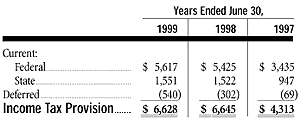 An analysis of the income tax provision is as follows: (in thousands)
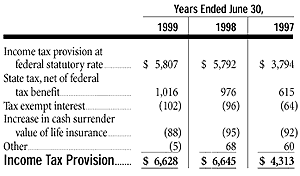 The difference between the financial statement provision and
amounts computed by using the statutory rate of 34% is reconciled
as follows: (in thousands)
The difference between the financial statement provision and
amounts computed by using the statutory rate of 34% is reconciled
as follows: (in thousands)
The Company is allowed to deduct an addition to a reserve for bad
debts in determining taxable income. This addition differs from the
provision for loan losses for financial reporting purposes. No deferred
taxes have been provided on the income tax bad debt reserves prior
to 1988, which total $6 million. This tax reserve for bad debts is
included in taxable income of later years only if the bad debt reserves
are subsequently used for purposes other than to absorb bad debt
losses. Because the Company does not intend to use the reserves
for purposes other than to absorb losses, deferred income taxes of
$2.4 million were not provided at June 30, 1999 and 1998, respectively.
Pursuant to SFAS 109, the Company has recognized the deferred tax
consequences of differences between the financial statement and
income tax treatment of allowances for loan losses arising after
June 30, 1987.
 In August 1996, the "Small Business Job Protection Act of 1996"
was passed into law. One provision of this act repeals the special bad
debt reserve method for thrift institutions provided for in Section
593 of the Internal Revenue Code. The provision requires thrifts to
recapture any reserves accumulated after 1987 but forgives taxes owed
on reserves accumulated prior to 1988. The six year recovery period
for the excess reserves began in taxable year 1999. The adoption of
the act did not have a material adverse effect on the Company's
consolidated financial position or results of operations.
In August 1996, the "Small Business Job Protection Act of 1996"
was passed into law. One provision of this act repeals the special bad
debt reserve method for thrift institutions provided for in Section
593 of the Internal Revenue Code. The provision requires thrifts to
recapture any reserves accumulated after 1987 but forgives taxes owed
on reserves accumulated prior to 1988. The six year recovery period
for the excess reserves began in taxable year 1999. The adoption of
the act did not have a material adverse effect on the Company's
consolidated financial position or results of operations.
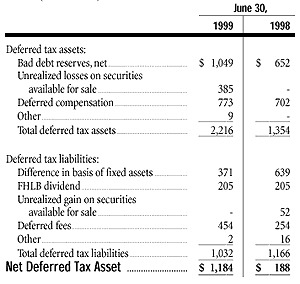
The Company's deferred income tax assets and liabilities are as
follows: (in thousands)
Previous | Return to Table of Contents | Next
|