Notes to Consolidated Financial Statements
for the Three Years in the Period Ended June 30, 1999
12. REGULATORY MATTERS
The Bank is subject to various regulatory capital requirements
administered by the federal banking agencies. Failure to meet
minimum capital requirements can initiate certain mandatory-
and possible additional discretionary-actions by regulators that, if
undertaken, could have a direct material effect on the Bank's financial
statements. Under capital adequacy guidelines and the regulatory
framework for prompt corrective action, the Bank must meet specific
capital guidelines that involve quantitative measures of the Bank's
assets, liabilities and certain off-balance sheet items as calculated
under regulatory accounting practices. The Bank's capital amounts
and classification are also subject to qualitative judgments by the
regulators about components, risk weightings, and other factors.
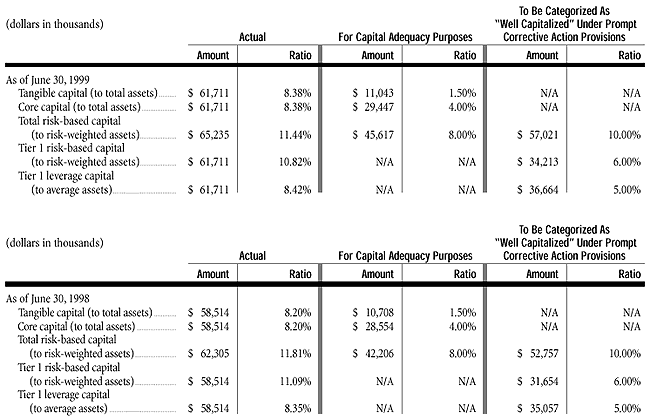
Quantitative measures that have been established by regulation
to ensure capital adequacy require the Bank to maintain minimum
capital amounts and ratios (set forth in the table below). The Bank's
primary regulatory agency, the OTS, requires that the Bank maintain
minimum ratios of tangible capital (as defined in the regulations)
of 1.5%, core capital (as defined) of 4%, and total risk-based capital
(as defined) of 8%. The Bank is also subject to prompt corrective
action capital requirement regulations set forth by the Federal Deposit
Insurance Corporation ("FDIC"). The FDIC requires the Bank to
maintain minimum capital amounts and ratios of total and Tier I
capital (as defined in the regulations) to risk-weighted assets (as
defined), and of Tier I capital (as defined) to average assets (as
defined). As of June 30, 1999, the Bank met all capital adequacy
requirements to which it is subject.
As of June 30, 1999 and 1998, the most recent notifications
from the OTS categorized the Bank as "well capitalized" under the
regulatory framework for prompt corrective action. To be categorized
as "well capitalized" the Bank must maintain minimum total risk-based,
Tier 1 risk-based, and Tier 1 leverage ratios as set forth in the
table. There are no conditions or events since that notification that
management believes have changed the institution's category.
Dividend Restrictions
The principal source of income and funds for the Company are
dividends from the Bank. The Bank is subject to certain restrictions
on the amount of dividends that it may declare without prior
regulatory approval. At June 30, 1999, approximately $13.0 million
of retained earnings were available for dividend declaration without
prior regulatory approval.
Recapitalization of SAIF
On September 30, 1996, the President of the United States signed into
law an omnibus appropriations act for fiscal year 1997 that included,
among other things, the recapitalization of the Savings Association
Insurance Fund (SAIF) in a section entitled "The Deposit Insurance
Funds Act of 1996" ("the Act"). The Act included a provision whereby
all insured depository institutions would be charged a one-time
special assessment on their SAIF assessable deposits as of March 31,
1995. The Company recorded a pre-tax charge of $3,001,000 during
the year ended June 30, 1997, which represented 65.7 basis points of
the March 31, 1995, assessable deposits.
Previous | Return to Table of Contents | Next
|