|
 |
|
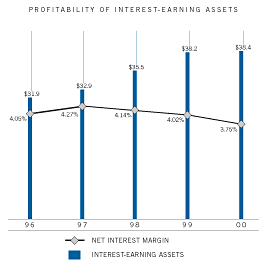
Average investment securities were lower in 2000. The majority of the decrease occurred in the available-for-sale investment category and resulted from the sale of approximately $4.0 billion of investment securities as part of the comprehensive financial restructuring late in the third quarter of 2000. Interest-earning asset growth was further controlled through the use of off-balance sheet loan-funding vehicles during 2000. In an effort to reduce the amount of lower yielding commercial loans maintained on the balance sheet while retaining the customer relationships, AmSouth sells loans to third-party commercial loan conduits. AmSouth also sells residential first mortgages and, beginning in 2000, dealer indirect automobile loans to third-party conduits. Sales to conduits reduce the amount of loans on the balance sheet and accordingly the interest revenue associated with those loans. However, because the loans that are sold to the conduits typically have lower yields, the net interest margin expands and AmSouth retains higher yielding assets on the balance sheet, while expanding funding capacity. In addition, the decision to securitize almost $1 billion of automobile loans at the beginning of the fourth quarter limited reported loan growth in 2000. On a managed loan basis, average loans grew by $2.8 billion versus 1999 managed loans. The increase in average interest-earning assets was funded by a $716 million increase in borrowed funds while average deposits decreased between periods by approximately $395 million. The primary areas of increase in borrowing were long-term Federal Home Loan Bank (FHLB) advances and short-term bank notes.
|
In 1999, NII grew $63.9 million to more than $1.5 billion, an increase of 4.4 percent. The growth was attributable to a higher level of average interest-earning assets, partially offset by a decrease in the net interest margin. Average interest-earning assets were $38.2 billion in 1999 compared to $35.5 billion in 1998, an increase of $2.7 billion. The growth in average interest-earning assets occurred in both loans and investment securities. Net loans grew $1.4 billion in 1999 to $25.5 billion and represented 54.2 percent of the growth in average interest-earning assets. The growth occurred primarily in commercial real estate, home equity and dealer indirect lending. Growth in investment securities accounted for the remainder of the increase in average interest-earning assets for 1999. The increase, primarily in the held-to-maturity category, was the result of a planned expansion during the second half of 1999 in connection with the Merger. The increase in average interest-earning assets was funded by a $567.3 million increase in deposits and a $2.3 billion increase in borrowings. Primary sources for the increase in borrowed funds were short-term federal funds purchased and securities sold under agreements to repurchase, long-term FHLB advances and subordinated debt. The effects of the growth in average interest-earning assets on NII in 1999 were partially offset by a 12-basis-point decline in the NIM from 4.14 percent in 1998 to 4.02 percent. The decline in the NIM was the result of a 33-basis-point decline in the yield on interest-earning assets due, primarily, to the higher level of investment securities and a decline in the yield on loans during the year. The decrease was partially offset by a 29-basis-point decrease in rates paid for interest-bearing liabilities. Growth in NII during 1999 was also reduced by the use of commercial and residential first mortgage conduits discussed earlier. Management anticipates modest expansion in the NIM in 2001 provided the economy experiences modest growth and AmSouth’s balance sheet management strategy is successful. Provision for Loan Losses The provision for loan losses is the charge to earnings necessary to maintain the allowance for loan losses at an adequate level to absorb losses inherent in the loan portfolio. In 2000, AmSouth recorded provision charges for loan losses totaling $227.6 million, compared to $165.6 million recorded in 1999 and $99.1 million in 1998. |
|
|
 |
|