

|
Management
Discussion & Analysis pg 1
2 3
4 5 6
7 8 9
10 11 12
13 14 |
| Net
cash used in investing activities in fiscal 2002 was $965 million,
compared with $1.0 billion and $416 million in fiscal 2001 and
2000, respectively. In fiscal 2002, cash was used for business
acquisitions, construction of new retail locations, information
systems improvements and other additions to property, plant and
equipment, including construction of a new corporate headquarters
and expansion of our distribution facilities. The primary purpose
of the cash investment activity was to support our expansion
plans, improve our operational efficiency and enhance shareholder
value. Strong operating cash flows more than offset cash used to
fund our business expansion plans, construct new stores and fund
strategic initiatives.
In fiscal 2002 and 2001, net cash provided by financing activities was $495 million and $218 million, respectively, while $395 million was used in financing activities in fiscal 2000. We raised $726 million, net of offering expenses, through the issuance of convertible debentures in fiscal 2002. The proceeds of the issuance will be used for general corporate purposes. Favorable market conditions were also a factor in the decision to issue convertible debentures. In addition, we retired $266 million in Senior Subordinated Notes due 2003 and 2008 acquired as part of the Musicland acquisition. Fiscal 2001 included a $200 million investment by Microsoft Corporation in our common stock. For more information regarding the convertible debentures and retirement of debt, refer to note 3 of the Notes to Consolidated Financial Statements. Sources
of Liquidity We have a $200 million unsecured revolving credit facility scheduled to mature in March 2005 and, as a result of the Future Shop acquisition, a $44 million secured revolving credit facility that will expire in fiscal 2003. The $44 million facility increases to $53 million on a seasonal basis. We also have a $200 million inventory financing line. Borrowings under this line are collateralized by a security interest in certain merchandise inventories approximating the outstanding borrowings. We received no advances under the $200 million credit facility or the inventory financing line in fiscal 2002 or 2001. Future Shop had peak borrowings under the $44 million credit facility of $32 million and $39 million in fiscal 2002 and 2001, respectively. Our credit
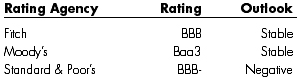
ratings as of March 2, 2002, were as follows: Factors that
can impact our credit rating include changes in the economic
environment, conditions in the retail and consumer electronics
industries, our financial position and changes in our business
strategy. We do not currently foresee any reasonable circumstances
under which our credit rating would be significantly downgraded.
However, if a significant downgrade were to occur, it could
adversely impact, among other things, our future borrowing costs,
access to capital markets, vendor financing terms and future new
store operating lease costs. In addition, the conversion rights of
the holders of our convertible debentures could be accelerated if
our credit rating were to be downgraded. |
 back
to top back
to top |