| |
|
|
|
Borders.com began operations in fiscal 1998. Sales increased 53.1% and 289.1% in 2000 and 1999 respectively. Net loss for 2000 increased primarily as a result of an $11.3 million after-tax asset impairment charge related to the computer hardware and software at Borders.com. The increased loss in 1999 over 1998 was due to a full year of the site’s operating expense versus a partial year in 1998 due to the site’s start up in late 1998. The fluctuations in net loss as a percentage of sales are driven by the same factors. Depreciation expense increased in 2000 and 1999 as a result of the depreciation expense recognized on the capital expenditures required to develop and operate the site and to fulfill customer orders. Interest expense increased in 2000 and 1999 due to higher average borrowing levels necessary to finance the site’s development and operation.
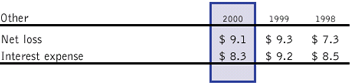
Net loss consists of various corporate governance costs and income. The 2000 net loss remained essentially flat with the prior year due to a $3.5 million after-tax charge related to employee severance and the costs of writing off redundant headquarters buildings and certain equity investments. The change in 1999 was primarily due to a $3.4 million after-tax charge related to the resignation of the Company’s former Chief Executive Officer. Interest expense represents corporate-level interest costs not charged to the Company’s operating segments. Liquidity and Capital Resources The Company’s principal capital requirements are to fund working capital needs, the opening of new stores, the refurbishment and expansion of existing stores, and continued development of web-based commerce technologies. Net cash provided by continuing operations in 2000 was $152.8 million, as compared to $181.3 million in 1999. The current year activity primarily reflects income before non-cash charges for depreciation and amortization offset by cash used for inventories as a result of store expansion at Borders. Inventory net of accounts payable increased primarily due to 49 new Borders stores. Net cash used by discontinued operations represents the cash needed for the operations of All Wound Up in fiscal 2000 and 1999. Net cash used for investing was primarily for capital expenditures for new stores and the refurbishment of existing stores. Capital expenditures in 2000 primarily reflect the opening of 49 new superstores and 11 new Waldenbooks stores. Additional capital spending in 2000 reflected the development and installation of in-store web-based technology and spending on corporate information technology infrastructure. Capital expenditures in 1999 reflect the opening of 50 new superstores and 39 new Waldenbooks stores. Capital expenditures in 1998 reflected the opening of 47 new superstores, 16 new Waldenbooks stores, a new distribution center and expansion of the home office facility. Net cash provided by financing in 2000 was $19.5 million, resulting primarily from net borrowings under the Credit Facility and the issuance of common stock under the Company’s employee benefit plans. Net cash used for financing in 1999 was $15.0 million, resulting primarily from the repurchase of common stock of $25.4 million, partially offset by the issuance of common stock under the Company’s employee benefit plans. The Company expects capital expenditures will decrease to approximately $110.0 to $120.0 million in 2001, resulting primarily from fewer domestic store openings. In addition, capital expenditures will result from international store openings, refurbishment of a number of existing stores, and investment in information systems streamlining. The Company currently plans to open approximately 25 to 30 domestic Borders superstores, five to seven international stores, and ten new Waldenbooks mall stores in 2001. Average cash requirements for the opening of a domestic prototype Borders books and music superstore are $2.3 million, representing capital expenditures of $1.1 million, inventory requirements, net of related accounts payable, of $1.1 million and $0.1 million of pre-opening costs. Average cash requirements to open a new or expanded Waldenbooks store range from $0.4 million to $0.7 million, depending on the size and format of the store. The Company plans to lease new store locations predominantly under operating leases. The Company plans to execute its expansion plans for its Borders superstores and other strategic initiatives principally with funds generated from operations and financing through the Lease and Credit Facilities. The Company believes funds generated from operations, borrowings under the Credit Facility and financing through the Lease Facility will be sufficient to fund its anticipated capital requirements for at least the next two to three years. As discussed below, the Credit and Lease Facilities expire in October 2002, but the Company expects to be able to successfully renew the Facilities. The Company believes that its borrowing costs may increase beginning in November 2002, if financial market conditions are unchanged. The Company currently has a share repurchase program in place with remaining authorization to repurchase approximately $66.8 million. During 2000 and 1999, $9.2 million and $25.4 million of common stock was repurchased, respectively. |
| |
|
|