|
|
Management
Discussion
and Analysis
|
|
t
Overview
Net sales were a record $6.3
billion in 1998, 11 percent higher than in 1997, and 19
percent higher than in 1996. Nelson Industries, Inc.,
acquired in January 1998, and Cummins India Limited, which
was first consolidated in the fourth quarter of 1997, added
sales of $428 million. Without these additional sales, net
sales for 1998 would have been $5.8 billion, an increase of
4 percent over 1997.
As disclosed in Notes 3 and
4 to the Consolidated Financial Statements, the Company
recorded charges in 1998 totaling $217 million, comprised of
$78 million for revised estimates of additional product
coverage liability for both base and extended warranty
programs, $114 million of costs associated with the
Company's plan to restructure, consolidate and exit certain
business activities and $25 million for a civil penalty
resulting from an agreement reached with the U.S.
Environmental Protection Agency and the Department of
Justice regarding diesel engine emissions. Excluding these
charges, earnings before interest and taxes were $282
million in 1998, compared to $312 million in 1997 and $232
million in 1996. Including the charges, the Company's net
loss was $21 million or $(.55) per share in 1998. Net
earnings in 1997 were $212 million or $5.48 per share and
$160 million or $4.01 per share in 1996.
To maintain Cummins'
technological leadership, the Company has been in the
process of upgrading or replacing engines across all product
lines. This new product development program peaked in 1998
with a record six new engine introductions. While this
investment in product development offers competitive
advantages, it resulted in a temporary increase in product
costs and a decrease in profitability in 1998.
Results of
Operations
Net Sales:
In 1998, the Company
achieved its seventh consecutive year of record sales,
totaling $6.3 billion. Revenues from sales of engines were
55 percent of the Company's net sales in 1998, with engine
revenues and unit shipments 8 percent and 9 percent higher,
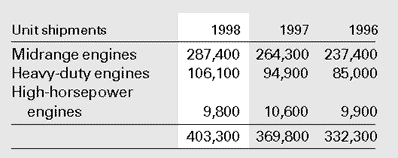
respectively, than in 1997. The Company shipped a record
403,300 engines in 1998, compared to 369,800 in 1997 and
332,300 in 1996 as follows:
Revenues from non-engine
products, which were 45 percent of net sales in 1998, were
16 percent higher than in 1997. The major changes within
non-engine revenues were in filtration, with the sales of
Nelson included from the date of acquisition by Cummins, and
PowerCare (which includes new parts and remanufactured
engines and parts). Sales of the remaining non-engine
products, in the aggregate, were essentially level with
1997.
The Company's sales for each
of its key segments during the last three years
were:
Top
of page
Cummins' engine business is
the Company's largest business segment, producing engines
and parts for sale to customers in both automotive and
industrial markets. Engine business customers are each
serviced through the Company's worldwide distributor
network. The engines are used in trucks of all sizes, buses
and recreational vehicles, as well as a variety of
industrial applications including construction, mining,
agriculture, marine, rail and military. Engine business
revenues were $4.0 billion in 1998, a 9 percent increase
over 1997 and 20 percent over 1996.
Sales of $2.9 billion in
1998 for automotive markets were 12 percent higher than in
1997 and 20 percent higher than in 1996. In 1998, heavy-duty
truck engine revenues were 19 percent higher than in 1997 on
a 20 percent increase in units. Within the North American
heavy-duty truck market, unit shipments were up 20 percent
over 1997, and Cummins continued to be the market leader
with a 32-percent market share. In 1998, the Company began
limited production of the Signature 600, a new electronic
engine designed to capture a larger share of this market.
International unit shipments for the heavy-duty market in
1998 were 20 percent higher than in 1997 due to continued
strong demand in European and Mexican automotive
markets.
Revenues from the sales of
engines for medium-duty trucks in 1998 were 13 percent lower
than in 1997 on a 12-percent decrease in units. In North
America, the Company was affected by Ford's relocation of
its production facilities, partially offset by increased
sales in international markets, primarily Brazil.
For the bus and light
commercial vehicle market, engine revenues in 1998 were 26
percent higher than in 1997, on a 22-percent increase in
unit shipments. In January, Cummins jointly announced with
DaimlerChrysler a new, fully electronic engine &emdash; the
ISB &emdash; for the Dodge Ram pickup. The increase in 1998
was due primarily to record unit shipments to
Daimler-Chrysler for the Dodge Ram pickup, which were 26
percent higher than in 1997 and 37 percent higher than in
1996, and continued strong demand in bus markets.
In
1998, revenues from industrial markets were 1 percent higher
than in 1997. Revenues from sales of engines decreased,
while parts sales increased. Engine revenues in 1998 were
1 percent lower than in 1997
on an 8-percent increase in unit shipments. The variance
between revenues and units resulted from lower heavy-duty
and high-horsepower engine sales and a shift in product mix
of midrange engine sales. The increased level of shipments
was due to continued strong construction volumes in North
America and Europe, partially offset by declines in
worldwide agricultural markets. Sales of engines and parts
into the marine market in 1998 were 6 percent lower than in
1997, due primarily to the economic turmoil in Asia. Sales
into the mining market were 21 percent lower than the prior
year. In 1998, Cummins announced an agreement with Komatsu,
a joint venture partner, to develop a 3.3 liter engine
targeted for the construction market, scheduled for release
in the second half of 1999.
Revenues of $1.2 billion in
1998 for power generation were 2 percent higher than in 1997
and 1 percent higher than in 1996, with sales continuing to
be impacted by the economic conditions in Asia and lower
sales in Europe. Without the consolidation of Cummins India
Limited, power generation sales would have decreased 4
percent from 1997. Sales of the Company's generator sets
continued to reflect growth in North America, which offset
declines in demand for generator sets in Asia. Engine sales
to generator set assemblers were down 12 percent from the
prior year and sales of alternators were down 11 percent,
due primarily to lower demand in Asia and the Company's
change in strategy, emphasizing sales of generator sets.
Sales of small generator sets for recreational vehicles and
other consumer markets remained strong in North America,
increasing 12 percent from 1997.
Sales of $1.1 billion in
1998 for filtration and other were 40 percent higher than in
1997 and 44 percent higher than in 1996, with Nelson,
acquired in January 1998, contributing sales of $311
million. International distributor sales increased 12
percent from 1997 due to the consolidation of Cummins India
Limited in the fourth quarter of 1997.
Net sales by marketing
territory for each of the last three years were:
Top
of page
In
total, international markets accounted for 43 percent of the
Company's revenues in 1998. Europe and the CIS, representing
13 percent of the Company's sales in 1998, were 1 percent
lower than in 1997 and 4 percent higher than in 1996. Sales
to Canada, representing 7 percent of sales in 1998, were 44
percent higher than in 1997 due to the acquisition of Nelson
and the relocation of certain customer production
facilities. Asian and Australian markets, in total,
represented 13 percent of the Company's sales in 1998, as
compared to 16 percent in 1997 and 17 percent in 1996. In
Asia, sales to China were essentially flat compared to 1997,
while revenues in Korea decreased 64 percent, Southeast Asia
declined 47 percent and sales to Japan and India were 19
percent below 1997 levels, excluding the effect of Cummins
India Limited consolidation.
Business in Mexico and Latin
America, representing 8 percent of sales, was 29 percent
higher than in 1997, but began to decline in the latter part
of 1998. Sales to Latin America, including Brazil,
represented 4 percent of the Company's sales in 1998 and
were 28 percent higher than in 1997. Brazil individually
accounted for 2 percent of sales in 1998. The recent
economic events in Brazil have resulted in increased
interest rates and devalued currencies in the region. Many
of the Company's customers are sensitive to interest rates,
which will affect sales demand. The devaluation of local
currencies also could have an impact on operations, as
certain of the Company's transactions are based in Brazilian
currency, and could result in currency gains or losses.
Sales to Mexico, representing approximately 4 percent of the
Company's sales in 1998, could also potentially be affected
by the economic uncertainty in Brazil. These events could
reasonably be expected to have an adverse effect on the
Company's business, however, the extent cannot be estimated
reasonably based upon presently available
information.
Gross
Margin:
As disclosed in Note 3 to
the Consolidated Financial Statements, the Company recorded
special charges in 1998 of $92 million for product coverage
costs and inventory write-downs. The product coverage
special charges of $78 million include $43 million primarily
attributable to base warranty costs and $35 million for
extended warranty programs. These charges relate to a
revised estimate of product coverage liability for engines
manufactured in previous years. The special charges recorded
in 1998 also include $14 million for inventory write-downs
associated with the Company's restructuring and exit
activities. These write-downs reflect amounts of inventory
rendered excess or unusable due to the closing or
consolidation of facilities.
The Company's gross margin
percentage before the product coverage and inventory special
charges was 21.4 percent in 1998, compared to 22.8 percent
in 1997 and 22.5 percent in 1996. The Company's gross margin
percentage declined due to a temporary increase in product
coverage costs from ISB and ISC engines and higher new
product costs attributable to the production ramp-up of the
ISB, ISC and Signature 600 engines. This decrease was
partially offset by the benefit from higher volume and
pricing. The acquisition of Nelson and consolidation of
Cummins India Limited added $124 million. Gross margin
percentage after the special charges was 19.9 percent.
Product coverage costs,
excluding the special charges, were 3.3 percent of net sales
in 1998, compared to 2.6 percent in 1997 and 2.7 percent in
1996.
Top
of page
Operating
Expenses:
Selling and administrative
expenses were 12.5 percent of net sales in 1998, compared to
13.2 percent in 1997 and 13.8 percent in 1996. On the
11-percent sales increase in 1998, these expenses, which
include volume-variable components, were up less than 6
percent in absolute dollars. Net benefits of the Company's
cost reduction and restructuring actions were partially
offset by increases in expenses associated with new product
launches and information systems during 1998.
Research and engineering
expenses were 4.1 percent of net sales in 1998, compared to
4.6 percent in 1997 and 4.8 percent in 1996. This is a
result of a reduction in technical spending and certain
product developments moving to the production
stage.
The Company's losses from
joint ventures and alliances were $30 million in 1998,
compared to income of $10 million in 1997. The difference
was due primarily to the consolidation of Cummins India
Limited and losses at the Company's joint venture with
Wartsila. Cummins Wartsila is being affected by lower sales,
primarily due to decreased demand in Asia, and higher
product coverage expenses.
In
an effort to address the decline in the Company's business
in Asia, to leverage overhead costs for all operations and
to improve joint venture operating performance, the Company
established a restructuring program in 1998. As a result of
this program, the Company recorded a charge of $100 million
for costs to reduce the worldwide workforce by approximately
1,100 people, as well as costs associated with streamlining
certain majority-owned and international joint venture
operations.
The charges for
majority-owned operations included $38 million for severance
and related costs associated with workforce reductions in
the engine and power generation businesses, primarily for
administrative positions. The estimated costs of these
reductions were based on amounts pursuant to benefit
programs and contractual provisions or statutory
requirements at the affected operations. Approximately
one-half of these 1,100 employees left the Company prior to
December 31, 1998. An asset impairment loss of $22 million,
calculated according to the provisions of SFAS No. 121, was
recorded primarily for engine manufacturing equipment to be
disposed of upon the closure or consolidation of facilities
or the outsource of production. The recovery value for the
equipment to be disposed of was based on estimated
liquidation value. The carrying value of assets held for
disposal and the effect on earnings from suspending
depreciation on such assets is immaterial. Facility
consolida-tion and other costs of $17 million included lease
termination and facility exit costs of $10 million, product
support costs of $3 million, and litigation and other costs
of $4 million. As the restructuring consists primarily of
the closing or consolidation of smaller operations, the
Company does not expect these actions to have a material
effect on future revenues.
The charges for
restructuring joint venture operations totaled $23 million,
the majority of which relates to actions being taken at the
Company's joint venture with Wartsila, which is part of the
Company's power generation business. The charges included
$11 million for employee severance and related benefits for
approximately 1,200 people, $7 million for a tax asset
impairment loss and $5 million for other facility and
equipment-related charges.
Approximately $25 million,
primarily related to employee severance, has been charged to
the restructuring liabilities as of December 31, 1998. Of
the total charges associated with restructuring activities,
cash outlays will approximate $60 million. The program is
expected to be essentially complete by the end of 1999 and
yield approximately $50 million in annual savings at
completion.
In 1998, the Company
recorded a charge of $25 million for a civil penalty to be
paid by the Company as a result of an agreement reached with
the U.S. Environmental Protection Agency, the Department of
Justice and the California Air Resources Board regarding
diesel engine emissions. In addition to the civil penalty,
the agreement provides a schedule for diesel engines to meet
certain emission standards and requires manufacturers to
continue to invest in environmental projects to further
reduce oxides of nitrogen (NOx) emissions. The Company has
developed extensive corporate action plans to comply with
all aspects of the agreement. Additionally, three separate
court actions have been filed as a result of allegations of
the diesel emissions matter. The New York Supreme Court
ruled in favor of the Company. This matter is now on appeal.
A California State Court recently ruled in favor of the
Company. A recent action was just filed in the U.S. District
Court, the District of Columbia.
Top
of page
Year 2000:
The Company continues to
address the impact of the Year 2000 issue on its businesses
worldwide. This issue affects computer systems that have
date-sensitive programs that may not properly recognize the
year 2000. With respect to the Company, this issue affects
not only computer systems but also machinery and equipment
used in production that may contain embedded computer
technology.
Following a review and
assessment of information systems and technology used in its
internal business operations and production, the Company
inventoried and identified those systems and products that
the Company believes may be vulnerable to Year 2000 failures
and established a program to address Year 2000 issues. The
Company's Year 2000 efforts are being carried out by the
Company's Year 2000 Team under the leadership of the
Director of Year 2000 Compliance. A Year 2000 program office
has been established at each of the Company's facilities and
is overseen by a Year 2000 coordinator. The Year 2000 Team
maintains a reporting structure to ensure that progress is
made and tracked on Year 2000 issues. In addition to
internal resources, the Company has retained external
resources to assist with the implementation of its Year 2000
program.
The Company's program
consists of the remediation, replacement or retirement of
affected systems. Remediation is the alteration of a
non-compliant application to make it compliant, replacement
is the substitution of a non-compliant application with a
compliant upgrade or product and retirement is the
discarding of non-compliant applications that have been
determined to be dispensable.
The Company completed a
substantial portion of its remediation efforts and testing
in 1998, and expects to complete that process by the end of
the second quarter of 1999.
The Year 2000 Team will
remain in place through January 1, 2000, and beyond as
needed. Their role is to ensure that compliance is
maintained once it is attained. The Company maintains
contact with its key suppliers to obtain information
relating to the status of such suppliers with respect to
Year 2000 issues, placing particular emphasis on determining
the Year 2000 readiness of its critical
suppliers.
The Company expects to incur
total expenditures of approximately $45 million in
connection with its Year 2000 program and remediation
efforts. To date, the Company has incurred approximately $30
million in costs relating to its Year 2000
efforts.
There can be no assurances
that the systems or products of third parties, which the
Company relies upon, will be timely converted or that a
failure by a third party, or a conversion that is
incompatible with the Company's systems, would not have a
material adverse effect on the Company. This is particularly
true because the Company utilizes sole suppliers for certain
products. The high level of skill and expertise required to
develop certain components makes it impossible to change
suppliers quickly. The failure of a sole supplier may lead
to a delay in production.
The Company continues to
develop contingency plans in the event that its operations
are disrupted on January 1, 2000. Such contingency plans
include the stockpiling of certain business critical
inventory, and identifying alternative suppliers where
possible.
The estimated time of
completion of the Company's Year 2000 program and compliance
efforts, and the expenses related to the Company's Year 2000
compliance efforts are based upon management's best
estimates, which were based on assumptions of future events,
including the availability of certain resources, third party
modification plans and other factors. There can be no
assurances that these results and estimates will be
achieved, and the actual results could materially differ
from those anticipated. Specific factors that might cause
such material differences include, but are not limited to,
the availability of personnel trained in this area and the
ability to locate and correct all relevant computer codes.
Top
of page
Other:
Interest expense of $71
million was $45 million higher than in 1997 and $53 million
higher than in 1996 due to the increased level of borrowings
to support working capital on the higher sales level and to
complete the acquisition of Nelson. Other income decreased
$13 million in 1998 as compared to the year-ago period,
primarily due to the Nelson goodwill amortization and lower
royalty income.
Provision for Income
Taxes:
The Company's effective
income tax rate normally is below the 35% U.S. federal
corporate tax rate. The lower tax rate is a result of tax
benefits on export sales and tax credits on research
expenses. These benefits in 1998 were more than offset by
the unfavorable tax effects of nondeductible losses in
foreign joint ventures and nondeductible EPA penalty and
goodwill amortization. The combined effect was a 1998 income
tax provision of $4 million.
Cash Flow and Financial
Condition
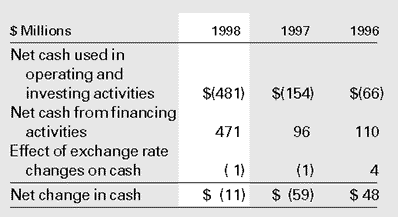
Key elements of
cash flows were:
During 1998, net cash used
for operating and investing activities was $481 million. The
higher level of net cash requirements in 1998 was due
primarily to the acquisition of Nelson, planned capital
expenditures ($271 million in 1998, compared to $405 million
in 1997 and $304 million in 1996) for investments in new
products and for working capital. Net working capital in
1998 was 12.8 percent of sales, compared to 11.6 percent in
1997. Investments in joint ventures and alliances of $22
million reflected the net effect of capital contributions
and cash generated by certain joint ventures.
Net cash provided from
financing activities was $471 million in 1998. As disclosed
in Note 6, the Company issued $765 million face amount of
notes and debentures under a $1 billion registration
statement filed with the Securities and Exchange Commission
in December 1997. Net proceeds were used to finance the
acquisition of Nelson and pay down other indebtedness
outstanding at December 31, 1997. Based on the Company's
projected cash flow from operations and existing credit
facilities, management believes that sufficient liquidity is
available to meet anticipated capital and dividend
requirements in the foreseeable future.
Top
of page
Market
Risk:
The Company is exposed to
financial risk resulting from volatility in foreign exchange
rates, interest rates and commodity prices. This risk is
closely monitored and managed through the use of derivative
contracts. As clearly stated in the Company's policies and
procedures, financial derivatives are used expressly for
hedging purposes, and under no circumstances are they used
for speculating or for trading. Transactions are entered
into only with banking institutions with strong credit
ratings, and thus the credit risk associated with these
contracts is considered immaterial. Hedging program results
and status are reported to senior management on a periodic
basis.
Due to its international
business presence, the Company transacts extensively in
foreign currencies. As a result, corporate earnings
experience some volatility related to movements in exchange
rates. In order to exploit the benefits of global
diversification and naturally offsetting currency positions,
foreign exchange balance sheet exposures are aggregated and
hedged at the corporate level through the use of foreign
exchange forward contracts. The objective of the foreign
exchange hedging program is to reduce earnings volatility
resulting from the translation of net foreign exchange
balance sheet positions. A hypothetical 10% adverse change
in the foreign currency exchange rates would decrease
earnings by approximately $4 million. This calculation does
not reflect the impact of the gains and losses in the
underlying exposures that would be offset, in part, by the
results of the derivative instruments. The sensitivity
analysis also ignores the impact of foreign exchange
movements on Cummins' competitive position as well as the
remoteness of the likelihood that all foreign currencies
will move in tandem against the U.S. dollar.
The Company currently has in
place an interest rate swap that effectively converts
fixed-rate debt into floating-rate debt. The objective of
the swap is to lower the cost of borrowed funds. A
hypothetical 100 basis-point increase in the floating
interest rate from the current level would correspond to a
$2 million increase in interest expense over a one-year
period. This sensitivity analysis does not account for the
change in the Company's competitive environment indirectly
related to change in interest rates and the potential
managerial action taken in response to these
changes.
The Company is exposed to
fluctuation in commodity prices through the purchase of raw
materials as well as contractual agreements with component
suppliers. Given the historically volatile nature of
commodity prices, this exposure can significantly impact
product costs. The Company uses commodity swap agreements to
partially hedge exposures to changes in copper and aluminum
prices. The effect of a hypothetical 10% depreciation of the
underlying commodity price would be a loss of approximately
$5 million. This amount excludes the offsetting impact of
the price changes in commodity costs.
Forward-looking
Statements:
This Management's Discussion
and Analysis of Results of Operations and Financial
Condition and other sections of this Annual Report contain
forward-looking statements that are based on current
expectations, estimates and projections about the industries
in which Cummins operates, management's beliefs and
assumptions made by management. Words, such as "expects,"
"anticipates," "intends," "plans," "believes," "seeks,"
"estimates," variations of such words and similar
expressions are intended to identify such forward-looking
statements. These statements are not guarantees of future
performance and involve certain risks, uncertainties and
assumptions ("Future Factors") which are difficult to
predict. Therefore, actual outcomes and results may differ
materially from what is expressed or forecasted in such
forward-looking statements. Cummins undertakes no obligation
to update publicly any forward-looking statements, whether
as a result of new information, future events or
otherwise.
Future Factors include
increasing price and product competition by foreign and
domestic competitors, including new entrants; rapid
technological developments and changes; the ability to
continue to introduce competitive new products on a timely,
cost-effective basis; the mix of products; the achievement
of lower costs and expenses; domestic and foreign
governmental and public policy changes, including
environmental regulations; protection and validity of patent
and other intellectual property rights; reliance on large
customers; technological, implementation and cost/financial
risks in increasing use of large, multi-year contracts; the
cyclical nature of Cummins' business; the outcome of pending
and future litigation and governmental proceedings; and
continued availability of financing, financial instruments
and financial resources in the amounts, at the times and on
the terms required to support Cummins' future
business.
These are representative of
the Future Factors that could affect the outcome of the
forward-looking statements. In addition, such statements
could be affected by general industry and market conditions
and growth rates, general domestic and international
economic conditions, including interest rate and currency
exchange rate fluctuations, and other Future
Factors.
Top
of page
|