|
|

|
Cummins Engine
Company is the leading worldwide designer and
manufacturer of diesel engines ranging from 60 to
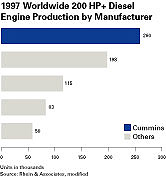
6,000 horsepower and the largest producer of diesel
engines over 200 horsepower. The company's key
markets for these engines are automotive, power
generation and industrial. The company also
provides filtration systems and natural gas engines
as well as engine components and electronic
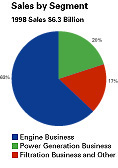
systems. Cummins' 1998 sales were $6.3 billion and
it employed 28,341 people.
|
|
|
Dear Fellow
Shareholders:
The theme of this 1998
report to shareholders is VALUE-the fundamental on which any
endeavor is judged by those involved or affected. For a
business enterprise, this starts with the value brought to
its shareholders.If shareholder value is to be sustained
over any period of time, it must be linked to the value
customers and partners of that enterprise receive from doing
business with it.
Clearly,
companies that deliver superior value to their shareholders
over time are the ones that deliver superior value to their
customers and partners over time.
We at Cummins firmly believe
we can deliver superior value to both shareholders and
customers and partners. In 1998, while our financial results
fell short of our goals, we took important steps towards
delivering superior value to our customers and partners and
towards meeting our financial objectives.
We believe
meeting those objectives will deliver superior value to our
shareholders.
Our financial objectives are
to achieve earnings before interest and taxes (EBIT) of 9
percent in years when a majority of our markets are healthy.
This will equate to a return on average net assets of
approximately 25 percent and a strong free cash
flow.
Our engine-related products
are associated with capital purchases by our customers and
are, therefore, affected significantly by economic
slowdowns. In recession years our earnings target before
interest and taxes is at least 3 percent.
We begin 1999 with continued economic difficulties in Asia
and Latin America and some concern about European markets,
but North American automotive and construction markets
remain generally strong. While forecasting in our business
is difficult, we currently expect relatively level revenues
in the next two-year period. That could change
rapidly.
An economic slowdown that
included Europe and North America would inevitably affect
the timing by which we will hit our targets. Regardless of
economic conditions, however, we anticipate steady progress
over the next two years as we work to meet the needs of
customers in all our markets, to reduce costs and to improve
gross margin and cash flow.
We are
confident that the actions we are taking will put us in a
position to meet our targets consistently in the
future.
Because motivated, capable
people are vital to taking care of the customer in
cost-effective ways, they are central to our achievement of
shareholder value. Sustained profitable growth that meets
the expectations of shareholders will give our people
opportunities for personal growth, bring value to our
suppliers, and provide resources that permit us to
contribute value to the countries and communities in which
we operate.
Top
of page
The Year 1998
We had solid accomplishments
in 1998. Our revenues were a record $6.266 billion, compared
to $5.625 billion in 1997. In North America, automotive,
construction, power generation and filtration markets were
strong, offsetting sales declines in Asia and in our
agricultural and other commodity-based markets around the
world. We completed our acquisition of Nelson Industries and
successfully integrated it into our Filtration Business. We
launched a record six new engines and two new fuel systems.
Our Power Generation Business made significant progress
toward improved profitability.
Excluding special charges,
earnings were $282 million before interest and taxes.
Reported results included special charges for restructuring,
product coverage and our settlement with the U.S.
Environmental Protection Agency (EPA), resulting in a net
loss of $21 million or 55 cents per share. Settling with the
EPA avoided costly litigation and disruption in the
marketplace, even though we believe firmly we were and are
in full compliance with all federal and state
regulations.
Actions we are taking to
improve profitability are described in more detail later in
this letter. They include restructuring and major
initiatives to reduce the costs of the materials and
services we buy.
Overall,
1998 was a year in which we brought more value to customers
in each of our markets and laid the foundation for
improvements in earnings and cash flow to bring more value
to our shareholders.
Value for our
Customers
Customer value derives from
three principal elements.
• Products that provide
our customers with the most cost-effective
performance
• Information that
enables our customers to run their businesses more
efficiently
• Responsive support
for all aspects of customer need
Cummins made
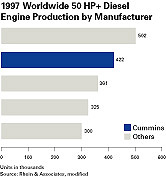
substantial progress in all three areas in 1998.Cummins is
the world leader in diesel engine production over 200
horsepower and is the second largest producer of engines
above 50 horsepower. We have achieved this position by
designing and producing products that meet the needs of our
customers better than our competitors' products.
We emerged from the early
1990s with improving financial performance, but recognized
that electronics and information technology had opened a
whole new horizon for our industry. Also, we knew tougher
emissions standards were likely to emerge after the year
2000. In order to continue as the industry's technical
leader, we needed to respond boldly. And we did. In the
years since 1994, we have been upgrading or replacing
engines across our entire product line - incorporating
advanced electronic controls, combustion and air handling
technology - and adding new engines on both the upper and
lower ends of the horsepower range.
1998 was the year of peak
expense in this program. We introduced a record six new
engines together with two entirely new fuel systems. New
midrange engines were the ISB and ISC, which incorporate
full-authority electronic controls and software. The ISC
uses our new CAPS fuel system. Industrial versions of these
midrange engines are being introduced in 1999.
For our customers in
heavy-duty markets, we introduced the ISM and the
revolutionary Signature 600 engine with our HPI fuel system.
In addition, we introduced two new high-horsepower engines,
the 3200-horsepower CW170, part of our Cummins Wartsila
joint venture, and the 2700-horsepower QSK60.
Both of these
high-horsepower engines are designed to increase our
penetration in the prime power generation market and to
establish leadership in mining equipment markets.
All of the
new engines are meeting marketplace objectives, and
customers report that they are delighted with the engines'
responsiveness, power and fuel economy.
This year, 1999, will see
the release of four more new engines: a version of the
Signature series for automotive fleet customers and
industrial markets; a new 9-litre engine based on advanced
electronic C-series technology; the QSK45 - a lower
horsepower version of the QSK60; and a 3.3 litre engine to
be produced at the Komatsu Cummins Engine Company in Oyama,
Japan.
The acquisition of Nelson
Industries - a major producer of air and liquid filtration
products, and exhaust and emissions control systems -
enables us to bring more product value to our OEMs. Nelson
is the leading producer of exhaust systems for diesel -
powered equipment in North America and ranks second in air
intake systems. Combined with Fleetguard, this acquisition
makes us an integrated first tier supplier of three critical
engine subsystems: air intake, fluids and exhaust. These
subsystems are required for every engine, regardless of
market or application, so we can bring additional business
to Nelson from our other businesses.
Closely
related to the value superior products bring to our
customers is the information we can provide.
Electronics and information
technology are an integral part of the operation of our
engines. We are also using information technology to enable
our customers to manage more efficiently by integrating
vehicles into their business operations and into the supply
chain. We are the principal owners of Innovative Computing
Corporation, which provides fleet management solutions and
Internet-based products, enabling customers to exchange data
throughout the entire supply chain.
Providing support is the
third critical part of creating value for our customers.
This goes beyond technology and information systems to what
we call PowerCare - powerful care for our customers. Our 31
North American - and 110 international distributors are our
partners in delivering superior support to our customers
through programs such as QuickServe, which offers one-hour
diagnosis and completion of most repairs within six hours,
and Support Plus, which guarantees instant parts access with
no service premiums.
We continue to rely on
customer councils as we develop new support programs and new
products for our heavy-duty automotive, construction, mining
and power generation markets.
Top
of page
Cummins Alliance
Our
success in creating value for our customers has made Cummins
a highly desirable alliance partner for many leading
companies around the world.
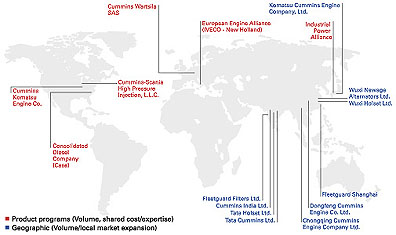
We have pursued two kinds of
partnerships. First, we have alliances with strong technical
partners with whom we can share expertise and the costs of
developing new products.
Our technical alliance
partners include Case, IVECO, Komatsu, New Holland, Scania
and Wartsila, and we are working collaboratively with them
to develop the next generation of products for the 21st
century. The second type of business alliance partnership is
with leading equipment producers in important markets for
future growth like China, India, Turkey and Japan. Our
partners provide invaluable knowledge and contacts in the
local business and political communities, as well as market
leadership.
In October, Cummins and five
other diesel engine manufacturers ended nearly a year of
intense negotiations with the U.S. Environmental Protection
Agency and the Department of Justice by signing consent
decrees. The settlement requires diesel engines to meet some
new emissions standards immediately. Substantially tougher
standards originally set for 2004 must be met 15 months
earlier, in October 2002. The major impact is on our
heavy-duty, line-haul engines.
Because
Cummins has laid a technical foundation unequaled in our
industry, we are confident of our ability to meet the new
standards.
In the markets in which we
participate, the goal of cleaner air coexists with the goal
of durable and cost-effective products. We believe these
goals are not mutually exclusive, and we have the technology
to deliver on both.
We expect to
continue as the industry leader in an environment of more
demanding emission controls.
Top
of page
Value for Our Shareholders
The second area of
accomplishment in 1998 was laying the foundation for future
improvement in earnings and cash flow. Free cash flow
provides the opportunity to reward the shareholder through
share repurchase, dividend increases and/or investment in
future growth.
We have simplified our
financial objectives based on an analysis of the nature of
our business as well as on benchmarking the world's best.
The objectives reflect profitable performance over the
business cycle.
In order to hit our
financial objective of 9 percent EBIT in good years, our
cost structure targets are 25 percent gross margin and 16
percent selling, administrative, research and engineering
(SAR) expense. We believe our goals are realistic and
attainable, and we are pursuing them on three fronts: gross
margin improvement, lower SAR expense and cash flow
improvement.
Gross Margin. In 1994 and
early in 1995, Cummins achieved a gross margin of 25
percent. As the costs of the new product development program
increased, the percentage of gross margin declined to just
above 20 percent in the fourth quarter of 1998. We intend to
return to the 25-percent gross margin level by improving
product coverage costs, lowering start-up costs,
restructuring and achieving lower material cost.
Our gross margin was lower
than planned in 1998 and below our target. A key factor was
higher costs for launching our new engines. Because of
learning curves and inevitable reliability problems
associated with any new product launch, new products cost
more than the ones they replace for some period of time.
Then, as volume builds, initial problems are corrected,
manufacturing becomes more efficient and costs come down.
We are
confident production costs for our new engines will
eventually be lower than for the products
replaced.
While we will be introducing
four new engines in 1999, the risks are considerably lower.
Three are derivatives of engines released in 1998, so the
work to improve their cost and quality is already underway.
The fourth, the 3.3 litre engine, is based upon proven
technology.
Gross margin will also be
improved as a result of the actions announced in the third
quarter when we took a charge of $114 million for
restructuring Cummins operations and those of our joint
ventures around the world. Restructuring is underway and
includes consolidating both office and manufacturing
operations and outsourcing production of non-strategic
components. Cummins staffing levels will fall by over 1,100,
and employment in joint ventures will decline by an
additional 1,200 people. Benefits began modestly in 1998,
will grow in 1999 and are expected to reach more than $50
million annually beginning in 2000, with most of these
savings contributing to gross margin improvement.
Finally, we have embarked on
a program to reduce the costs of materials that go directly
into our products. Those materials represent the largest
single item on our income statement, so the opportunity for
savings is substantial. A parallel program is in place for
goods and services like office supplies, computers, freight,
travel and health care, with some of the savings affecting
gross margin and the balance lowering SAR costs.
Top
of page
|
|
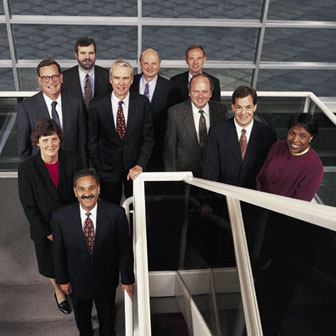
The Cummins Policy
Committee provides leadership and a real commitment
to building our business and value for you.
Members of the
Committee, from left to right:
Kiran Patel,
Jean Blackwell,
Tim Solso,
Joe Loughrey,
Jim Henderson,
Jack Edwards,
Dave Jones,
Roberto Cordaro,
Mark Gerstle and
Pamela Carter.
|
Selling, Administrative and Research (SAR) Costs. A major
success in 1998 has been the steady reduction of selling,
administrative and research costs. In 1994, these costs
totaled 18.5 percent of sales. In the first quarter of 1998
they were just below 18 percent. In the fourth quarter they
were reduced to 16 percent, which is our target. Compared to
the first quarter, fourth-quarter administrative costs were
lower by $9 million, a full point as a percent of sales.
Fourth-quarter research costs were below 4 percent.
We will
pursue opportunities to move below 16 percent in the
future.
Cash Flow. The prospect for
our business to generate increased free cash flow in the
future is excellent, even with relatively level revenues in
the next two years. First, major capital expenditures for
this cycle of new product development are behind us. Second,
improving overall profitability through restructuring and
purchasing and supply management, as we have described
above, will also contribute to cash flow. Finally, we have a
major program to improve our management of working capital -
specifically, inventory and receivables &endash; providing
another opportunity for cash flow improvement.
The cash generated will give
Cummins the flexibility to maintain a prudent capital
structure and provide a return to shareholders through
dividends and buying back Cummins shares. Over the past four
years, share repurchases have resulted in a decrease in
shares outstanding from 41.6 million to 38.4
million.
Business Results. Our Engine
Business, made up of a broad variety of automotive and
industrial markets, is the one in which we have made the
investment in new products. Therefore, its results have been
impacted significantly in the last year.
We expect to
see the improvement we have described above reflected in
returns from these markets in the next two years.
The Power Generation
Business has been making progress towards its financial
objectives primarily through restructuring and cost
reduction to date. Much of the restructuring announced in
the third quarter is directed towards further improving
Power Generation results. A continuing challenge is the
release of the Cummins-Wartsila engines in the face of Asian
market weakness. The engines will, however, permit us to
compete more effectively in the more profitable prime power
market.
Our Filtration Business and
Other includes our filtration companies, Fleetguard and
Nelson, as well as our turbocharger company, Holset, and 14
distributorships owned by Cummins. The acquisition of Nelson
Industries has proven to be very successful, adding
approximately 6 cents per share to corporate results. In
addition, the filtration and exhaust systems business
enables us to benefit from marketplace synergies with
customers of our Engine and Power Generation
businesses.
Top
of page
Corporate Values
At Cummins, our commitment
to providing value for our shareholders and customers goes
hand in hand with our commitment to corporate
responsibility. We believe firmly that acting with honesty
and integrity is sound business - absolutely essential if we
are to attract the very best people, customers, suppliers,
partners and distributors.
We are also
convinced that it is in Cummins' best interest to be
concerned about the communities and the society in which we
do business, because a healthy society provides the best
foundation for business success.
As we work to create value
for our customers and our shareholders, we recognize the
value added by our own people around the world - in our
technical centers, plants, offices and distributorships.
People are the source of innovation in our products, care
for our customers and operational improvements. We depend on
their commitment, their hard work and their ideas.
We thank our
people for helping Cummins meet the challenges of 1998, and
we will continue to rely on them in the years
ahead.
Board Changes. Another
valuable asset for Cummins is its diverse Board of
Directors. We have had two changes to the Board since our
last Annual Report. First, Don Perkins, former Chairman of
the Jewel Companies and a member of Cummins' Board of
Directors for 25 years, reaches the mandatory retirement age
for Board members in 1999 and is not, therefore, being
nominated for re-election to the Board. Over his years with
us, Don has served the Board in many roles, most recently as
Chair of the Audit Committee. Don's experience, his
understanding of worldwide business, and his leadership in
improving corporate governance are unmatched, and we have
benefited greatly from his perspective and insight.
Don has been steadfast in
his commitment to the interests of our shareholders, and all
of us have learned immeasurably from him. We will miss
him.
Second, we are pleased to
welcome a new Board member, Jim Johnson, Chairman of the
Executive Committee of the Board of Directors of the Federal
National Mortgage Association (FNMA or "Fannie Mae"), the
largest non-bank financial services company in the world.
Jim has an outstanding record of effectiveness in creating
shareholder value while chairman and chief executive officer
of Fannie Mae from 1991 through 1998 as well as a thorough
understanding of public policy issues.
Top
of page
Outlook
The future for Cummins and
its shareholders is bright. Our people are focused on
delivering superior value to shareholders by delivering
superior value to our customers and partners.
Our
investment in innovation offers our customers advanced
technology and puts Cummins in a better position than anyone
else in the industry to meet tough new emissions standards,
increase market share around the world and grow profitably.
We have clear targets for
financial return. We are confident that we will make
significant progress toward these targets in the next few
years despite a continued unsettled world economic
situation. While we are not anticipating substantial growth
in our markets for 1999, we expect to gain market share as
our new products make their mark and as growth synergies
resulting from our Nelson acquisition are
realized.
We thank you, the owners of
Cummins, for your continued support. We remain dedicated to
increasing the value of your investment and look forward to
sharing our progress and prospects with you at our Annual
Shareholders' Meeting on Tuesday, April 6, in Columbus
Indiana.
James A.
Henderson
Chairman and Chief Executive
Officer
Theodore M. Solso
President and Chief
Operating Officer
Cummins Engine Company,
Inc.
March 3, 1999
Top
of page
|