

 |
||||||
 |
||||||
 |
||||||
 |
||||||
 |
||||||
 |
||||||
 |
||||||
 |
||||||
|
 |
|
The year 1998 was another good year for CMS Energy. While earnings increased significantly over 1997,
they did not meet our expectations, due largely to warm winter weather and low oil prices.
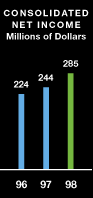
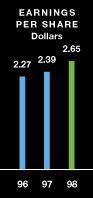
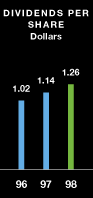
However, 1998 was an exceptional year of development for the future as $6 billion of acquisitions and new "greenfield" projects were successfully secured. These projects involve more than $3.5 billion of CMS Energy investment that will contribute greatly to our earnings growth over the next five years. Net income in 1998 increased 17 percent to $285 million, and earnings per share grew 11 percent to $2.65. The common dividend was increased 10 percent to $1.32 annually--the sixth straight year of double-digit increases. This financial growth reflects strong performances by our utility and diversified energy businesses. Pretax operating income from diversified energy operations increased 33 percent, even though our exploration and production business suffered from the lowest oil prices in 13 years. In Michigan, where our Consumers Energy utility operates, weather in 1998 was the warmest in more than 75 years. This dramatically reduced home heating sales and caused a 14 percent drop in total natural gas deliveries. However, electricity sales were strong, with deliveries increasing nearly 6 percent and operating earnings up 10 percent. That, and operational improvements in both the gas and electric businesses, helped the utility increase pretax operating income nearly 3 percent.
Acquisition Positions CMS Atop Midwest Market This purchase establishes CMS Energy as the premier energy company serving the Midwest. The 10,400 miles of gas pipeline connect CMS production, gathering and processing facilities in the Texas and Oklahoma Panhandle with our Michigan gas distribution and storage operations. The result is a seamless energy network that covers the entire energy spectrum, from the wellhead to the customer, from the Mid-Continent and South all the way to the Midwest. This diversity will give CMS Energy important advantages as the country's utility industry is deregulated. That effort is already underway in Michigan, where Consumers Energy is midway through a three-year natural gas pilot program to test customer reaction.
Electric deregulation is also progressing in Michigan. In March of this year, the Michigan Public Service
Commission issued a final order that phases in competition beginning this fall, while providing Consumers
Energy with full recovery of its stranded costs. The transition culminates in 2002, when all customers will
have the opportunity to shop among competing electricity providers.
Record Growth for Diversified Energy
A $1.6 billion, 1,886 megawatt natural gas-fueled power plant and
liquefied natural gas facility to be built in Tamil Nadu, India.
A $700 million, 710 megawatt natural gas-fueled power plant and
50 million gallons/day desalination project to be built in Abu Dhabi, United Arab Emirates.
A $300 million, 710 megawatt natural gas-fueled cogeneration plant that will serve all the electric and
steam needs of Ford Motor Company and Rouge Steel Company at the Rouge complex in Dearborn, Michigan.
Excess electricity will be sold in the Midwest market.
The $60 million acquisition of a 50 percent ownership in a 300 megawatt coal-fueled cogeneration plant
nearing completion in Thailand. CMS Energy's success and growth have been widely recognized in the energy
industry. The Edison Electric Institute honored CMS Energy last year as the single best performer in terms
of total return to shareholders over the past five years, presenting its 1998 EEI 100 Index of
Investor-Owned Utilities Award. And Independent Energy magazine honored CMS Energy as one of the Top
Ten Developers of 1998.
Outlook
In addition, the GasAtacama pipeline and power project--one of the largest energy projects in the world
during the last several years--has just been completed. The pipeline transports natural gas from Argentina
across the Andes Mountains to Chile's copper mining region. There, it fuels a generating plant that has a
crucial price advantage in the energy-intensive copper industry.
As a result of all of these activities, we expect 1999 to be another year of strong growth for CMS Energy.
None of the successes I have discussed here would be possible without the hard work of many talented and
dedicated employees. We are proud of our 10,000 CMS people and the additional 2,500 partnership
employees, and thank them for their contributions.
Finally, we thank our Board of Directors for their wise counsel and continuing strong support.
|

Request Printed Annual Report | Download PDF Annual Report | Contact CMS Energy