

 |
||||||
 |
||||||
 |
||||||
 |
||||||
 |
||||||
 |
||||||
 |
||||||
 |
||||||
|





 |
|
North America
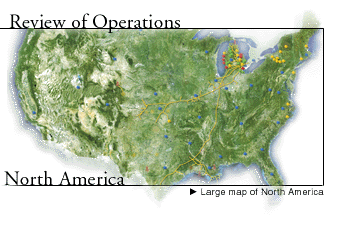
CMS Energy provides a breadth of electricity and gas capabilities matched by few others in the United States. The energy chain starts with CMS Energy's exploration and production business, CMS Oil and Gas. Already active in the U.S. Gulf Coast, the company has expanded its drilling focus into the Mid-Continent and the Rocky Mountain regions, which will provide new gas supplies for the Panhandle and Trunkline pipelines. CMS Oil and Gas is already the largest natural gas producer in northern Michigan's Antrim shale fields. The company has developed special production techniques to tap this unconventional gas source. The gas is processed at CMS-operated facilities that also serve other producers. The plants exceeded design capacity in 1998, peaking at 357 million cubic feet per day. The company is using its Antrim expertise with unconventional gas supplies to develop 500,000 acres in the Powder River Basin in Montana and Wyoming. Natural gas will be produced from fractured coal seams and then will be directed into a new gathering system to be built and owned by CMS Energy.
Strong Transportation Link to Markets Acquisition of the Panhandle Companies is an important addition. Built in part to serve Consumers Energy, its pipeline system is already connected to the utility's gas distribution and storage system in Michigan. Its operations complement CMS Energy's purchase of Continental Natural Gas and Heritage Gas Services earlier in 1998. These companies purchase, gather, process and market natural gas and natural gas liquids produced in Texas and Oklahoma. The proposed TriState pipeline progressed in 1998, signing long-term transportation agreements for about two-thirds of its projected capacity. TriState will connect the Chicago area with Michigan and pipelines moving natural gas to eastern U.S. markets.
Utility Operations Consumers Energy improved its operating performance again in 1998. Operating and maintenance expenses ranked among the lowest of the nation's large utilities. Gas leak response time--already an industry benchmark--improved to an average of 27 minutes. Driven by a strong Michigan economy, electric deliveries rose 6 percent to 40 billion kilowatt-hours. The warmest winter weather since 1921 depressed the heating market and gas sales. Gas deliveries declined 14 percent to 360 billion cubic feet. Consumers Energy successfully completed the first year of a pilot program that tests natural gas deregulation. The experiment lets a limited number of customers shop elsewhere for their gas supply. Approximately 100,000 customers participated during 1998, the full amount allowed for the year. In March 1999, the Michigan Public Service Commission issued a final order that phases in electric deregulation. Beginning this fall, a limited number of customers will be able to buy electricity from alternate suppliers. By 2002, all customers will be able to participate.
Energy Production A partnership led by CMS Energy's independent power generation business has started building the first large-scale power plant to be located in Michigan since 1990. This 710 megawatt plant will be located in Dearborn, at an automotive and steel manufacturing complex operated by Ford Motor and Rouge Steel. Excess electricity will be sold to industrial customers or utilities. The project includes a peaking turbine, scheduled to begin operating this summer. Elsewhere in the state, CMS Energy plans to add about 250 mega-watts of gas-fired peaking plants, for use primarily in summer months. CMS Energy's existing independent power plants performed well last year. Its U.S. facilities total about 2,200 megawatts, with the majority of them located in the northeastern part of the country. Four of the plants set lifetime records for earnings and three set records for availability or capacity. The 1,370 megawatt Midland Cogeneration Venture also marked a record year, setting a lifetime record for earnings and averaging 99 percent availability on its 1,240 megawatt contract to Consumers Energy.
Energy Marketing and Services The energy services business grew substantially, with 560 energy services assignments performed. The company also made inroads into new markets in Canada, Pennsylvania and the southeastern U.S. CMS MST has been active in Pennsylvania's deregulated electricity market, and in 1998 acquired the assets of an energy marketing firm that has more than 300 commercial and industrial customers in the western part of the state. |




Request Printed Annual Report | Download PDF Annual Report | Contact CMS Energy