


 |
 |
|
2002 was an exceptionally challenging year. The U.S. economy remained mired in weakness, resulting in softer conditions in the country’s office markets. Job growth remained negative, vacancies were high, leasing activity was lackluster and rents fell. As managers, we were confronted with myriad challenges. While the results were disappointing relative to our own expectations entering 2002, we continued to achieve earnings growth for our shareholders, outperformed our competitors in maintaining occupancy in our portfolio and expanded our important services business, among many accomplishments.
This is not the first time we have faced a challenging environment. We are celebrating our 40th year as a company and our 10th year on the New York Stock Exchange. We‘ve seen a lot of changing conditions. One of our strengths has been our success at managing these changes and rising to these challenges. Throughout our history, the company has grown and prospered, holding to our core values in a variety of economic cycles and environments across a number of different markets.
 |
|
 |
In this letter, we will review some of the key challenges of 2002 and the ways in which our team at CarrAmerica has addressed them. In addition, throughout this annual report, we’ll describe some of the wonderful accomplishments of individuals in the company during the year. While it’s difficult to look back on the year 2002 with genuine fondness, we have much to celebrate.
Financial Performance
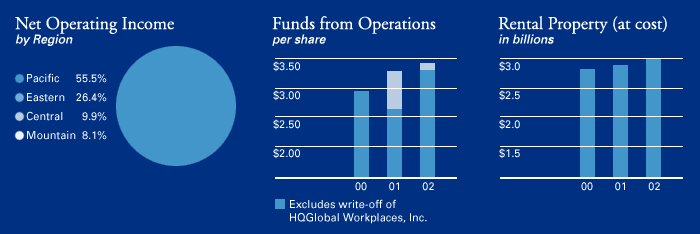
Funds from Operations (FFO) for 2002, including an $8.7 million charge related to HQ Global lease guarantees, were $196.9 million or $3.31 per adjusted share. That compares to $182.5 million or $2.64 per adjusted share for 2001, which included an impairment loss of $42.2 million on our investment in HQ Global. FFO for 2002, excluding the $8.7 million HQ Global lease guarantee charge, would have been $205.6 million or $3.45 per adjusted share, compared to FFO for 2001 which, excluding the $42.2 million HQ Global investment impairment loss, would have been $224.7 million or $3.27 per adjusted share, an increase of 5.5% per adjusted share.
Diluted earnings per share for 2002, including the $8.7 million HQ Global lease guarantee charge, were $1.47 on net income of $109.3 million, compared to diluted earnings per share of $0.71 on net income of $79.1 million for 2001, including the $42.2 million HQ Global investment impairment loss. Diluted earnings per share for 2002, excluding the $8.7 million HQ Global lease guarantee charge, would have been $1.64 on net income of $118.0 million, compared to diluted earnings per share for 2001 which, excluding the $42.2 million HQ Global investment impairment loss, would have been $1.39 on net income of $121.3 million.
We exited the year with a strong balance sheet, and as we look ahead to 2003, one of our primary goals will be to maintain that sound position. Our financial strategy, particularly in this economic environment, is to keep our debt level relatively flat as a percentage of total market capitalization.
We manage our balance sheet conservatively with an emphasis on financial flexibility. Similar to most of our peers, we maintain 20% to 25% variable rate debt relative to all of our borrowings to properly balance our exposure to interest rates. This provided a meaningful amount of interest savings over the course of the year. We maintain a $500 million line of credit and keep substantial funds available in that vehicle to maintain strong liquidity.
Although 2002 was a challenging year, we maintained strong dividend coverage and a low dividend payout ratio. While we increased our dividend by 8.1% in 2002, the percentage of FFO that we paid as dividends was 60%, which is conservative compared to that of other REITs.
The Office Market
The operating environment in 2002 was an extremely difficult one. To make matters worse, it came on the heels of 2001—a year when the industry experienced the largest decline in occupancies across all markets in recent history. As the economy continued to soften in 2002, we experienced an environment characterized by high vacancies and low tenant demand for the second consecutive year.
Companies reacted to the softness and uncertainty in their own businesses by lowering their square footage requirements or delaying decisions to lease office space for as long as possible. At year-end, market vacancies were running in the 12% to 25% range across our 12 national markets, except in a few key submarkets such as downtown Washington, D.C.
These soft market conditions lasted longer than we had anticipated. At the beginning of 2002, we had expected vacancies to peak mid-year; however, leasing activity during the second half of the year was lower than anticipated. As rents continued to drop and demand remained low in most markets, the leasing environment remained highly competitive.
Our people reacted to these conditions extremely well, due in large measure to their experience and dedication, the quality of our portfolio and our ability to respond aggressively to economic conditions. To minimize the impact on occupancies, we took a realistic view of lease economics, emphasizing occupancy above rental rates. To minimize the impact of potential credit losses, we focused aggressively on getting ahead of credit issues, actively managing and monitoring our receivables and the financial condition of our tenants. Focusing on lease renewals well ahead of their scheduled lease expirations and maintaining our strong local broker relationships were fundamental to our aggressive pursuit of tenants. Never forgetting the importance of work environments to our customers, we maintained our exacting standards for the appearance of our properties and continued to improve our responsiveness to customer needs through the use of our web-based InfoCentre resource.
We are pleased with our performance given the difficult economic environment. For the year, our average vacancy for the portfolio was 8%, compared to 17% for the industry as a whole. In an environment where there was little leasing velocity, we leased more than 2.1 million square feet of space, consistent with our average volume over the last three years of 2.4 million square feet.
This year, our performance is unquestionably due to the sheer will, experience and skills of CarrAmerica’s people. Our 780 employees were able to call on their local knowledge and outstanding customer relationships to outperform in our markets, find new growth opportunities in our services businesses and continue to build shareholder value.
Investment and Development
With the poor performance of the broader equity markets along with low interest rates, 2002 proved to be a competitive environment for real estate investment. In fact, we were surprised by the strength of the investment markets. With rents continuing to fall in many markets, we would have expected a drop in office building values. On the contrary, in Washington, D.C. and Southern California the price of office buildings went up by as much as 20%.
 |
|
|
In Washington, D.C., which remains the strongest commercial market in the country, we sold a building in which CarrAmerica had invested $3 million as a joint venture partner and achieved a gain of $5 million.
Combined, these sales resulted in net proceeds to CarrAmerica of $176.1 million and total gains of $34.7 million, which are not included in FFO. The proceeds were used to invest in high-quality properties with the potential for building value and generating strong returns. The largest of these acquisitions was Canal Center in Alexandria, Virginia, a Class A multi-tenant project consisting of five adjacent buildings totaling approximately 589,000 square feet, acquired at a price of $141.5 million. We also acquired three properties in key West Coast markets. They include 3075 Hansen Way, a two-building property in Stanford Research Park in Palo Alto for $31 million, and two San Diego properties—Carroll Vista Center, an approximately 108,000-square-foot property consisting of one biotech building and two office buildings for $25 million and, for $19 million, 11119 North Torrey Pines Road, a 77,000-square-foot building. All three properties are 100% occupied and situated in markets with strong, long-term growth potential.
On the development side, construction on Terrell Place, a 534,000-square-foot office, retail and residential project in downtown Washington, D.C., owned in a joint venture with JPMorgan Fleming Asset Management, continued and construction on several other projects was completed. We have continued to focus on development management projects for customers, utilizing the strength of our development team for the benefit of our customers. We have a number of major projects underway including the Freedom Forum/Newseum building on Pennsylvania Avenue; a building for the International Monetary Fund (IMF) at 1900 Pennsylvania Avenue adjacent to its existing headquarters at 700 19th Street in Washington, D.C.; an office building for Network Associates in Plano, Texas; and the Sidney Kimmel Cancer Center in the dynamic biotech community of La Jolla, California. Through such projects, we’re able to provide challenges for our talented development professionals during down times, build relationships with important clients, generate revenues and continue to build our reputation in key markets.
The Organization and Corporate Governance
We made several senior management appointments in 2002—appointments that spotlight the talent we have within the company. As you can see by the joint signature on this letter, Philip L. Hawkins was promoted to the position of President and Chief Operating Officer and appointed to the company’s Board of Directors in March 2002. With this appointment, we recognized the exceptional leadership role Phil has played since 1998 as Chief Operating Officer of CarrAmerica. This is also an important milestone in that it is the first time in our history that the company’s president has not been a member of the Carr family.
Stephen E. Riffee was named Chief Financial Officer in March 2002, overseeing all financial and capital operations. Steve has been with CarrAmerica since 1999, serving as Senior Vice President, Controller and Treasurer. Steve’s extensive experience and leadership provide a significant contribution to CarrAmerica. Over the past two years, he has been instrumental in strengthening the company’s infrastructure, a process that included the establishment of a Shared Service Center in 2001, which services all of our customers and properties, facilitating the flow of information and accounting processes. Our investments in infrastructure and technology are paying off in smoother internal operations and operating efficiencies. The Shared Service Center alone has saved us almost $3 million over the past year. These infrastructure investments also improve our ability to serve a wide range of customers and build third-party business. That business is particularly valuable in this economic environment.
In addition, those infrastructure and technology improvements made it far easier for us to manage the administrative and accounting changes brought on by the new Securities and Exchange Commission regulations and new listing standards proposed by the New York Stock Exchange.
These changes, of course, sprang from the call for corporate reforms that surfaced in 2002 in the wake of highly publicized unethical conduct among several high-profile executives and companies. We welcome the scrutiny brought on by these events. We have always set high standards for our company and our employees, and our commitment to ethical behavior extends beyond regulatory compliance. Since our beginnings, doing the right thing on behalf of our shareholders, employees and customers has been very much a part of our culture as an organization. We feel strongly that promoting integrity depends on creating such an environment, and we are committed to continuing to do so.
To further our commitment to maintaining an environment where integrity and ethics are woven into the fabric of our corporate culture, we implemented several important corporate governance initiatives during 2002. Under the leadership of our Board of Directors, we conducted an extensive review of all of our corporate governance policies and processes. Following this review, we took a number of steps, starting with expanding the mandate of the Board’s Nominating Committee to include overseeing corporate governance issues. Shortly thereafter, we approved Corporate Governance Guidelines for the Board of Directors that covered a wide range of issues. In addition, we reconstituted our Board committees to ensure that only independent directors serve on the Audit, Executive Compensation, and Nominating and Corporate Governance committees. Additionally, each of these committees now has a charter that clearly defines its responsibilities. We also revised our existing Code of Business Conduct and Ethics, extending it to the members of the Board of Directors. Early in 2003, we developed and approved a Code of Ethics for the CEO and senior financial officers. We believe that these changes will have a positive and lasting impact on our corporate environment.
Looking Ahead to 2003
It is always difficult to predict the future, but particularly so in the current environment. As we enter the new year, vacancies appear to have peaked and we are seeing positive indicators in some of our markets. However, the real estate industry tends to lag the overall economy, and we do not expect a turnaround to have a significant positive impact on our industry in 2003. Given that, in the year ahead, we will continue to manage our balance sheet conservatively and continue to put a real emphasis on financial flexibility and dividend coverage. We will continue to focus on our overriding goal: to build long-term value for our shareholders.
We remain confident that we can continue to successfully compete and find opportunity in our markets with the support of the most experienced and knowledgeable employees in the business.
 Thomas A. Carr Chairman of the Board |
 Philip L. Hawkins President and Chief Operating Officer |

|
(In thousands) | 2000 | 2001 | 2002 | |||
|
|
||||||
| Revenue: | |||||||
| Real Estate Property Operations | $ | 523,601 | $ | 494,749 | $ | 503,191 | |
| Real Estate Services | $ | 26,172 | $ | 31,037 | $ | 24,538 | |
| Net Income | $ | 179,467 | $ | 79,061 | $ | 109,305 | |
| Funds from Operations: | |||||||
| Including HQ Global Charges | $ | 220,430 | $ | 182,492 | $ | 196,896 | |
| Excluding HQ Global Charges | N/A | $ | 224,741 | $ | 205,589 | ||
| Rental Property (at cost) | $ | 2,813,320 | $ | 2,872,047 | $ | 3,007,882 | |
| Portfolio (consolidated square feet) | 20,439 | 20,293 | 20,303 | ||||
| Total Market Capitalization(1) | $ | 3,852,695 | $ | 3,551,724 | $ | 3,300,120 | |
| Debt/Total Market Capitalization | 31.4% | 39.6% | 48.7% | ||||
(1) Based on closing price of common stock on the last trading day of the year. |
|||||||