





TO OUR SHAREHOLDERS:
We live in remarkable times. And for Duke Energy, 2001 was a year of remarkable change, challenge – and results. On the preceding pages, you saw impressive numbers, delivered by an outstanding team. You’ll recognize achievement and value growth in the numbers and charts – and focus, integrity and intellect in the people behind them.
In a year that sometimes seemed “out of focus,” Duke Energy posted its strongest-ever earnings. In the midst of economic downturn, an industry in transition and the cycles of an erratic market, we delivered on our promises to investors and customers. The power of focus helped us hold our ground in 2001 – and realize new gains as well.
As I write this letter in late February, investors in the U.S. and around the world are trying to make sense of things. Following fast on the heels of the dot.com demise of 2000, the bankruptcies of two major energy companies created new shockwaves from Wall Street to Main Street. Many investors I talk with feel stung by these experiences. Some are reluctant and confused. All are skeptical.
This more sober investor outlook is a positive development. As a manic market of inflated highs and tailspin lows is replaced by more measured expectations and clear-headedness, we return to basics. Basics in business strategy and direction. In performance measures and valuations. In customer service and corporate values. And in clear, straightforward communications.
We applaud this shift back to basics. The investing public deserves – and should demand – reliable information, candor and accountability. It is time for realism, rationality and forthright reporting. It is time for straight talk.
In that spirit, here are six questions I would ask when investing in any company:
[1] What business is the company in?
Sounds simple, doesn’t it? But as companies have diversified, merged and morphed, the lines aren’t as clear as they once were.
Not all companies with energy in their names are equally invested in energy. Many have diversified broadly into non-energy ventures. Duke Energy is an energy company. We have been for nearly a century, and our future success will play out in the vital, growing marketplace of world energy.
In North America and key regions around the world, our strategy is the same. We gather, process, transport, store and market natural gas. We design, build, own and operate electric generating facilities. We manage and trade energy. We provide millions of customers with reliable energy.
This integrated approach gives us the ability to avoid the market vulnerabilities of “pure plays” in our industry – the pure merchant generators or the pure traders. We pursue related lines of business, but always with a measured, disciplined approach. And as we have broadened our horizons, we have stuck close to our roots of energy expertise and experience.
We build our business on more than power plants and pipelines. We also build our business on relationships. We take a partnering approach with our customers, and focus on delivering solutions, solving problems and making a positive difference in their businesses. For example, to help our customers navigate the complexities of energy supply and demand for both natural gas and power, we have developed e-systems through which they can access energy information and complete transactions in real time.
Large or small, retail or wholesale, our customers have vastly different needs. But they all expect two things – reliable service and reasonable prices. We put all of our resources to work to make sure our customers get both.
[2] How does the company make money?
Our integrated business model – combining natural gas and power assets with trading and marketing – is what differentiates Duke Energy. Our generating facilities, gas processing plants, pipelines and wires are more than just steel, concrete and machinery – they are the building blocks of value and growth. Our trading and marketing skills help us mitigate risk, navigate changing commodity cycles and economic conditions, and protect and enhance the value of our assets. By linking hard assets with trading and marketing capabilities, we increase – manyfold – our ability to deliver strong and consistent shareholder value.
Our portfolio of assets is fluid and flexible. We buy, build, manage and sell energy assets and products in much the same way investors manage their investment portfolios: We strive to buy low and sell high! Our practice of acquiring and selling positions is critical to capturing value and aligning our business with market realities, so you’ll continue to see movement within the Duke Energy portfolio.
We build our businesses, plants and pipelines in the pathways of growth, developing the systems and facilities to efficiently connect supply and demand. It’s like the secret of ice hockey great Wayne Gretsky’s success – “skating where the puck is going to be.” We build for tomorrow’s growth.
The $8 billion acquisition of Westcoast Energy is the latest milestone in that grow-forward strategy. Westcoast is a natural gas pipeline, storage and distribution company based in Vancouver, British Columbia. It’s the perfect fit for Duke Energy – ideally positioned, linking complementary assets, and advancing our long-term earnings potential.
With the addition of Westcoast’s network, Duke Energy will have unparalleled access to North America’s major natural gas supply basins and markets. Westcoast also brings an impressive network of gas gathering and processing services and gas storage capacity, as well as a talented team that will complement our own.
In financial terms, the Westcoast acquisition will be immediately accretive to earnings upon closing, and will spur future growth in our gas transmission and other businesses. We retain our strong balance sheet and financial flexibility with the acquisition, consistent with our commitment to maintain solid creditworthiness.
Operational excellence. Portfolio diversity. The overlay of energy trading and origination. Strategic acquisitions and divestitures. Financial strength. Those are our business model basics. When you put them together, you get sustainable growth and shareholder value.
[3] How has the company performed?
Today’s investors seek real, reliable financial performance. Not platitudes. Not lofty talk of potential earnings and growth. Financial performance is the most basic of the basics, and we haven’t lost sight of that fundamental at Duke Energy.
You’ll see many impressive numbers in this report. Here are a few that matter the most in our business: A sound, sustainable earnings stream. The ability to deliver superior returns on capital. A debt level that gives us ready and secure access to that capital. And the ability to effectively manage risk exposure.
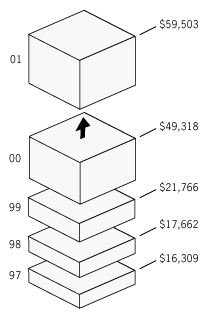
In 2001, revenues grew by 21 percent to nearly $60 billion, and earnings per share from our ongoing operations increased a record 26 percent. Reported earnings per share have seen a compound annual growth rate of 13 percent per year since 1998.
Our “A” Standard & Poor’s credit rating – the strongest in our industry – allows us to initiate projects and see them through. We’ve worked hard to protect and strengthen our credit standing. In 2001, those efforts paid off when we completed the largest-ever combined equity and equity-linked transaction in the industry. We expect to see attractive acquisition opportunities in 2002 and beyond, and our credit muscle lets us move quickly on new growth opportunities.
We have access to capital – and we earn superior returns on that capital. Since 1998, Duke Energy has ranked in the top five of a 20-company peer group in return on capital employed. Our debt-to-capital ratio is a solid 46 percent, and we lead the industry with 17 percent return on equity.
 |
|||
|
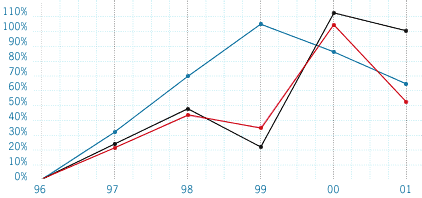
COMPARATIVE RETURNS |
|
|
|
 Duke Energy
 S&P 500
 Dow Jones Utilities
Like you, we’re less than satisfied with Duke Energy’s stock performance for the year, down 8 percent at year end. In context, we held our own, outperforming the S&P 500 and most of our energy peers. We exceeded our earnings estimates for 2001 and overcame the negative impacts of general economic uncertainty and energy sector weakness.
 |
|
 |
|
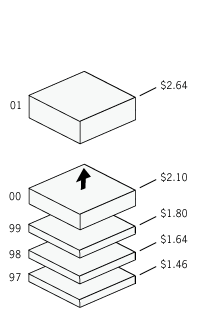
Ongoing Earnings per Share |
Revenues (in millions) |
Financial performance is important. So is financial transparency. Investors need access to information so they can make informed decisions. And they need to know that their company has a clear picture of its risks and exposures at any given moment in time.
[4] How does the company manage its risk?
Duke Energy has one of the most comprehensive risk control structures in the energy industry. Led by our chief risk officer, systems and personnel throughout the organization ensure compliance with both internal controls and external regulatory procedures.
We monitor “daily earnings at risk” due to energy price fluctuations. By analyzing historic commodity prices, we can estimate the impact of future price movements on our portfolio. By design, the level of our daily earnings at risk is moderate, and it is constantly measured and monitored.
Effective risk management is embedded in our trading operations as well. We apply rigorous hedging discipline to all of our merchant generation and gas processing capacity, often selling future production through long-term contracts to lock in the spreads (the difference between the cost of production and the market price). That discipline protects us from dramatic swings in commodity prices. In the current market, we have hedged 91 percent of our merchant generation output for 2002, and 62 percent for 2003 and 2004.
You’ll find detailed explanations of our risk management and accounting practices in the Management’s Discussion and Analysis section of this report.
|
|
|||||||||
|
|
|
|
|||||||
|
* 2001 RECOGNITION |
|
Energy Company of the Year |
||||||||
|
|
|||||||||
|
|
|||||||||
|
|
|
|
|||||||
|
Best Company in North America |
|
Safety Achievement Award |
||||||||
|
|
|||||||||
|
|
|||||||||
|
|
|
|
|||||||
|
Top 100 E-Businesses |
|
Most Admired |
||||||||
|
|
|||||||||
|
|
|||||||||
|
|
|
|
|||||||
|
Dow Jones |
|
Conservation Achievement Award |
||||||||
|
|
|||||||||
[5] What is the company’s future outlook?
Not even a crystal ball can guarantee a perfect answer here, but there are signs to look for: a demonstrated track record, strong competitive positioning and the market’s capacity for growth.
A year ago, Duke Energy increased its earnings growth goal to 10 to 15 percent compounded annually, from a base of $2.10 per share in 2000. We outpaced that pledge in 2001, and we expect to achieve the high end of that range in 2002.
After a turbulent year, the U.S. energy market remains resilient and healthy. Despite the exodus of key energy players in 2001, our industry – larger than any one company – remains strong. Customers take flight to quality, and companies like Duke Energy – with size, scope and a reputation for dependability – have an opportunity to forge new customer relationships.
The energy market continues to function efficiently and effectively. Buyers and sellers who trade electronically are moving to strong and stable energy trading platforms like the InterContinental Exchange, which Duke Energy helped create in 2000.
We also have confidence in the growth potential of the energy market, even in current economic conditions. Reliable, efficient, affordable energy is key to global economic growth. The U.S. Energy Information Agency predicts that world energy consumption will increase by more than 50 percent by the year 2020. Even in a stalled economy, U.S. energy demand continues to grow by 1 to 2 percent annually.
For our part, we’re building and acquiring thousands of megawatts of electric generation and thousands of miles of natural gas pipeline to serve North American and global energy markets. We’re also adding capacity to store natural gas, produce natural gas liquids and transport petroleum products.
We’ve developed 12,000 megawatts of gas-fired power generation in the U.S. since 1997, including six new facilities brought on line for last summer’s peak – an unprecedented accomplishment. We’re building 11 more facilities to begin operation this summer, and generating facilities at five more locations are under construction for 2003.
We’re also judiciously expanding our international operations – building generation capacity to meet growing demand in Latin America, extending our pipeline system in Australia, and pursuing new investments in liberalizing markets in Europe.
[6] What about the company’s character?
In the energy business – in any business – integrity, character, trust and respect are critical success factors.
Tough times test a company’s character and staying power. In 2001, we faced challenges and disruptions, in our industry and our world. The California energy crisis. Major energy companies in bankruptcy or decline. Downward pressure on energy prices. An economy in recession. The horrific events and aftershocks of September 11.
Our company’s strength comes from its focus on resolving problems, not avoiding them. It’s a simple formula: We run a good business, we tell the truth, we work from facts and we find solutions.
In California, for example, through all the political rhetoric, we focused on real solutions – keeping the plants running, and adding new supply to smooth out price volatility in wholesale markets for the long term. I’m extremely proud of our employees, who worked long hours under intense scrutiny to keep the lights on during the crisis.
Turbulent times and volatile markets call for strong leadership.
The seven executives who join me on Duke Energy’s policy committee are at the top of their fields. They bring together diverse backgrounds and expertise, and set the true-north direction of our company. Behind them we have bench strength – an outstanding management team leading 24,000 talented energy professionals who span the disciplines of our business.
Ours is a team that does well from a business perspective, and does good from the perspective of our many stakeholders. The men and women of Duke Energy work to improve their communities and better the lives of their neighbors with charitable giving, volunteer work and civic involvement. And to prepare the next generation for a better tomorrow, we invest our time, talent and resources to support advancements in education at all levels.
The company’s core values, business model, earnings ability, demonstrated performance, management discipline and future outlook – those are the critical elements I would question as an investor. The answers speak to a company’s character, progress and potential.
Our company rose to the challenges of 2001 by focusing on the basics: Value creation. Consistently strong financial performance. Integrity and candor in our financial reporting. Positioning our businesses for future growth and opportunity. Diversity and balance. Trust and respect.
I believe those basics are the mark of a good company and of a good investment. They are the foundation that grounds us – and the spark that inspires us to new heights.
Richard B. Priory
FEBRUARY 19, 2002

RICHARD B. PRIORY
 |
Duke Energy Field Services is the number one natural gas liquids producer in North America, twice as large as our nearest competitor. |
|
Duke Energy owns and operates more than 30,000 megawatts of electric generation worldwide. |
|
With the addition of Westcoast’s pipelines, Duke Energy will be able to deliver up to 30 percent of the Canadian gas supplies consumed in U.S. markets. |
