
Notes to Consolidated Financial Statements Notes
Note 1: Acquisitions and Dispositions of Assets
On January 31, 1999, the company and Morton approved a merger agreement under which the company will acquire Morton in a cash and stock transaction valued at $4.9 billion, including the assumption of $268 million of debt. On February 5, 1999, the company commenced a cash tender offer to purchase up to 80,916,766 shares of Morton common stock for $37.125 per share, representing 67% of the outstanding Morton shares on January 31, 1999. The tender offer is subject to certain conditions including, among other things, the tender of at least a majority of the outstanding shares of Morton on a fully diluted basis, the expiration or termination of the applicable waiting period under the Hart-Scott-Rodino Act, and the receipt of European Union approval. The offer is scheduled to expire on Friday, March 5, 1999, unless extended. The tender offer is not conditioned upon obtaining financing. Following the successful completion of the tender offer, the company intends to acquire the remaining Morton shares in a second-step merger. In this step, subject to shareholder approval, each share of Morton will be exchanged for between 1.0887 and 1.3306 of company shares based on the company's stock price for a period of twenty days prior to closing, or, if fewer than 80,916,766 shares are purchased in the tender, for a combination of cash and company stock.On January 23, 1999, the company acquired all of the outstanding shares of LeaRonal for approximately $460 million. LeaRonal develops and manufactures specialty chemical processes used in the manufacture of printed circuit boards, semiconductor packaging and electronic connector plating, and also provides processes for metal-finishing applications. LeaRonal reported $242 million in sales and $21 million in net income for its fiscal year ended February 28, 1998.
The LeaRonal and Morton acquisitions will be financed through a combination of commercial paper, bank loans and long-term debt and will be accounted for using the purchase method. Their results are not included in the company's 1998 results.
The company sold its interest in the AtoHaas and RohMax businesses in June 1998 for cash proceeds of $287 million, resulting in a net after-tax gain of $76 million, or $.41 per share. Subsequent to the sale of the AtoHaas joint venture, the buyer asserted a claim against the company in late 1998 related to the value of certain joint venture assets. Because the investigation and assessment of this claim is not expected to be completed until the latter part of the first quarter of 1999, the potential amount of the claim and its impact on results of operations and financial position, if any, cannot be reasonably estimated at this time.
During 1998 and 1997, the company purchased a 33% interest in Rodel and in early 1999 purchased an additional 15% interest. The total cost for these investments was approximately $149 million. Rodel is a privately held, Delaware-based leader in precision polishing technology serving the semiconductor, memory disk and glass polishing industries. The investment is accounted for on the equity method with the company's share of earnings reported as equity in affiliates. Also in 1998, the company acquired the remaining 50% interest in NorsoHaas, an affiliate during 1997.
Note 2: Investments
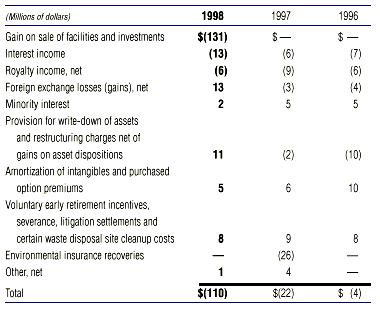
The company's investments in its affiliates (20-50%-owned) totaled $118 million and $150 million at December 31, 1998, and 1997, respectively. The decrease from 1997 relates primarily to the divestiture of the AtoHaas and RohMax joint ventures offset by the company's additional 7% investment in Rodel. Primarily as a result of the investment in Rodel the company's total investments in affiliates exceed the equity in the under-lying net assets by approximately $64 million and $41 million at December 31, 1998 and 1997, respectively.Note 3: Other Income, Net
Note 4: Financial Instruments
The company uses derivative financial instruments to reduce the impact of changes in foreign exchange rates, interest ratesand commodity raw material prices on its earnings, cash flows and fair values of assets and liabilities. The company enters into derivative financial contracts based on analysis of specific and known economic exposures and by policy prohibits holding or issuing derivative financial instruments for trading purposes. Credit risk associated with non-performance by counterparties is mitigated by using major financial institutions with high credit ratings. The company also limits the amount of derivative contracts it enters into with each counterparty.The company uses primarily purchased foreign exchange option contracts to hedge anticipated sales in foreign currencies by foreign subsidiaries. The option premiums paid are recorded as assets and amortized over the life of the option. Gains and losses on purchased option contracts are deferred and recorded in the period in which the underlying sales transactions are recognized, except for the contracts to hedge anticipated sales by subsidiaries that use local currency as their functional currency. These contracts, which amounted to approximately 5% and 32% of the total notional amount outstanding at December 31, 1998 and 1997, respectively, are marked to market at each balance sheet date.
The notional amounts of foreign exchange option contracts totaled $326 and $118 million at December 31, 1998, and 1997, respectively. The table below summarizes by currency the notional value of foreign exchange option contracts in U.S. dollars:
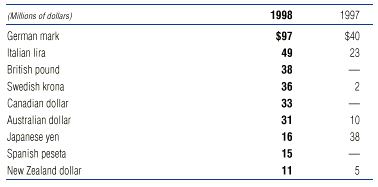
The contracts outstanding at each balance sheet date have maturities of less than eighteen months. At December 31, 1998 and 1997, net deferred unrealized gains were $2 million and $4 million, respectively.
The company also uses forward exchange contracts to reduce the exchange rate risk of specific foreign currency transactions. These contracts require the exchange of a foreign currency for U.S. dollars at a fixed rate at a future date. The maturities are generally less than fifteen months. The carrying amounts of these contracts are adjusted to their market value at each balance sheet date and recorded in other income and expenses. At December 31, 1998, the open foreign exchange forward contracts totaled $70 million in notional amounts, of which $55 million is to hedge the intercompany loans denominated in German marks of $14 million and Italian lira of $41 million.
Fifteen million dollars are to reduce operating exposures in Japanese yen. At December 31, 1997, one Japanese yen forward contract, which matured in February 1998, was outstanding with a notional value of $5 million. Net unrealized losses at December 31, 1998 were $1 million and gains at December 31, 1997 were not material.
Currency swap agreements are used to manage short-term exposure positions with various foreign currencies. Maturities generally do not exceed thirty days. The carrying amounts of these swap agreements are adjusted to their market value at each balance sheet date and recorded in other income and expense. At December 31, 1998, the open swap agreements totaled $26 million in notional amounts, of which $20 million is to exchange the U.S. dollar for British pounds while $6 million is to exchange the U.S. dollar for German marks. The unrealized losses on the currency swap agreements were not material at December 31, 1998.
At both December 31, 1998 and 1997, the company was party to a written interest rate option contract with a notional amount of $25 million to monetize the call provision on the company's 9.375% debentures due 2019. The counterparty paid the company a premium of $5 million for the right to receive 9.375% fixed rate payments beginning 1999 through 2002. In return, the counterparty will pay the company variable interest payments based on the six-month LIBOR. The written option has been marked to market at each balance sheet date.
At December 31, 1997, the company held an interest rate floor expiring in 1999 to hedge $50 million of its fixed-rate debt. The floor rate under this contract was 6%. The premium paid for the option was amortized to interest expense over the life of the option. This contract was closed out during 1998 at an immaterial gain.
The company uses commodity swap agreements for hedging purposes to reduce the effects of changing raw material prices. Gains and losses on the swap agreements are deferred until settlement and recorded as a component of underlying inventory costs when settled. The notional value of commodity swap agreements totaled $5 million and $9 million at December 31, 1998 and 1997, respectively. The company recorded immaterial net losses in 1998 and net gains of $1 million in 1997.
The fair value of financial instruments was estimated based on the following methods and assumptions:
Cash and cash equivalents, accounts receivable, accounts payable and notes payable - the carrying amount approximates fair value due to the short maturity of these instruments.Long-term debt - the fair value is estimated based on quoted market prices for the same or similar issues or the current rates offered to the company or its subsidiaries for debt with the same or similar remaining maturities and terms.
Interest rate option contracts - the fair value is estimated based on quoted market prices of the same or similar issues available.
Foreign currency option contracts - the fair value is estimated based on the amount the company would receive or pay to terminate the contracts.
Foreign currency forward and swap agreements - the carrying value approximates fair value because these contracts are adjusted to their market value at the balance sheet date.
Commodity swap agreements - the fair value is estimated based on the amount the company would receive or pay to terminate the contracts.
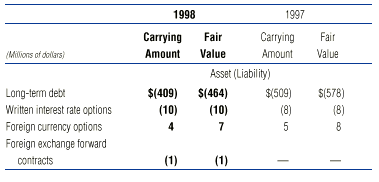
The carrying amounts and fair values of material financial instruments at December 31, 1998 and 1997, are as follows:
Previous | Return to Annual Report Main page | Next