
Notes to Consolidated Financial Statements Notes
Note 5: Income Taxes
Earnings before income taxes earned within or outside the United States are shown below:
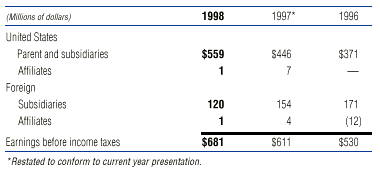
Earnings before income taxes in 1998 include $19 million related to an extraordinary loss on early extinguishment of debt.
The provision for income taxes is composed of:
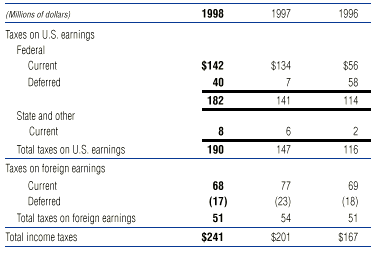
Income taxes in 1998 include a $6 million tax benefit resulting from an extraordinary loss on early extinguishment of debt.
Cash payments of income taxes were $237 million, $181 million and $120 million in 1998, 1997 and 1996, respectively.
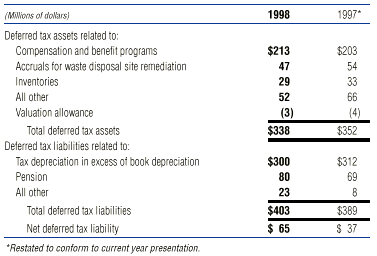
Deferred income taxes reflect temporary differences between the valuation of assets and liabilities for financial and tax reporting. Details at December 31, 1998 and 1997, were:
Deferred taxes, which are classified into a net current and non-current balance by tax jurisdiction, are presented in the balance sheet as follows:
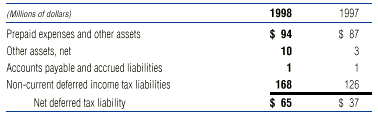
The valuation allowance was reduced by $1 million in 1998 and 1997 due to usage of tax credit carryforwards and net operating loss carryforwards.
The effective tax rate on pre-tax income differs from the U.S. statutory tax rate due to the following:
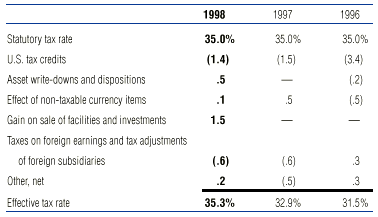
The company has net operating loss carryforwards of $5 million to offset future foreign taxable income through 2003.
Provision for U.S. income taxes, after applying statutory tax credits, was made on the unremitted earnings of foreign subsidiaries and affiliates which have not been reinvested abroad indefinitely. Total unremitted earnings, after provision for applicable foreign income taxes, were approximately $399 million at December 31, 1998. If the foreign subsidiaries and affiliates earnings that have been reinvested abroad indefinitely were remitted as dividends, the amount of additional U.S. income taxes, after applying statutory tax adjustments, would be approximately $25 million.
Note 6: Segment Information
In 1998, the Company adopted SFAS No. 131, "Disclosures about Segments of an Enterprise and Related Information." The statement supersedes SFAS No. 14, "Financial Reporting for Segments of a Business Enterprise," replacing the industry segment approach with a management approach. SFAS No. 131 designates the internal management accountability structure as the source of the company's reportable segments. The statement also requires disclosures about products and services, geographic areas and major customers. The adoption of this standard did not affect results of operations or financial position but did affect the disclosure of segment information as presented below.The company's business segment reporting under SFAS No. 131 is consistent with the changes in its financial reporting structure incorporated in the company's reporting since the first quarter of 1998. These changes, and concurrent changes to the management organization, were made to better reflect the company's technical strengths and focus on key markets. There are three business segments: Performance Polymers, consisting of the Polymers and Resins (which includes Coatings, Specialty Polymers and Building Products), Monomers, Formulation Chemicals and Plastics Additives businesses; Chemical Specialties, consisting of the Agricultural Chemicals, Ion Exchange, Biocides and Primenes businesses; and Electronic Materials, consisting of Shipley and Rodel, Inc., an affiliate. Corporate includes non-operating items such as interest income and expense, corporate governance costs, corporate exploratory research and, in 1998, loss on early extinguishment of debt.
The 1997 and 1996 presentations have been restated to reflect these changes. In the restatement, 1997 and 1996 results of AtoHaas and RohMax are reported under Performance Polymers.
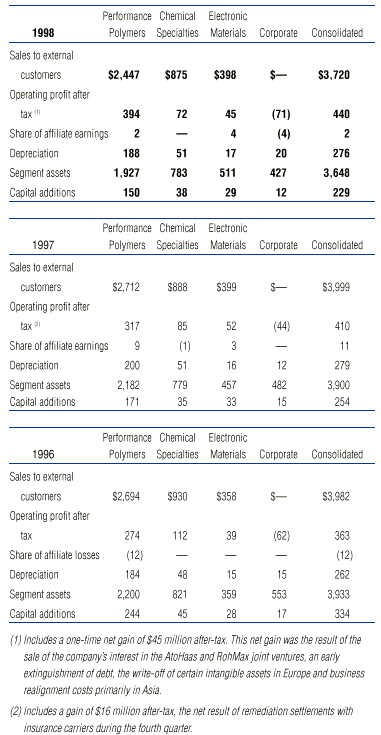
The tables below present sales and long-lived asset information by geographic area as of and for the periods ending December 31. Sales are attributed to the United States and to all foreign countries combined based on customer location and not on the geographic location from which goods were shipped.

Previous | Return to Annual Report Main page | Next