The Company utilizes Sears Roebuck Acceptance Corp. ("SRAC"), a wholly-owned subsidiary, to
issue commercial paper, to maintain a medium-term note program, to issue intermediate-term
notes and to issue long-term underwritten debt. SRAC issued term debt securities totaling
$2.53 billion in 1998. SRAC commercial paper outstanding was $4.24 billion and $5.25 billion
at January 2, 1999, and January 3, 1998, respectively. SRAC commercial paper is supported
by $6.105 billion of syndicated credit agreements; $1.04 billion of which expires in 1999,
$875 million of which expires in 2002 and $4.19 billion of which expires in 2003. The
weighted average interest rate on SRAC term debt issued in 1998 was 6.43% compared to 6.78%
in 1997. The decrease in rate is due to a general decline in interest rates. The following
securities were issued during 1998:
- $478 million of fixed-rate medium-term notes, weighted average coupon of 6.03% and average term of 5.7 years;
- $50 million of variable-rate medium-term notes, average term of one year; and
- $2 billion of discrete underwritten notes, weighted average coupon of 6.53% and average term of 20 years.
The Company, through its subsidiary SRFG, Inc., securitizes domestic credit card receivables
to access intermediate-term funding in a cost-effective manner. In 1998, the Company issued
$985 million of fixed-rate term certificates through securitizations, compared to $523
million in 1997. As of January 2, 1999, there were $6.63 billion of investor certificates
outstanding that were backed by sold domestic credit card receivables.
During 1997, the Company paid $633 million to terminate two interest rate swaps that hedged
variable-rate debt. The $633 million payment represented the market value of the swap
contracts at the date of termination and the related accrued interest payable. As a result,
a deferred loss of $466 million was recorded and is being amortized as interest expense over
the remaining lives of the original swap period.
On November 12, 1996, the outstanding 8.88% Preferred Shares, First Series were redeemed at
a redemption price of $25 per depository share plus accrued dividends to the redemption
date.
CAPITAL SPENDING
The Company has substantially completed its capital expenditure program initiated in 1993 to
renovate and update its Full-line Stores. In addition, the Company has increased the number
of its Full-line and Specialty Stores. Capital expenditures during the past three years are
as follows:
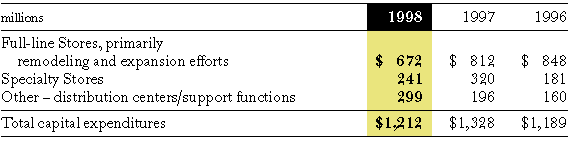
The Company plans capital expenditures of $1.2 billion for 1999, which includes remodeling
and expansion of approximately 55 existing Full-line Stores, the opening of 18 to 25 new
Full-line Stores and more than 250 Specialty Stores. The Company may also pursue selective
strategic acquisitions.
SHARE REPURCHASES
During 1998, the Company repurchased 10.6 million shares of its
common stock for $528 million under its share repurchase program
related to employee stock-based incentive plans.
LIQUIDITY
Based upon the expected cash flow to be generated from future operations and the Company's
ability to cost-effectively access multiple sources of funding, the Company believes
sufficient resources will be available to maintain its planned level of operations, capital
expenditures and dividends in the foreseeable future.
YEAR 2000
Year 2000 compliance is the ability of information systems to properly recognize and process
dates and date-sensitive information including the year 2000 and beyond (commonly referred
to as Year 2000 or Y2K). Year 2000 compliance is critical to the Company because the
Company and many of its merchandise vendors and service providers are highly reliant on
information systems to operate their businesses.
The Company is using both internal and external resources to complete its Year 2000
compliance initiatives. The Year 2000 efforts of the Company's credit and bank operations
are subject to regulatory review.
State of Readiness
In 1997, the Company established a corporate project office, which reports to an executive
management team, to oversee, monitor and coordinate the Company-wide Year 2000 effort. The
Company's Year 2000 compliance plan focuses on three areas - information systems, business
management and merchandise vendors - and generally covers six stages:
- Inventorying the Company's systems (including equipment with embedded chips), merchandise vendors and service providers;
- Assessing whether a Year 2000 compliance issue exists for each system and provider;
- Remediating each system with a Year 2000 compliance issue by performing any necessary enhancements, upgrades, modifications or replacements;
- Testing each remediated system by using a date simulation testing tool for future dates that trigger specific processing;
- Certifying each system, which involves performing final testing for validation of Year 2000 compliance by systems, finance and business senior managers; and,
- Contingency planning to mitigate Year 2000 compliance risks.
Only the inventory, assessment and contingency planning stages apply to merchandise vendors and service providers.
|
