 |
| 1. SUMMARY OF SIGNIFICANT ACCOUNTING POLICIES
Basis of presentation The preparation of financial statements in conformity with generally accepted accounting principles requires management to make estimates and assumptions that affect the reported amounts of assets and liabilities and disclosure of contingent assets and liabilities at the date of the financial statements and the reported amounts of revenues and expenses during the reporting period. Actual results could differ from these estimates. Certain reclassifications have been made in the 1997 and 1996 financial statements to conform with the current year presentation.
Fiscal Year
Merchandise Sales and Services
Store Pre-opening Expenses
Earnings Per Common Share
Cash and Cash Equivalents
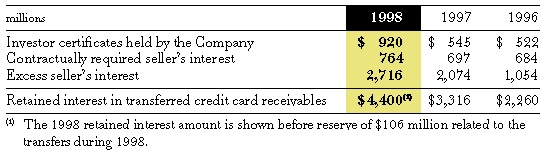
Retained Interest in Transferred Credit Card Receivables
Retained interests are as follows:
The Company intends to hold the investor certificates and contractually required seller's
interest to maturity. The excess seller's interest is considered available for sale. Due to
the revolving nature of the underlying credit card receivables, the carrying value of the
Company's retained interest in transferred credit card receivables approximates fair value
and is classified as a current asset.
Credit Card Receivables
Credit card receivables are shown net of an allowance for uncollectible accounts. The Company
provides an allowance for uncollectible accounts based on impaired accounts, historical
charge-off patterns and management judgement.
Under the Company's proprietary credit system, uncollectible accounts are generally charged
off automatically when the customer's past due balance is eight times the scheduled minimum
monthly payment, except that accounts may be charged off sooner in the event of customer
bankruptcy. Finance charge revenue is recorded until an account is charged off, at which time
uncollected finance charge revenue is recorded as a reduction of credit revenues. The Company
has primarily used this proprietary system for all periods presented in the financial
statements. However, in the fourth quarter of 1998, the Company converted 12% of its managed
portfolio of credit card receivables to a new credit processing system. Under the new system,
uncollectible accounts will be charged off automatically when the customer fails to make a
payment in each of the last eight billing cycles. Finance charge revenue that is charged off
will continue to be recorded as a reduction of credit revenue. The remaining 88% of accounts
on the proprietary credit system will be converted to the new system in 1999.
The Company adopted Statement of Financial Accounting Standards ("SFAS") No. 125, "Accounting
for Transfers and Servicing of Financial Assets and Extinguishments of Liabilities" in 1997.
SFAS No. 125 requires that the Company recognize gains on its credit card securitizations
which qualify as sales and that an allowance for uncollectible accounts not be maintained for
receivable balances which are sold. Prior to adoption of SFAS No. 125, the Company maintained
an allowance for uncollectible sold accounts as a recourse liability and did not recognize
gains on securitizations. Accordingly, the adoption of SFAS No. 125 increased net income by
$36 million in 1998 and $136 million in 1997 versus the net income that would have been
recognized under the previous accounting method.
Merchandise Inventories
The LIFO adjustment to cost of sales was a credit of $34 and $17 million in 1998 and 1997,
respectively, and a charge of $19 million in 1996. Partial liquidation of merchandise
inventories valued under the LIFO method resulted in credits of $2 million in 1997. No layer
liquidation occurred in 1998 or 1996. If the first-in, first-out ("FIFO") method of inventory
valuation had been used instead of the LIFO method, merchandise inventories would have been
$679 and $713 million higher at January 2, 1999, and January 3, 1998, respectively.
Merchandise inventories of International operations, operations in Puerto Rico, and certain
Sears Tire Group formats, which in total represent approximately 12% of merchandise
inventories, are recorded at the lower of cost or market based on the FIFO method.
Property and Equipment
Long-Lived Assets
Goodwill
Advertising
Direct-Response Marketing
Membership acquisition and renewal costs, which primarily relate to membership solicitations,
are capitalized since such direct-response advertising costs result in future economic benefits.
Such costs are amortized over the shorter of the program's life or five years, primarily in
proportion to when revenues are recognized. For specialty catalogs, costs are amortized over
the life of the catalog, not to exceed one year. The consolidated balance sheets include
deferred direct-response advertising costs of $131 and $90 million at January 2, 1999, and
January 3, 1998, respectively, and that are included in prepaid expenses and deferred
charges, or other assets.
Off-Balance Sheet Financial Instruments
Interest rate swap agreements modify the interest characteristics of a portion of the
Company's debt. Any differential to be paid or received is accrued and is recognized as an
adjustment to interest expense in the statement of income. The related accrued receivable or
payable is included in other assets or liabilities. The fair values of the swap agreements
are not recognized in the financial statements.
Interest rate caps are used to lock in a maximum rate if rates rise, but enable the Company
to otherwise pay lower market rates. The cost of interest rate caps is amortized to interest
expense over the lives of the caps. Payments received based on interest rate cap agreements
reduce interest expense. The unamortized cost of interest rate caps is included in other
assets.
Gains or losses on terminations of interest rate swaps are deferred and amortized to interest
expense over the remaining life of the original swap period to the extent the related debt
remains outstanding.
Financial instruments used as hedges must be effective at reducing the type of risk
associated with the exposure being hedged and must be designated as hedges at inception of
the hedge contract. Accordingly, changes in market values of financial instruments must be
highly correlated with changes in market values of the underlying items being hedged. Any
financial instrument designated but ineffective as a hedge would be marked to market and
recognized in earnings immediately.
Effect of New Accounting Standards
Effective January 4, 1998, the Company adopted AICPA Statement of Position ("SOP") 98-1,
"Accounting for the Costs of Computer Software Developed or Obtained for Internal Use,"
which requires the Company to capitalize certain software development costs. Generally,
once the capitalization criteria of the SOP have been met, external direct costs of materials
and services used in development of internal-use software, payroll and payroll-related costs
for employees directly involved in the development of internal-use software and interest
costs incurred when developing software for internal use are to be capitalized. The adoption
of this SOP did not have a material effect on the Company's consolidated financial position,
results of operations or cash flows during 1998.
Effective January 2, 1999, the Company adopted SFAS No. 131, "Disclosures about Segments of
an Enterprise and Related Information," and SFAS No. 132, "Employers' Disclosures about
Pensions and Other Postretirement Benefits." SFAS No. 131 establishes revised standards for
the reporting of information about the Company's operating segments, and SFAS No. 132
standardizes the disclosure requirements for pension and other postretirement benefit plans.
The adoption of these statements did not impact the Company's consolidated financial position,
results of operations or cash flows, but did affect the disclosures contained in Notes 5 and
15. Prior year information has been restated to conform with the requirements of these
statements.
In June 1998, the Financial Accounting Standards Board issued SFAS No. 133, "Accounting for
Derivative Instruments and Hedging Activities," which is required to be adopted in years
beginning after June 15, 1999. The Company is currently evaluating the effect this statement
might have on the consolidated financial position or results of operations of the Company.
|

Annual Report Contents | Previous | Next |
|
|
|