SYSCO 1998 Annual Report
Letter to Shareholders
 As consumers we are fortunate to live in a land of abundant choices - from
what and where we eat to where we live, where we shop, where we bank, even
how we invest our money. When we choose to dine out or take home food prepared
by others, the choices are plentiful. SYSCO's employees, suppliers, customers
and shareholders also have made choices - as employees, to provide consistent
quality products and excellent service to our customers; as suppliers,
to allow us to market their products; as customers, to purchase the products
we distribute and the services we provide; and as shareholders, to purchase
our common shares. By fulfilling our commitments to employees, suppliers
and customers in fiscal 1998, SYSCO made solid progress in meeting shareholder
expectations and increasing the value of your company.
As consumers we are fortunate to live in a land of abundant choices - from
what and where we eat to where we live, where we shop, where we bank, even
how we invest our money. When we choose to dine out or take home food prepared
by others, the choices are plentiful. SYSCO's employees, suppliers, customers
and shareholders also have made choices - as employees, to provide consistent
quality products and excellent service to our customers; as suppliers,
to allow us to market their products; as customers, to purchase the products
we distribute and the services we provide; and as shareholders, to purchase
our common shares. By fulfilling our commitments to employees, suppliers
and customers in fiscal 1998, SYSCO made solid progress in meeting shareholder
expectations and increasing the value of your company.
Total sales in fiscal 1998 reached $15.3 billion, a 6 percent increase. Four weekly sales records were set, including three in the fourth quarter. On a real basis, after adjusting for acquisitions and inflation/deflation, sales growth was 5.9 percent for fiscal 1998. On a calendar 1997 basis (most recent data), the $158 billion foodservice distribution industry grew at a moderate 2.1 percent, at the lower end of its 2 percent to 3 percent historical annual growth rate. SYSCO compares favorably at 4.3 percent for the same period and continues to grow at a faster pace than the industry because it offers an ever-expanding array of product choices, reliable delivery schedules and services that assist customers in strengthening their profitability. Basic and diluted earnings per share before accounting change rose 12 percent in fiscal 1998 to $0.95 versus $0.85 the prior year, in line with our objectives. The increase was due to customer mix improvements that enhanced operating margins and to accelerated share repurchases. The earnings per share previously stated do not reflect a one-time, non-cash accounting charge of $0.08 per share taken against second quarter 1998 earnings to comply with a consensus ruling by the Emerging Issues Task Force of the Financial Accounting Standards Board. The ruling required that certain business process reengineering costs related to the development and installation of the SYSCO Uniform System (SUS), a company-wide redevelopment of information technology processes, be expensed as incurred. Prior to the change, which was effective in November 1997, SYSCO had capitalized such costs in accordance with generally accepted accounting principles in effect at the time. Installations of SUS have been completed in approximately 70 percent of the operating companies, and the project will be concluded well before the end of calendar 1999, enhancing productivity company-wide and effecting year 2000 compliance for the system.
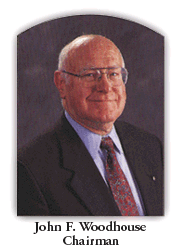
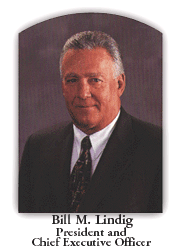
Marketing associate-served sales to independent customers increased as a percent of total foodservice sales to 53 percent from 51 percent last year. This reflects an ongoing effort to appropriately balance the customer mix through customer attraction and retention programs. In addition, the 33,000 SYSCO Brand products are especially suitable for this customer segment. This line, which is the hallmark of our business, allows us to help customers improve their profitability. While SYSCO does not manufacture or process any products, the company is dedicated to procuring products of the most consistent quality for America's diners. This ideal is reinforced by a team of more than 180 quality assurance professionals unparalleled in our industry. Continually, they consult with 1,500-plus worldwide growers and manufacturers of SYSCO Brand products, developing product specifications, monitoring production processes and enforcing SYSCO's stringent standards. Relationships with suppliers are excellent and, in May, an initiative was announced to solicit more participation of minority and women-owned suppliers of quality, competitively priced products. The SYGMA Network, Inc., SYSCO's chain restaurant distribution subsidiary, set a new sales record of $1.4 billion in fiscal 1998. This was 8.3 percent above last year, and represented 9 percent of overall sales. We remain committed to serving growing segments of this market as evidenced by a recent five-year agreement expanding service to approximately 1,700 additional Wendy's International, Inc. locations across the U.S. The new service began in late summer and is being added gradually over four to six months. It should increase annual sales by about $600 million and expand the total Wendy's business to approximately $1 billion, making Wendy's SYSCO's largest customer. To serve their restaurants efficiently, we have opened a new SYGMA facility in Illinois, will open Florida and North Carolina centers, and are adding to capacity in Oklahoma, Detroit and Atlanta. SYGMA also will open a Stockton, California facility during the second fiscal quarter. Sales of the operations in our "fold-out" expansion program have grown more rapidly than the overall SYSCO average. Four "fold-out" operations and one "fold-out"/relocation have been built since 1995, including the most recent that will open near San Diego, California during the fiscal 1999 second quarter. One additional "fold-out" is slated to open in Birmingham, Alabama in the March quarter and we expect to add new facilities each year via this program. As these operations continue to mature, they should produce meaningful incremental growth. Although acquisitions played a vital role in establishing geographic footholds in SYSCO's early years, the company's sustained growth in market share primarily reflects internally-generated sales increases within each market served. While the acquisition pace has diminished, selective acquisitions that offer strategic advantages will continue to be vital in building share in certain markets. Recent examples include the acquisitions of the foodservice distribution division of Jacksonville, Florida-based Beaver Street Fisheries, Inc. and the Jordan's Foodservice Distribution Division of Jordan's Meat's, Inc., in Westbrook (Portland), Maine, which greatly expanded our New England coverage. Each generates approximately $130 million in annual revenues. Equally important, they provide access to a marketing associate-served customer base, a primary SYSCO focus. Investments in facilities, fleet and equipment were $259 million in 1998, higher than the $211 million of 1997, with facility and fleet purchases comprising 63 percent of the total. For fiscal 1999, capital expenditures are anticipated at $240 to $260 million. In May, SYSCO announced a $500 million shelf registration of debt securities for general corporate purposes, including additions to working capital, capital expenditures, acquisitions, stock repurchases and/or repayment of indebtedness. Subsequent to year end, $225 million was drawn down to reduce commercial paper debt. The balance sheet is healthy with ample cash and appropriate long-term debt capacity to fuel growth through ongoing "fold-out" expansion and strategic acquisitions. At fiscal year-end, net long-term debt was $867 million, or 39 percent of total capitalization, as compared to $686 million a year earlier. SYSCO generates significant cash to fund working capital requirements, capital expenditures, dividends and a portion of the share repurchases. The balance of the fiscal 1998 12-million-share buyback was financed through additional debt, which contributed to higher debt and interest expense for the year. In fiscal 1998, 12.1 million shares of the company's stock were repurchased at a cost of $263 million, bringing to 71 million the total number of shares repurchased since May 1992. A new 8-million-share buyback program was authorized in September. The company has been accelerating share repurchases to offset the two million shares issued annually in various benefit and compensation plans, as well as to increase earnings per share by reducing total shares outstanding. Increased operating earnings, along with fewer shares outstanding, resulted in a 23 percent return on average shareholders' equity and a 15 percent return on average total capital before the accounting change. At fiscal year-end, SYSCO's founder and senior chairman of the board of directors, John F. Baugh, retired after 28 years of distinguished service. From SYSCO's inception, Mr. Baugh had served as a director and until 1985 was a principal officer of the corporation. As a leader and active participant in the foodservice distribution industry, he has been instrumental in shaping the course of an industry that is today a major economic force in North America. His guidance will be missed. In July, the board of directors elected SYSCO's president and chief executive officer, Bill M. Lindig, chairman of the board. He will retain his position as chief executive officer. Also, Charles H. Cotros, executive vice president and chief operating officer, will become president and continue as chief operating officer. Both executives assume their new roles January 1, 1999, when John F. Woodhouse, current chairman of the board, becomes senior chairman. He will continue as a director and as chairman of the board's executive committee. Also, Richard J. Schnieders, a director of SYSCO and senior vice president of merchandising services and multi-unit sales, was elected executive vice president of foodservice operations of the company, effective January 1, 1999. He will oversee the five senior vice presidents of operations, each of whom are responsible for 10 to 12 of the 60 traditional operating companies. Thomas E. Lankford, senior vice president of operations for SYSCO's northeast region, will succeed Mr. Schnieders as senior vice president of merchandising and multi-unit sales. Larry J. Accardi, president and chief executive officer of the Atlanta operating company, will assume Mr. Lankford's post. Just prior to fiscal year-end, Kenneth J. Carrig joined SYSCO as vice president and chief administrative officer and Thomas G. Wason was named assistant vice president, perishables. In September, Gordon M. Bethune, chairman and chief executive officer of Continental Airlines, Inc., was elected a director, adding a new dimension to SYSCO's leadership. Historically SYSCO has maintained a dividend payout policy of approximately 30 percent or more of trailing earnings per share and has paid dividends consistently throughout its history. Last November the directors raised the quarterly cash dividend to $0.17 from $0.15 per share and in February 1998 declared a two-for-one stock split, concurrently increasing the quarterly cash dividend. At $0.18 per share ($0.09 on a post-split basis) this represented an 18 percent increase in fiscal 1998. The stock dividend was the eighth in the company's 28-year history, while the February dividend increase was the 29th since the initial public offering in March 1970. These decisions reflect the board's belief that management's strategies will continue to generate substantial earnings growth and significant future cash flow. To continue to enhance SYSCO's value, management has determined certain financial objectives: to attain high single-digit real sales growth; to grow earnings per share at four to six percentage points above real sales growth; to achieve 24 percent return on average shareholders' equity and to maintain a 35 percent to 40 percent long-term debt to total capitalization ratio. Outlook for the future growth of our industry and for achieving our
expectations is strong, given high consumer confidence levels, low unemployment
rates and modest inflation in the U.S. and Canada. Also, the recent uncertainty
in world markets is expected to have minimal impact on our industry. SYSCO
intends to continue expanding its leadership position by spearheading innovations
to offer customers a breadth and depth of products and value-added benefits,
supported by unequaled service. Strong financial resources, excellent supplier
relationships and the commitment of outstanding employees to provide superior
local market service throughout North America should allow SYSCO to continue
to prosper.
John F. Woodhouse
September 25, 1998 |
 The company's internal food cost inflation index was deflationary during
the first half of the year and inflationary in the latter half, resulting
in zero inflation for the full year, compared to 2.3 percent inflation
for fiscal 1997. The third-quarter upturn followed a five-quarter deflationary
period and resulted primarily from inclement weather patterns that affected
West Coast fresh produce supplies. We anticipate modest inflation in fiscal
1999.
The company's internal food cost inflation index was deflationary during
the first half of the year and inflationary in the latter half, resulting
in zero inflation for the full year, compared to 2.3 percent inflation
for fiscal 1997. The third-quarter upturn followed a five-quarter deflationary
period and resulted primarily from inclement weather patterns that affected
West Coast fresh produce supplies. We anticipate modest inflation in fiscal
1999.