

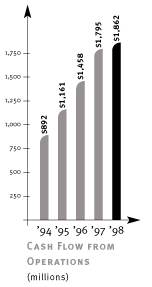
 Our financial condition remains strong. Cash flow from operations was $1,862 million, driven by earnings growth, strong inventory control and accounts payable leveraging. Internally generated funds continue to be the most important component of our capital resources and, along with our ability to access a variety of financial markets, provide funding for our expansion plans. We continue to fund the growth in our business through a combination of retained earnings, debt and sold securitized receivables.
During 1998, average total receivables serviced (which includes both retained and sold securitized receivables) increased 6 percent, or $124 million, due to growth of the Target Guest Card. Year-end total receivables serviced increased 3 percent from last year. In 1998, the number of Target Guest Card holders grew to over 12 million accounts at year end, compared with over nine million in 1997. In 1999, we expect continued growth of the Target Guest Card, which will benefit sales growth and credit profitability.
Inventory levels increased $224 million in 1998. This growth was more than fully funded by the $423 million increase in accounts payable over the same period.
Capital expenditures were $1,657 million in 1998, compared with $1,354 million in 1997. Investment in Target accounted for 82 percent of 1998 capital expenditures, with 10 percent at Mervyn's and 8 percent at DSD. Net property and equipment increased $844 million, reflecting capital invested offset by depreciation. During 1998, Target opened 55 net new stores, Mervyn's closed one store and DSD closed two stores. Approximately 63 percent of total expenditures was for new stores, expansions and remodels. Other capital investments were for information systems, distribution and other infrastructure to support store growth. Over the past five years, Target's retail square footage has grown at a compound annual rate of approximately 10 percent. We expect Target to continue to expand in the range of 7 to 9 percent annually for the foreseeable future.
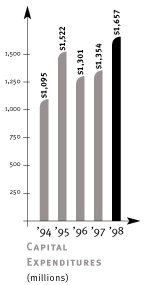 Capital expenditures in 1999 are expected to approximate $1.8 billion for the construction of new stores, expansion and remodeling of existing stores, and other capital support. The majority of capital will continue to be invested in Target. In the upcoming year, Target plans to open 60 to 65 net new stores, including new stores in the Boston and Pittsburgh markets and additional stores in New York, New Jersey, North and South Carolina, and other states. DSD plans to open one new store in 1999. Our plans also include full-scale remodels of 46 Target, seven Mervyn's and nine DSD stores.
Our financing strategy is to ensure liquidity and access to capital markets, to manage the amount of floating-rate debt and to maintain a balanced spectrum of debt maturities. Within these parameters, we seek to minimize our cost of borrowing.
In January 1999, our Board of Directors authorized the repurchase of $1 billion of our common stock. We expect to complete our repurchase program over the next two years. Repurchases will be made primarily in open market transactions, subject to market conditions. There was no repurchase activity in 1998.
A key to our access to liquidity and capital markets is maintaining strong investment-grade debt ratings. During the year, our long-term debt was upgraded by Moody's and Standard and Poor's. Further liquidity is provided by $1.6 billion of committed lines of credit obtained through a group of 31 banks. Going forward, we expect that continued profit increases and cash flow from operations will allow us to fund our planned capital expenditures and share repurchase while maintaining or improving our debt ratings.
|
|
|
|
 | |||
| Credit Ratings | |||
| Moody's | Standard and Poor's | Duff & Phelps | |
| |||
| Long-term debt | A3 | A- | A- |
| Commercial paper | P-2 | A-2 | D-1- |
| Sold securitized receivables | Aaa | AAA | N/A |
| |||
|
|
 |
 |