

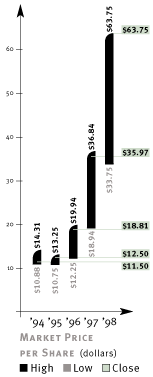
 Our primary objective is to maximize shareholder value over time through a combination of share price appreciation and dividend income while maintaining a prudent and flexible capital structure. Our total return to shareholders was 79 percent in fiscal 1998 and 45 percent and 27 percent per year over the last five and ten years, respectively.
Measuring Value Creation
We measure value creation internally using a form of Economic Value Added (EVA), which we define as after-tax segment profit less a capital charge for all investment employed. The capital charge is an estimate of our after-tax cost of capital adjusted for the age of our stores, recognizing mature stores inherently have higher returns than newly opened stores. We estimate the after-tax cost of capital for our retail business is approximately 10 percent, while our credit operations, after-tax cost of capital is approximately 6 percent as a result of its ability to support higher debt levels. We expect to generate returns in excess of these costs of capital, thereby producing EVA.
EVA is used to evaluate our performance and to guide capital investment decisions. A significant portion of executive incentive compensation is tied to the achievement of targeted levels of annual EVA improvement.
Financial Objectives
We believe that managing our business with a focus on EVA helps achieve our objective of annual earnings per share growth of 15 percent or more over time. We plan to produce these results, while maintaining a prudent debt ratio for our retail operations, which will allow efficient capital market access to fund our growth. Earnings per share before unusual items has grown at compound annual rates of 20 percent and 14 percent over the last five and ten years, respectively.
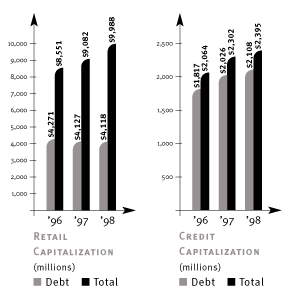
Reflecting our strong cash flow, we ended 1998 with a retail debt ratio of 41 percent. In evaluating our debt level, we separate retail operations from credit operations due to their inherently different financial characteristics. We view the appropriate capitalization of our credit business to be 88 percent debt and 12 percent equity, similar to ratios of comparable credit card businesses.
 | |||
| Debt Ratio* | |||
| 1998 | 1997 | 1996 | |
| |||
| Retail | 41% | 45% | 50% |
| Credit | 88% | 88% | 88% |
| Total Debt Ratio | 50% | 54% | 57% |
| |||
| *Includes the impact of sold securitized receivables and off-balance sheet operating leases as if they were debt. | |||
|
|
 |
 |