|


 As this letter goes to press, we are experiencing one of the most remarkable periods in the history of the global iron and steel business. The global demand for iron ore is soaring, thanks largely to the amazing economic growth in China and the resultant demand for steel. Virtually all iron ore merchants are sold out for 2004, and Cleveland-Cliffs is no exception. As this letter goes to press, we are experiencing one of the most remarkable periods in the history of the global iron and steel business. The global demand for iron ore is soaring, thanks largely to the amazing economic growth in China and the resultant demand for steel. Virtually all iron ore merchants are sold out for 2004, and Cleveland-Cliffs is no exception.
Our Company is positioned to participate in the global growth of the iron ore business and is aggressively taking advantage of the opportunities. In 2003, for example, we were introduced to Laiwu Steel Group, one of China's premier steel companies, which has been significantly expanding its steelmaking capacity and has a tremendous need for iron ore supplies. Together we formed United Taconite and acquired the assets of EvTac Mining Company, which was not operating and in bankruptcy. Today, the mine is up and running at near full capacity with a streamlined work force and a more efficient cost structure. The mine's pellet production is being used by Cliffs to satisfy its domestic demand and by Laiwu to satisfy its iron ore requirements.
The addition of United Taconite increases Cliffs' managed North American iron ore capacity to 37 million tons, or about 45 percent of total North American capacity. Cliffs' managed tonnage represents about 58 percent of North American iron ore consumption. We manage six of the 11 iron ore mines in North America.
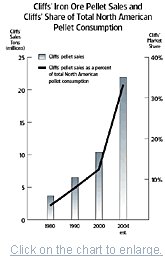
With the acquisition of EvTac and the consolidation of the ownership in our existing mines, Cliffs' own capacity has nearly doubled from about 12 million tons at the end of 2001 to about 22 million tons currently. We had record pellet sales volume of 19.2 million tons in 2003, up 31 percent over 2002. In 2004, we expect to sell our new full capacity of 22 million tons.
 There are iron ore companies that are much larger, but arguably none possess the world-class competency of Cleveland-Cliffs to turn low-grade iron ore, or taconite, into high-grade blast furnace pellets. Going forward, we expect that this competency will be in high demand as low-grade ores inevitably become a greater part of global iron ore consumption, just as they have in North America. We are just now starting an assignment for Venezuela's Ferrominera to manage its Minorca pellet plant, with the objective of increasing the output and productivity of this 3 million ton pellet plant. There are iron ore companies that are much larger, but arguably none possess the world-class competency of Cleveland-Cliffs to turn low-grade iron ore, or taconite, into high-grade blast furnace pellets. Going forward, we expect that this competency will be in high demand as low-grade ores inevitably become a greater part of global iron ore consumption, just as they have in North America. We are just now starting an assignment for Venezuela's Ferrominera to manage its Minorca pellet plant, with the objective of increasing the output and productivity of this 3 million ton pellet plant.
Encouraging signs notwithstanding, the past few years have been very challenging for Cleveland-Cliffs and our industry as a whole. In fact, a large portion of our iron ore customers today are steel mills that have been acquired out of bankruptcy or have been reorganized. While the process has been difficult, a stronger, better capitalized steel industry has emerged.
Perhaps the best example is International Steel Group, now our largest customer. ISG represents the acquisition of three steel companies out of bankruptcy – all of which were Cliffs' customers or partners. With the expected acquisition of Weirton Steel, ISG will consume approximately 9 million of Cliffs' 22 million tons of sales capacity this year. At its formation, Cliffs invested $13 million in ISG to buy the idled assets of LTV and $13 million more to acquire the assets of Acme and Bethlehem. As of March 1, Cliffs' share of ISG from these investments has a market value of $238 million, including $20 million in our pension plan.
Cliffs has managed through this industry reorganization with skill and innovation. We have carefully controlled our credit exposure and, as a result, have had only minor losses during a period of massive insolvency of our customer base. A good example is Rouge Steel, now Severstal North America. We extended a secured $10 million loan to Rouge Steel in 2002 in return for all of its iron ore business. Now, as Severstal takes over Rouge, we have an exclusive contract for all of Severstal's iron business and have fully recovered our $10 million loan, including interest, from the Rouge estate.
The value of our ISG investment and the $166 million net proceeds from a January 2004 convertible preferred stock issue have restored financial strength to Cleveland-Cliffs. With the stock proceeds, we have paid off all of our remaining debt and contributed funds to our underfunded pension plans. Book net worth, which was as low as $79 million on December 31, 2002, has been increased to about $400 million. We now have the financial position to create additional value for shareholders.
In addition to the important task of reducing liabilities, we believe that Cliffs has a number of exciting investment opportunities. One is the Mesabi Nugget Project, which is in development at our Northshore Mine in Silver Bay, Minnesota. Cliffs has a 48 percent ownership interest in the project, and our other development partners are Steel Dynamics, Kobe Steel, Ferrometrics and the State of Minnesota. While we are taking a very careful approach in evaluating this project, the pilot plant results have been encouraging and we have successfully converted Northshore iron concentrates into high-grade pig iron, which has performed well in electric arc furnace trials. Assuming our last pilot plant campaign is successful, we expect to go ahead with a commercial-sized plant with Steel Dynamics and Kobe Steel. Cliffs' investment would be in the range of $20 million to $50 million, depending on our ownership interest and available financing.
In 2001, your management team began the task of remaking Cliffs from primarily a mine management company and mineral holder to a merchant mining company. Some of this was done out of necessity, as our partners at the time were becoming insolvent and unwilling to perform on their mine obligations. While we have been successful at increasing revenues through consolidation – our total revenues should approximate $1 billion in 2004 – the job of improving our cost structure is ongoing.
Even though we expect our price realizations to improve in 2004, we must still improve our margins. In 2003, we began a program to reduce our operating expenses by at least $35 million, and that program remains on track. Before acquiring United Taconite, we had reduced our U.S. salaried staff by nearly 20 percent, including a 30 percent reduction in our corporate office, and had successfully combined the Empire and Tilden mines in Michigan under a common management and eliminated redundant practices. We call this the "turning point" in how we manage our business for cost effectiveness, and we are dedicated to achieving our goal. In a commodity business, particularly one based on mining low-grade deposits, the job of improving cost effectiveness and productivity can never stop.
While we accomplished much in 2003 – including the formation of United Taconite and the commencement of our cost reduction efforts – we were disappointed by our operating results. High energy costs, unexpected ore quality upsets and even a flood in Michigan adversely affected our bottom line. We are dedicated to improving the competitiveness of our cost structure.
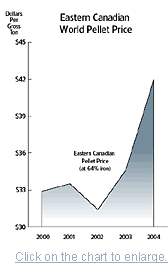 Although we are currently enjoying improved pricing for our pellets, the challenge to protect our future is the unending quest to reduce the cost of operations. The only way we can protect the jobs and benefits of our employees is by being as productive and cost effective as we can be. In 2003, we restructured not only salaried headcount, but also salaried pension and retiree medical benefits. In addition, our lack of profitability meant that salaried employees received no bonus payments. Looking ahead, our labor contracts with the United Steelworkers of America, which represents production and maintenance employees at five of our six operations, must be renegotiated in 2004. To protect jobs and benefits, it is imperative that these new contracts address the growth of pension and medical expense for both active and retired employees, as well as foster improved productivity. Although we are currently enjoying improved pricing for our pellets, the challenge to protect our future is the unending quest to reduce the cost of operations. The only way we can protect the jobs and benefits of our employees is by being as productive and cost effective as we can be. In 2003, we restructured not only salaried headcount, but also salaried pension and retiree medical benefits. In addition, our lack of profitability meant that salaried employees received no bonus payments. Looking ahead, our labor contracts with the United Steelworkers of America, which represents production and maintenance employees at five of our six operations, must be renegotiated in 2004. To protect jobs and benefits, it is imperative that these new contracts address the growth of pension and medical expense for both active and retired employees, as well as foster improved productivity.
On a positive note, we were very pleased with our safety record in 2003. We have set best-in-class safety objectives for the Company. Our safety performance in 2003, as measured by the MSHA frequency index (Total Reportable Incident rate), represented an improvement of 31 percent over 2002 and 48 percent over 2001. With an overall TRI rate of 2.7 percent, we believe that Cliffs ranks in the upper tier of domestic mining companies in protecting its employees and, in turn, enhancing productivity.
In closing, I want to thank all of our employees for their exceptional efforts in 2003. You have shown, once again, that you are up to the challenge and dedicated to making Cleveland-Cliffs a better company. Continued success can come only with everyone working together as a team.
|
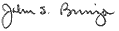
John S. Brinzo
Chairman, President and Chief Executive Officer
March 1, 2004 |
|
|