Downloads     Annual Report Home    
Annual Report search


Management Review  
Chairman’s Report Chief Executive Officer’s Report Board of Directors
Chief Financial Officer’s Report Corporate Governance Structure and Management Systems
Chief Executive Officer’s Report  cont.
1 2 3 4
Decrease font size   Increase font size   E-mail page   Print page


- Unprecedented cement demand -
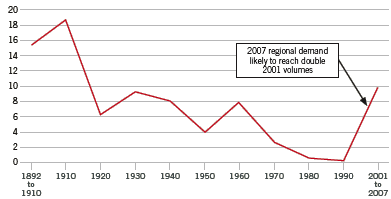
Cement volumes continued to reflect good growth as the South African economy entered a fifth consecutive year of growth, driving regional demand to a record 15,3 million tons per annum. The compound growth rate over this period has been almost 10% per annum and is reflected in the history of regional cement demand growth reflected on the graph below. The cumulative volume growth over the six years since 2001 is likely to reach almost 100% increase by the end of 2007.

Gauteng remained the powerhouse driver of demand accounting for nearly 40% of domestic volumes whilst the Eastern Cape market also exhibited double-digit growth. The Western Cape was flat year on year as the higher than usual winter rainfall disrupted construction activities. The Botswana market grew by 20% as that economy showed signs of recovering after several years of decline.

The government’s stated intent to triple the number of low-cost houses built annually could minimise the impact of any interest rate induced slow-down in private housing cement demand in the medium term.

The increased infrastructural investment planned by government, Eskom and other sectors is gathering momentum and we therefore expect continued demand growth in the year ahead. The bulk to bag ratio has begun to show signs of the anticipated swing toward bulk as the large infrastructural projects are gaining momentum.

Most of the five new 2010 FIFA World Cup stadium projects, existing stadium upgrades and the Gautrain metro contract have commenced and are drawing increasing cement volumes. The Gauteng Province recently announced a R22 billion motorway upgrade project to be completed before 2010. We understand that the commencement of the two new thermal power station projects for Eskom and the new R6,8 billion KwaZulu-Natal “King Shaka international airport” will be announced shortly.
 
 
SA regional cement demand compound growth per decade
%
 
 
- Delivering on our commitments to customers -
To meet the increased demand in the Inland market, we imported 330 000 tons of Surebuild cement we had manufactured in China. 220 000 tons of this cement supplemented our coastal cement supply and the balance was supplied to Mozambique. This effectively freed up 330 000 tons of our Inland production for the Inland and Botswana markets. In addition, we supplied the Inland market with 120 000 tons of cement from our Western Cape factories and a further 140 000 tons supplied from our Zimbabwean operations.
 
- Delivering new capacity and technology -
The company has not built a new production line since 1983/4, so it has been necessary to rebuild our engineering and project management expertise and capacity to cope with our expansion and modernisation programme over the next decade or so. During the year we have made significant progress with our two major Inland expansion projects. Both projects are running on time and within budget and considering the difficult conditions currently prevailing in the infrastructural arena in South Africa, this underscores the professionalism of our projects team.

Commissioning of the 1,25 million ton Batsweledi expansion at Dwaalboom is planned during the second calendar quarter of 2008. Consequently the benefit of additional cement production will be limited to the second half of the year and will depend on how quickly ramp-up to full production is achieved. In the meantime, we will continue to supply any cement demand shortfall with imported Surebuild product.

Construction of the state-of-the-art cement milling facility in Pretoria is well underway and will come on stream mid 2009 in the Inland region. It will not only replace old equipment, but will allow us to mill our total Inland kiln output with all the old production lines running, and also increase product blending effectively adding a further 350 000 tons of cement capacity to the Inland region.

We anticipate that together with some additional output from existing capacity, these two projects will add a possible 700 000 tons to our manufactured output in 2008, an additional 450 000 tons in 2009 and a further 900 000 tons in 2010. This assumes that all the old production lines are still being run to help minimise imports for the country until other new industry capacity comes on stream.

It is important to note that these old plants are significantly less energy efficient and are more maintenance costly than new technology plants. They therefore cannot run indefinitely and also cannot economically be made to comply with future environmental emissions standards and will thus have to be permanently retired when the supply and demand situation permits.

The Riebeeck West capacity expansion and modernisation project for the Western Cape market is progressing well and the environmental impact assessment report and 13 supporting specialist studies will be submitted for approval during December 2007. We are hopeful that the necessary regulatory approvals can be obtained in the second quarter of 2008 to enable us to submit this project to the board for approval.

Pre-feasibility studies are under way for the next Inland capacity expansion and modernisation project where we are fortunate enough to have the choice of four possible strategic options; two brown-field and two green-field options. We must stress that it is unlikely that any board decisions to proceed will be made before 2009 at the earliest and will be dependent on regional market growth rates.
 
 
Management Review > Chief Executive Officer's Report   Back to top  
1 2 3 4