Best manufacturing
company
to work for,
for the
fifth consecutive year |
| |
|
 |
|
|
“Coaching and mentorship programmes aimed
at empowering tomorrow’s leaders.” |
|
 |
| |
| |
- Maintaining open dialogue - |
The company believes in maintaining open and honest dialogue with its employees, with an emphasis on engaging and consulting with staff when the business needs restructuring due to operational issues. The percentage of employees recognised as members of a trade union is 44% in South Africa, 67% in Botswana and 73% in Zimbabwe. PPC acknowledges the freedom of association, and acknowledgement agreements exist between the company and relevant unions. |
| |
- Kambuku – Going for Gold - |
- Building on a strong foundation - |
At the heart of PPC’s growth and improvement lies the Kambuku process: encapsulating the spirit of continual improvement, shared values, effective communication and doing things the ‘best’ way – the PPC way.
Since the birth in 2000 of PPC’s Kambuku process as the preferred methodology of executing the principles of the VBM model, the company has grown from strength to strength. While the Kambuku process is well entrenched and underpins the way things are done at PPC, it is important to continually set a clear direction for the business and ensure that its processes are aligned to support this strategic direction, and meet its objectives.
For the past seven years, PPC has embraced the Kambuku processes and principles, with the aim of ensuring the organisation is a world class operation in all respects. Building on the foundation that has been created with passion, commitment, innovation and teamwork, PPC continues to record significant achievements. These include being voted the “Best Manufacturing Company to Work For”, for the fifth consecutive year, in the annual Deloitte “Best Company to Work For” survey. In 2007 PPC was ranked fourth in the medium-sized company category, and eighth overall. PPC has achieved a top 10 position in all of the years that it has entered the competition.
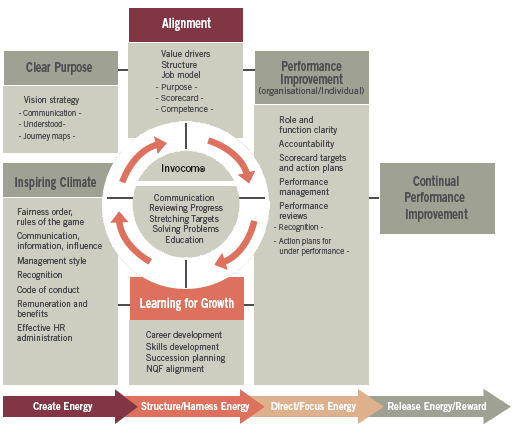
As part of the Kambuku process, an organisational performance model was developed. Known as ‘the vital elements of a performing organisation’, this model sets the benchmark for the internal standards, systems and processes that facilitate employee engagement and participation. |
| |
- Learning for growth - |
- A culture of improving knowledge and skills - |
Recognising that the future growth and success of the company are inextricably linked to its ability to grow and nurture the requisite skills, PPC has introduced a sixth vital element to the ‘vital elements model’. Under the mantra, Learning for Growth, the company has introduced individual development plans, workplace skills plans, an operations academy, an academy for sales & marketing, and other training-related activities and programmes. |
| |
- Kambuku enrichment - |
- Enriching Kambuku through empowerment, transformation and learning - |
As PPC moves forward in pursuit of the 2010 vision to Go for Gold, the Kambuku Enrichment programme has been introduced, primarily to enhance the existing Kambuku process by identifying gaps in the business and highlighting opportunities for improvement. Among the opportunities that form an integral part of the Kambuku Enrichment initiative are empowerment, transformation and a broad-based skills development programme.
The Kambuku Enrichment programme was launched across all sites within PPC, and reinforced through multi-media presentations, road shows and other internal communication methods, to secure understanding, generate excitement and buy-in, and commence implementation.
“It is important to note that this is not a new initiative: we are building on the foundation that we have already created and will continue to reinforce our Kambuku principles, embrace transformation, create value, drive productivity, and focus on the actions we need to take to create a better life for all.” |
| Orrie Fenn, chief operating officer |
- Coaching and mentoring - |
- Empowering tomorrow’s leaders, today - |
As part of PPC’s efforts to improve and sustain superior business results, the company has introduced a multi-level coaching and mentoring initiative, the coaching advance performance (CAP) programme. Over the past year PPC has revised and introduced the CAP programme as a broad-based skill to the PPC management team. As a point of reference, coaching refers to the transfer of operational theory and core skills into practice; mentoring refers to the transfer of leadership skills, knowledge and attributes. |
| |
- Individual perception monitor (IPM) - |
- Listening, learning and continually improving - |
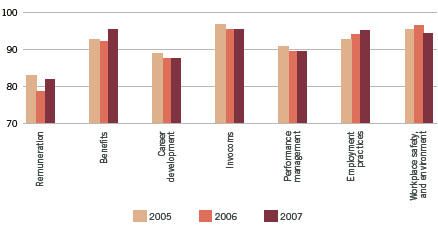
For the past six years, PPC’s annual IPM survey has given all employees the opportunity to express their views and rate the organisation on critical processes, including understanding the PPC vision, employee benefits, leadership behaviour, remuneration, training, coaching and communication. Participation in the survey is confidential. Importantly, the results of the survey are analysed by each site and by management on a centralised basis, with the purpose of identifying and addressing areas of concern and reinforcing positive trends. |
| |
| The vital elements of a performing organisation |
|
|
|
| |
 |
| |
| |
PPC-Total % positive results
(IPM survey) |
|
 |
|
|
|
| |
|