Investing in
communities and
sustainable upliftment projects |
| |
|
|
 |
| |
CASE STUDY |
- Cement plays crucial part in Bulembo Road face lift - |
More than 3 600 tons of PPC Surebuild cement will be used to give one of South Africa’s most scenic roads a face lift. Construction has started on the R134 million project to upgrade and tar the 28km Bulembo Road in Mpumalanga, linking Barberton with Swaziland.
Barberton-based company Above Average Investments Corporation will supply 3 265 tons of PPC’s 32.5R Surebuild cement over the next 18 months to the project’s main contractor, Africscan Construction. The agreement forms part of the Bulembo Road tender requirements to award 25% of the contract value to enterprises representing the local community.
Formerly a dirt road, a large percentage of the cement will be used to stabilise and provide strength to the road. The remainder of the cement will be used in project-related civil works such as bridge work, water drainage and road barriers.
Apart from short-term jobs created as part of the construction project, the upgrade is expected to have a significant impact on the local economy by bringing new tourism and business opportunities to the Barberton area.
Once completed the road linking Barberton in Mpumalanga to the Bulembo border post in Swaziland will form part of the shortest route from Nelspruit to KwaZulu-Natal and from KwaZulu-Natal to the Kruger National Park.
Winding through several valleys the upgraded mountainous road will provide tourists with safe and comfortable access to the breathtaking views of the Lomati and Mlumati valley as well as the south-western section of Songimvelo.
The Bulembo Road upgrade forms part of a regional investment of more than R300 million which includes the upgrade of the R40 from Nelspruit to Barberton.
Getaway magazine selected the Bulembo Road as one of the top 10 most scenic routes in South Africa.
Completion of the Bulembo Road project is expected in January 2009. |
| |
- About Above Average Investments - |
Above Average Investments Corporation is a business enterprise aimed at stimulating growth within the building and civil construction sector. |
|
| |
CASE STUDY |
- The Time for Change bakers - |
“Words fail to express how much this bakery has changed the lives of these street children and sex workers. PPC’s donation has provided them not only with dignity but with a reason to live.” Barbara Hill, centre manager, Time for Change |
| |
- PPC’s support enables Time for Change to care for the most vulnerable members of society - |
In line with its policy of investing in CSI projects that empower people with the means to be self-sustaining, PPC has partnered with the street child centre, Time for Change, to establish a commercially viable bakery. This project provides street children and commercial sex workers with a sustainable alternative to life on the street |
| |
- Establishing a business case - |
In the quest for sustainability, PPC’s vision is to help traditional CSI projects migrate over time into SMME initiatives and for this reason the company emphasises the importance of a strong business case in many of its CSI interventions. Realising that the commercial success of the Time for Change bakery lay in a sound business foundation, PPC enlisted the assistance of the Small Enterprise Development Agency (SEDA) to conduct relevant market research and impart the knowledge and skills required to set up a successful small enterprise. SEDA addressed issues such as target markets, product testing, pricing, cash flow and customer relations, enabling Time for Change to formulate a full business plan and funding proposal for the project.
Following SEDA’s conclusion that proper training, capacity building and support from partners would ensure the success of the Time for Change bakery, PPC purchased industrial bakery equipment to kick-start production. The quality of the bakery’s products is all-important and will ensure its commercial viability. Its initial customers include other children’s homes and NPOs in the inner city and it has already been approached by shops and supermarkets in the city who are interested in purchasing the bakery’s products. |
| |
- Multiple benefits - |
A total of 22 street children from the Time for Change centre are employed on a shift basis at the bakery, giving them the incentive they need to stay off the streets. But the project’s benefits extend beyond these individuals. Other youngsters at the centre are involved in small arts and crafts projects that include dressmaking, jewellery-making and fine art, but without the funds to purchase raw materials and the access to markets where they can sell their goods, these small enterprises have not generated enough income to be sustainable.
The commercial success of the bakery has offered a lifeline to these other grassroots businesses, providing them with the much-needed capital to ensure their profitability. Beverage company, SAB, has donated sewing machines for the dress-making business and PPC will partner with various experts to provide training and skills development to these budding entrepreneurs. The company also plans to host quarterly market days that will provide Time for Change residents with the opportunity to sell their goods to PPC staff. |
|
|
|
“Ntsika Fund focuses primarily on developing
black
qualifying small enterprises.” |
|
 |
| |
| |
- Dinaledi bursaries - |
 |
Building the educational capacity of black communities |
|
PPC believes that strengthening the educational capacity of previously disadvantaged communities is the key for sustainable development. By investing in and supporting a variety of education programmes the company intends to facilitate the empowerment of young people, thereby enabling them to participate in economic activity.
This year PPC supported nine Dinaledi bursars selected from disadvantaged communities throughout South Africa to study at various universities.
Nine further community bursars, currently in their final school year, were interviewed and selected for the programme during 2007 to increase the number of bursars to 18 in 2008 to the total value of just over R1 million. |
| |
- Investing in and developing black businesses - |
|
The challenges facing small businesses |
|
The enterprise development component of the Department of Trade and Industry’s Codes of Good Practice for BBBEE aims to address certain key challenges facing black small and micro enterprises. These enterprises struggle to grow their businesses into bigger and more sustainable enterprises and often fail due to a lack of access to funding and a lack of business acumen, training and experience. |
| |
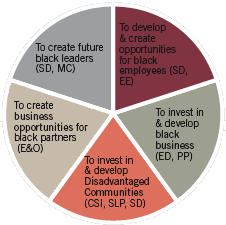
Fundamentals of the group’s transformation strategy |
| |
 |
| |
| MC – Management control |
SD – Skills development |
| E&O – Equity and ownership |
EE – Employment equity |
| ED – Enterprise development |
CSI – Corporate social investment |
| PP – Preferential procurement |
SLP – Social and labour plan |
|
|
 |
|
| |
|
Sponsored assistance |
|
In response to these challenges, PPC sponsored several training programmes for construction groups, including workshops on practical building skills, leadership development and concrete technology for Women for Housing (WFH). The company also sponsored a tendering, pricing and costing module for members of the National African Federation for the Building Industry (NAFBI).
PPC also sponsored an international conference for South African Women in Construction (SAWiC) as well as an advertorial for the National African Black Contractors and Allied Trades Forum (NABCAT) annual report. |
| |
|
New company to drive enterprise development |
|
PPC has established a new company to manage its enterprise development initiatives. This company, wholly owned by PPC, will trade under the name of “PPC Ntsika Fund (Pty) Limited”. The fund will focus primarily on developing black qualifying small enterprises (QSE’s) and exempted micro enterprises (EME’s) which are strategic to PPC. The underlying philosophy of the fund will be to establish solid partnerships with these businesses and grow them to reach and maintain operational and financial independence.
“Ntsika” is an Nguni word meaning pillar and is commonly used to refer to a ‘pillar of strength’. The term is also used to describe people or objects that one regards as the strongest source of support and inspiration.
In order to meet the challenges faced by small enterprises, the fund will invest in and develop small and micro black enterprises and entrepreneurs. PPC will maximise the compliance target of 3% of net profit after taxation for enterprise development. This will be achieved by developing QSE and EME strategic enterprises and supplying capital (equity and loans), sharing risk and building their capacity in terms of the provision of professional services and training.
The fund is governed by a board of directors consisting of a chairperson, a managing director and two PPC directors. |
| |
 |
| |
- Growth and transformation through preferential procurement - |
PPC has acted upon the recently gazetted “Codes of Good Practice on Broad-Based Black Economic Empowerment” which has not only brought the much-needed clarity but also provided the framework in which the transformation imperative can be realised.
The company’s preferential procurement strategy has been aligned to the requirements of the BBBEE scorecard, which allows for the measurement and support of BEE suppliers. In addition thereto, PPC has embarked on an educational drive by means of supplier information sessions to increase the awareness and requirements on the supply base.
For 2007, a preferential procurement target of R700 million with BEE suppliers had been set. This target was achieved by spending in excess of R900 million, a substantial increase of 48% from last year. |
| |
- Investing in and developing disadvantaged communities - |
- Facilitating growth and transformation - |
As a committed corporate citizen, PPC embraces the principles of corporate social responsibility (CSR) and corporate social investment (CSI). PPC made progress in finalising the group CSI policy which upholds the socio-economic tenets of the Mining Charter and the BBBEE scorecard. CSR addresses the overall response to economic, social and environmental consideration. CSI addresses the contribution to the communities in which PPC operates and sources labour. |
| |
- CSI spend - |
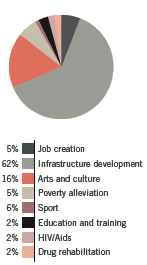
The company has concentrated its efforts on empowering communities through skills development and training in order to build sustainable projects and achieve a better life for all.
Through the CSI initiatives, PPC is making a significant contribution to the lives of thousands of needy South Africans, particularly children.
PPC spent R10 million in support of various projects across the country.
As in previous years, preference was given to projects and initiatives that promote: |
- Education and training;
- Health and welfare;
- Infrastructure development;
- Poverty alleviation;
- Sport; and
- Job creation.
|
|
|
CSI spend distribution
(%) |
|
| |
 |
|
|
| |
- Social and labour plans implementation - |
PPC made progress in the implementation of the local economic development projects of the five year social and labour plans (SLP). These SLP projects have been included into the local municipalities’ integrated development plans. Interaction forums are in place at all sites to consult with municipalities on the implementation of these projects. Some of the projects implemented: |
- PPC spent R400 000 on the upgrading and renovations of Danielskuil school, Lime Acres Primary School and Lime Acres Library in the Lime Acres community. A further R50 000 was spent on community ABET training.
- Over R200 000 was spent on the renovations of Motsaalore Primary School, the installation of water and electricity at Onkgopotse Tiro High School and various other community upliftment projects at Slurry.
- The company is involved with the Beestekraal community, the municipality and the Department of Education to build a school at Ramokoka village and has already spent R100 000 for the foundation phase.
- PPC continues to be involved with sponsoring the beach clean up campaign in the Port Elizabeth area in order to ensure a clean environment.
- PPC spent R85 000 on equipment for a computer centre at the Riebeeck West Primary School in the Western Cape and the planning phase of the crèche expansion.
|
|
|
|
| |
|