
- Home
- Highlights
- Overview and History
- Technology and Innovation
- Chairman’s Report
- Chief Executive Officer’s Report
- Drilling Services
- Drilling Products
- Regional Overview
- Our Core Values
- Board of Directors
- Executive Leadership Team
- Financial Report

- Directors' Report
- Independent Auditor's Report
- Directors' Declaration
- Financial Statements
- Supplementary Information
- Corporate Information
- Downloads
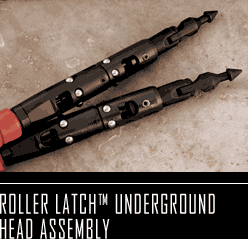
The patent-pending Roller Latch™ technology in this head assembly minimises wear on related components and improves reliability by eliminating adapter couplings and drive keys. This head assembly also includes a unique, patent-pending 'holdback brake' feature to retain inner tube assemblies in the drill string for safer operations when working in up-holes.
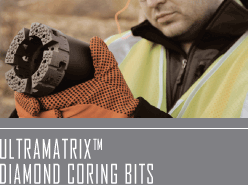
Patented Ultramatrix™ diamond coring bits are engineered to drill faster, last longer, and outperform existing bit technology in a wide range of drilling conditions and formations. The extended range and versatility reduces the number of bits needed on the job site, and drillers can expect increased productivity throughout the entire operation. This means less time spent tripping rods, and ultimately, more core in the box.
At Boart Longyear, innovation is about leveraging the strength and speed of our Global Products team working in close collaboration with our Global Drilling Services division. We deliver solutions that address the needs and challenges faced in the field. This sharing of field data, needs, safety requirements, best practices, and our global engineering presence results in a speed of driving innovation that increases safety and productivity in the field.
This integrated business model is the Boart Longyear advantage. We are proud to be the only drilling company participating in the Deep Exploration Technologies Cooperative Research Centre that was launched in Australia during 2010. This AUD$112 million project will develop and deliver technologies that result in more productive and safer ways to drill, analyse and target deep mineral deposits.
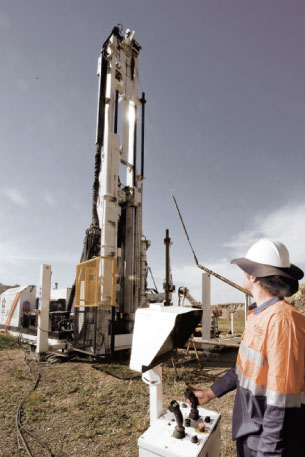

The SC9 introduces a new approach to surface exploration drills. Featuring a completely hands-free rod management system and technology that allows self monitoring and efficient rig operation, the SC9 is set to become the standard for fully automated exploration drilling.
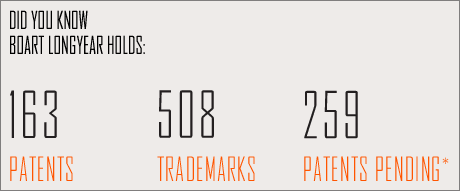
* The number of pending patent applications may not result in a corresponding number of issued patents. Applications may be rejected by the Patent Office, abandoned for business reasons or affected by other factors which would prevent us from obtaining patents.