Our company celebrated its 40th anniversary in 2005. Three themes characterized this milestone year:
- Dramatic growth
- Disciplined investment in manufacturing capacity and process capabilities
to meet current and emerging customer requirements
- Further strengthening of our position as the disk drive industry’s preferred supplier of suspension assemblies for disk drives
Growth: Strong Shipments and Record Revenues
The pace of growth in 2005 was extraordinary. Based on historical patterns, the suspension assembly market experienced about two years of volume growth in
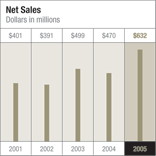
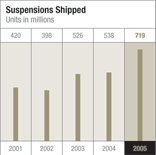
a single year. Our 2005 suspension assembly shipments grew by 34% compared with the prior year. Unit shipments totaled approximately 719 million and generated record net sales of $632 million.
Our growth in 2005 resulted from several factors. First, disk drive shipments in
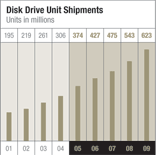
calendar 2005 have grown more than industry sources initially expected. For the year, disk drive shipments are expected to reach 374 million units, an increase of about 22% from 2004 and well ahead of the 13% growth initially forecasted for the year. The growth is resulting from increased demand for data storage in traditional computing applications as well as in consumer electronics applications.
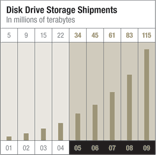
Second, demand for data storage is outpacing the rate of improvement in data density for disk drives in mass production. The rate of data density improvement in calendar 2005 is expected to remain about flat with the prior year at approximately 20%.
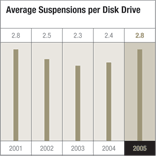
As a result, achieving the higher storage capacities necessary for many disk drive applications required using both sides of a single disk in a disk drive or adding disks. This caused the number of suspension assemblies consumed per disk drive to increase from an average of about 2.4 in 2004 to 2.8 in 2005, according to our estimates.
Third, our unit volumes in 2005 benefited from our share positions on types of disk drives in particularly high demand. These included higher capacity disk drives for computing applications such as near-line storage, as well as consumer electronics applications such as personal video recorders.
Our record 2005 net sales benefited from the increased suspension assembly shipments and slightly higher average selling prices. The average-selling-price increase reflects a 2005 product mix richer in suspension assemblies requiring advanced process capabilities to produce value-added features that help our customers achieve particular performance attributes.
We expect disk drives will remain the dominant data storage technology
for the foreseeable future because of the cost and performance advantages they offer over alternatives and the steady improvement in these advantages that the industry historically delivers. For calendar 2006, industry sources
are currently forecasting disk drive unit shipments of about 427 million, up 14% compared with 2005. The projected unit growth reflects continued use of disk drives across a broad range of storage applications in both business and consumer markets. We expect worldwide demand for suspension
assemblies should increase at a rate at least equal to the rate of growth in disk drive unit shipments.
Investment Focus: Innovation, Capacity and Process Capability
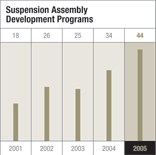
In 2005, we continued to invest in developing advanced processes to produce new suspension assembly designs and features. Our process capabilities, combined with close collaboration with our customers in the early stages of new disk drive programs, enable us to develop product features that help meet performance criteria for specific disk drive applications, increase data density and improve efficiencies and yields in customers’ automated manufacturing processes. Generally, we are strongly positioned on customer programs that incorporate leading-edge head and suspension technologies. In these situations, our proficiency in the required scientific, engineering and manufacturing disciplines and the integrated design, development, manufacturing and global service capabilities we bring are very highly valued.
We strive to be designed in first on customers’ new disk drive programs and to earn preferred supplier status on programs transitioning to volume production. To attain preferred supplier status, we must be able to manufacture our products reliably, at high volume and competitive cost, with extremely low part-to-part variation.
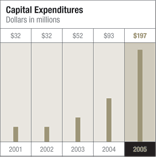
Because of the high demand we experienced in 2005, and the industry outlook for future disk drive volume, we have been expanding our manufacturing capacity. Our equipment capacity at the end of 2005 was approximately 20% higher than at the end of 2004. We currently expect to increase equipment capacity by an additional 25% to 30% by the end of 2006.
While adding capacity, we are also investing in new process technology and equipment. These process and equipment investments are required to enable further increases in miniaturization and precision as the disk drive industry migrates toward smaller form factors and read/write heads in a constant push for increased data density.
The further miniaturization of disk drives requires miniaturizing suspension assemblies and, in particular, requires the electrical conductors on our
suspension assemblies to be thinner and spaced closer together. We are enhancing our current “subtractive” process, which involves precision etching, to enable production of finer conductors.
By the end of 2006, we also expect to be producing “TSA+” prototype suspensions that use an additive process to produce still finer electrical conductors. Our ability to extend our current process to accommodate further conductor miniaturization and the rate at which our customers adopt smaller next-
generation read/write heads will largely determine the pace of transition to an additive process and the volume of products manufactured using this process.
Competitive Position: Strengthening Our Lead
It is fitting that our 40th anniversary year provided in microcosm the variety of challenges we have faced throughout our history. Those challenges included volatility in volume, escalating technical requirements and the need to navigate transitions in suspension assembly production.
In the face of these challenges and many more, we have built an industry-leading market and competitive position. Today, we derive our competitive strength primarily from four core competencies:
First, we are proven experts at integrating multiple scientific, engineering
and manufacturing disciplines to deliver compelling solutions for customers’ product performance challenges. Second, we strive to operate at levels of volume, quality, efficiency and reliability that our competitors cannot match. Third, we stay very close to our customers through our sales and marketing efforts, the inventory hubs we locate near our customers’ plants, and the design, engineering and service resources we continue to add in Asia so that we can respond quickly to customers’ needs. Finally, underlying our technical proficiency, focus on operating excellence and attentiveness to our customers is a pervasive, persistent, company-wide emphasis on continuously improving quality and performance and on driving innovation to benefit our customers.
In our BioMeasurement Division, we are leveraging these same core competencies in the further development of our InSpectra™ Tissue Spectrometer. We continue our work with medical researchers to demonstrate the clinical utility and economic value of StO2 (tissue oxygen saturation) as measured by our InSpectra System. In addition, during 2005, a total of 15 independent clinical studies using the InSpectra System were completed in the United States
and Europe. Results from a majority of these studies indicate the expanding potential of this new metric to more directly monitor the compromised circulation associated with various forms of shock. As these studies are reported at key trauma and critical care conferences on both sides of the Atlantic, the clinical community’s interest in this new technology is greatly increasing.
In the latter part of calendar 2006, we expect interim findings from a multi-site clinical study to be presented to trauma specialists. We also plan to introduce a second-generation version of our InSpectra System to the trauma and hemorrhagic shock markets and will continue to explore additional clinical uses for sepsis and other conditions.
We commend our people for rising to the volume and technology challenges we faced in 2005. We start the new fiscal year confident in our ability to
further strengthen our leadership position by serving our customers with integrated expertise and deep commitment to their interests that we believe
is unmatched in the industry.
Wayne M. Fortun
President and
Chief Executive Officer
John A. Ingleman
Vice President and
Chief Financial Officer
|