| | LIQUIDITY
AND CAPITAL RESOURCES Capital Commitments The
following table summarizes our capital commitments and contractual obligations
as of December 31, 2005, including long-term debt, operating lease payments, and
office lease payments, as well as the future periods in which such payments are
currently anticipated to become due: 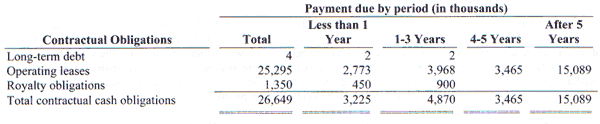
Additional
information regarding our capital commitments and contractual obligations, including
royalty payments, is contained in Notes 7, 8, and 12 of the Notes to our consolidated
financial statements, set forth in Item 8. Our working
capital for 2005, 2004, and 2003 was $43.7 million, $54.9 million, and $56.9 million,
respectively. The decrease in working capital for 2005 and 2004 over the comparable
periods of 2004 and 2003, respectively, was primarily the result of cash being
used to fund the construction of our new facilities in South Jordan, Utah, and
Galway, Ireland; the purchase and remodel of our facility in Chester, Virginia;
and the acquisitions of MCTec, MedSource and Sub-Q. The increases in working capital
for 2003 over 2002 was primarily due to an increase in our cash balance of $20.5
million in 2003 and $9.3 million in 2002. As of December 31, 2005, we had a current
ratio of 3.1 to 1. We had $0 outstanding under our line of credit at December
31, 2005. We assumed some capital leases with the purchase of the MedSource assets,
with an outstanding balance of approximately $4,000 at December 31, 2005. We generated
cash from operations for 2005, 2004, and 2003 in the amount of $11.2 million,
$26.5 million, and $25.2 million respectively. We maintain a long-term revolving
credit facility (the “Facility”) with a bank, which currently enables us to borrow
funds at variable interest rates. The Facility was voluntarily reduced to $500,000
in August 2002. The Facility expires on June 30, 2006. We are currently in discussions
with a different bank for a line of credit for $30 million, subject to a favorable
credit review. Historically, we have incurred significant
expenses in connection with product development and introduction of new products.
Substantial capital has also been required to finance the increase in our receivables
and inventories associated with our increased sales. During 2005, we paid approximately
$14.6 million for payments to complete the construction of our new MTL building
and cafeteria expansion in South Jordan, Utah. In addition, during 2005, we spent,
approximately $4.7 million to purchase a 102,000 square foot facility and add
a clean room in Chester, Virginia, and $1.5 million to purchase seven acres of
land just west of our current South Jordan, Utah facilities. Also during 2005,
significant investments were made for new equipment including approximately $1.8
million in molding equipment, approximately $3.4 million for an automated warehouse
shipping system, and approximately $2 million for automated production equipment.
Our principal source of funding for these and other expenses has been cash generated
from operations, sales of equity, cash from loans on equipment, and bank lines
of credit. We currently believe that our present sources of liquidity and capital
are adequate for current operations and for the foreseeable future. Critical
Accounting Policies and Estimates The SEC has requested
that all registrants address their most critical accounting policies. The SEC
has indicated that a “critical accounting policy” is one which is both important
to the representation of the registrant’s financial condition and results and
requires management’s most difficult, subjective or complex judgments, often as
a result of the need to make estimates about the effect of matters that are inherently
uncertain. We base our estimates on past experience and on various other assumptions
our management believes to be reasonable under the circumstances, the results
of which form the basis for making judgments about carrying values of assets and
liabilities that are not readily apparent from other sources. Actual results will
differ, and may differ materially from these estimates under different assumptions
or conditions. Additionally, changes in accounting estimates could occur in the
future from period to period. Our | |

