management
has discussed the development, and selection of our most critical financial estimates
with the audit committee of our Board of Directors. The following paragraphs identify
our most critical accounting policies: Inventory
Obsolescence Reserve: Our management reviews on a regular basis inventory
quantities on hand for unmarketable and/or slow moving products that may expire
prior to being sold. This review of inventory quantities for unmarketable and/or
slow moving products is based on estimates of forecasted product demand prior
to expiration lives. If market conditions become less favorable than those projected
by our management, additional inventory write-downs may be required. We believe
that the amount included in our obsolescence reserve has been an historically
accurate estimate of the unmarketable and/or slow moving products that may expire
prior to being sold. Our obsolescence reserve was approximately $1.7 million as
of December 31, 2005. Allowance
for Doubtful Accounts: A majority of our receivables are with hospitals,
which over our history, have demonstrated favorable collection rates. Therefore,
we have experienced relatively minimal bad debts from hospital customers. In limited
circumstances we have written off minimal bad debts as the result of the termination
of foreign distributors. The most significant write-offs over our history have
come from U.S. packers who bundle our products in surgical trays. We
maintain allowances for doubtful accounts for estimated losses resulting from
the inability of our customers to make required payments. The allowance is based
upon historical experience and a review of individual customer balances. If the
financial condition of our customers were to deteriorate, resulting in an impairment
of their ability to make payments, additional allowances may be required. Our
bad debt reserve was $758,663 at December 31, 2005, which is in line with historical
collection experience. Stock-Based Compensation:
We account for our stock compensation arrangements under the provisions of Accounting
Principles Board Opinion No. 25, Accounting for Stock Issued to Employees,
(“APB 25”). Accordingly, no compensation cost has been recognized for our stock
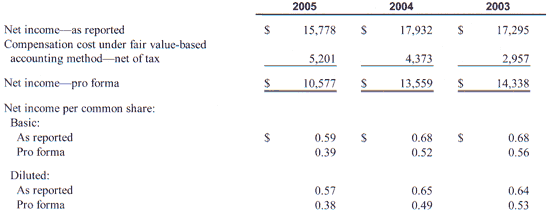
compensation arrangements. If the compensation cost for our compensation plans
had been determined consistent with Statement of Financial Accounting Standards
(“SFAS”) No. 123, Accounting for Stock-Based Compensation, our net income
and net income per common and common share equivalent would have changed to the
pro forma amounts indicated below (in thousands except per share data) :
 In
applying the Black-Scholes methodology to the option grants, we used the following
assumptions:
 For
options with a vesting period, compensation expense is recognized on a ratable
basis over the service period which corresponds to the vesting period. Compensation
expense is recognized immediately for options that are fully vested | 
