|
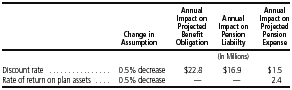
The following
chart reflects the annual impact of
a 0.5% decrease in certain assumptions.
If the discount rate increased by 0.5%,
the impact would be a similar amount
in the opposite direction.
We recorded
pension expense of $5.8 million in 2002
and pension income of $4.0 million in
2001. The $9.8 million increase is due
primarily to lower returns on plan assets
and an early retirement window that
was offered in 2001 and 2002. In 2003
we expect to record approximately $1.8
million of pension income.
Pension plan
assets are primarily made up of equity
and fixed income investments. The market
value of the plan assets has been affected
by declines in equity markets. At December
31, 2002, the fair value of pension
plan assets was $382.3 million. Actual
return on plan assets declined by approximately
$2.1 million during 2001 and by approximately
$58.5 million during 2002. Absent a
substantial recovery in the equity markets,
pension costs, cash funding requirements
and the additional pension liability
could substantially increase in future
years.
See Note
15 of the Notes to Consolidated Financials
Statements, “Employee Benefit Plans,”
for additional information.
Revenue Recognition
Energy
Sales
Energy sales
are recognized as delivered and include
an estimate for energy delivered but
unbilled at the end of each year. Power
marketing activities are accounted for
under the mark-to-market method of accounting.
Under this method, changes in the portfolio
value are recognized as gains or losses
in the period of change. The net mark-to-market
change is included in energy sales in
our consolidated statements of income.
The resulting unrealized gains and losses
are recorded as energy trading assets
and liabilities on our consolidated
balance sheets.
We primarily
use quoted market prices to value our
power marketing and energy trading contracts.
When market prices are not readily available
or determinable, we use alternative
approaches, such as model pricing. The
market prices used to value these transactions
reflect our best estimate of fair values
considering various factors, including
closing exchange and over-the-counter
quotations, time value and volatility
factors underlying the commitments.
Results actually achieved from these
activities could vary materially from
intended results and could unfavorably
affect our financial results.
Monitored
Services Revenues
Monitored
services revenues are recognized when security services are provided.
System installation revenues, sales revenues on equipment upgrades
and direct and incremental costs of installations and sales are
deferred for residential customers with monitoring service contracts.
For commercial customers, revenue recognition is dependent upon
each
|
|
specific customer contract. In instances
when the company passes title to a system unaccompanied by a service
agreement or the company passes title at a price that it believes
is unaffected by an accompanying but undelivered service, the company
recognizes revenues and costs in the period incurred. In cases where
the company retains title to the system or it prices the system
lower than it otherwise would because of an accompanying service
agreement, the company defers and amortizes revenues and direct
costs.
Deferred system
and upgrade installation revenues are
recognized over the expected life of
the customer utilizing an accelerated
method for residential and commercial
customers and a straight-line method
for Protection One’s Multifamily customers.
Deferred costs in excess of deferred
revenue are recognized over the initial
contract term, utilizing a straight-line
method, typically two to three years
for residential systems, five years
for commercial systems and five to ten
years for Multifamily systems. To the
extent deferred costs are less than
deferred revenues, such costs are recognized
over the estimated life of the customer
relationship.
Deferred revenues
also result from customers who are billed
for monitoring and extended service
protection in advance of the period
in which such services are provided,
on a monthly, quarterly or annual basis.
Revenues from monitoring activities
are recognized in the period such services
are provided.
Cumulative Effects
of Accounting Changes
Accounting
for Goodwill and for the Impairment
and Disposal
of Long-Lived Assets
Effective January
1, 2002, we adopted SFAS No. 142 and
SFAS No. 144. SFAS No. 142 established
new standards for accounting for goodwill.
SFAS No. 142 continues to require the
recognition of goodwill as an asset,
but discontinued amortization of goodwill.
In addition, annual impairment tests
must be performed using a fairvalue
based approach as opposed to an undiscounted
cash flow approach required under prior
standards.
SFAS No. 144 established
a new approach to determining whether
our customer account asset is impaired.
The approach no longer permits us to
evaluate our customer account asset
for impairment based on the net undiscounted
cash flow stream obtained over the remaining
life of goodwill associated with the
customer accounts being evaluated. Rather,
the cash flow stream used under SFAS
No. 144 is limited to future estimated
undiscounted cash flows from assets
in the asset group, which include customer
accounts, the primary asset of the reporting
unit, plus an estimated amount for the
sale of the remaining assets within
the asset group (including goodwill).
If the undiscounted cash flow stream
from the asset group is less than the
combined book value of the asset group,
then we are required to mark the customer
account asset down to fair value, by
way of recording an impairment, to the
extent fair value is less than our book
value. To the extent net book value
is less than fair value, no impairment
would be recorded.
To implement the new standards, an independent
appraisal firm was engaged to help management estimate the fair
values of Protection One’s and Protection One Europe’s goodwill
and customer accounts. Based on this analysis, we recorded a charge
in the first quarter of 2002 of approximately $749.3 million (net
of tax benefit and minority interests), of which $555.6 million
was related to goodwill and $193.9 million was related to customer
accounts.
|


