Accounting
for Derivative Instruments and
Hedging Activities
Effective January 1, 2001, we adopted SFAS
No. 133. We use derivative instruments
(primarily swaps, options and futures)
to manage interest rate exposure and
the commodity price risk inherent in
some of our fossil fuel and electricity
purchases and sales. Under SFAS No.
133, all derivative instruments, including
our energy trading contracts, are recorded
on our consolidated balance sheet as
either an asset or liability measured
at fair value. Changes in a derivative’s
fair value must be recognized currently
in earnings unless specific hedge accounting
criteria are met, in which case changes
are reflected in other comprehensive
income. Cash flows from derivative instruments
are presented in net cash flows from
operating activities.
Derivative instruments used to manage commodity
price risk inherent in fossil fuel and
electricity purchases and sales are
classified as energy trading contracts
on our consolidated balance sheets.
Energy trading contracts representing
unrealized gain positions are reported
as assets; energy trading contracts
representing unrealized loss positions
are reported as liabilities.
Prior to January 1, 2001, gains and losses
on our derivatives used for managing
commodity price risk were deferred until
settlement. These derivatives were not
designated as hedges under SFAS No.
133. Accordingly, on January 1, 2001,
we recognized an unrealized gain of
$18.7 million, net of $12.3 million
of tax. This gain is presented on our
consolidated statement of income in
2001 as a cumulative effect of a change
in accounting principle.
After January 1, 2001, changes in fair
value of all derivative instruments
used for managing commodity price risk
that are not designated as hedges are
recognized in revenue as discussed above
under “— Revenue Recognition — Energy
Sales.” Accounting for derivatives under
SFAS No. 133 will increase volatility
of our future earnings.
Revenue
Recognition
In the fourth quarter of 2000, we adopted
Staff Accounting Bulletin (SAB) No.
101, “Revenue Recognition,” which had
a retroactive effective date of January
1, 2000. The impact of this accounting
change generally required deferral of
certain monitored security services
sales for installation revenues and
direct sales-related expenses. Deferral
of these revenues and costs is generally
necessary when installation revenues
have been received and a monitoring
contract to provide future service is
obtained.
The cumulative effect of this change in
accounting principle was a charge to
income in 2000 of approximately $3.8
million, net of $1.1 million tax benefit,
and is related to changes in revenue
recognition at Protection One Europe.
Prior to the adoption of SAB No. 101,
Protection One Europe recognized installation
revenues and related expenses upon completion
of the installation.
|
|
Accounting Changes
Accounting
for Energy Trading Contracts
In October 2002,
the Financial Accounting Standards Board
(FASB), through the Emerging Issues
Task Force (EITF), issued Issue No.
02-03, which rescinded Issue No. 98-10,
“Accounting for Contracts Involved in
Energy Trading and Risk Management Activities.”
As a result, all new contracts that
would otherwise have been accounted
for under Issue No. 98-10 and that do
not fall within the scope of SFAS No.
133 can no longer be marked-to-market
and recorded in earnings as of October
25, 2002. We are not affected by this
change in accounting principle and are
not required to reclassify any of our
contracts. EITF Issue No. 02-03 also
requires that energy trading contracts
and derivatives, whether settled financially
or physically, be reported in the income
statement on a net basis effective January
1, 2003. We began to classify our energy
trading contracts on a net basis during
the third quarter of 2002.
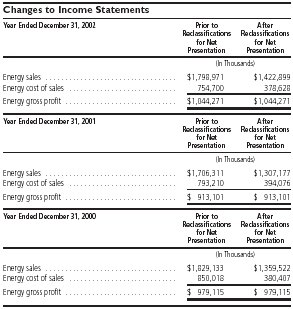
On July 1, 2002,
we began reporting mark-to-market gains
and losses on energy trading contracts
on a net basis, whether realized or
unrealized, in our consolidated income
statements. Prior to July 1, 2002, we
reported gains on these contracts in
sales and losses in cost of sales in
our consolidated income statements.
The changes are reflected in our consolidated
financial statements for the year ended
December 31, 2002. Prior periods shown
in our consolidated financial statements
have been reclassified to reflect the
effect of this change and to be comparable
as required by GAAP. As a result of
the net presentation, we expect significant
reductions in our energy revenues and
expenses from those reported in prior
periods, which will not affect gross
profit or net income. A summary of the
effects of this change for the years
ended December 31, 2002, 2001 and 2000
is as follows:
|


