|
investment. These earnings were reduced
by an $11.1 million write down in 2001
of the cost basis to the fair value
of certain securities held for investment
and other investments. Investment earnings
in 2000 included $45.3 million of ONEOK
investment income, a $91.1 million gain
from the sale of our investment in a
gas compression company, a $9.6 million
gain related to an investment and a
$24.9 million gain from the sale of
investments in paging companies.
WESTAR ENERGY CONSOLIDATED
The following discussion addresses changes
in other items affecting net income
for the years ended December 31, 2002,
2001 and 2000.
Interest Expense
2002
compared to 2001
Interest expense increased $8.5 million
due primarily to higher interest rates.
In 2002, we refinanced short-term debt
with long-term debt issued at interest
rates higher than the interest rate
on the short-term debt. The weighted
average interest rate on debt outstanding
increased to 6.34% at December 31, 2002
from 3.43% at December 31, 2001.
2001
compared to 2000
Interest expense decreased $20.7 million
due to lower interest rates and lower
outstanding debt at Protection One.
The weighted average interest rate on
our $500 million revolving credit facility
that was retired with proceeds from
the May 10, 2002 and June 6, 2002 debt
refinancings declined to 3.43% at December
31, 2001 from 8.11% at December 31,
2000.
Income Taxes
2002
compared to 2001
Income taxes decreased $89.3 million in
2002 compared to 2001. This was due
primarily to the increased loss before
income taxes and flow through tax benefits
associated with our security business.
Our overall effective tax rate changed
from a 64.0% benefit in 2001 to a 48.7%
benefit in 2002. The change in our effective
tax rate was due primarily to decreased
earnings before income taxes and flow
through tax benefits associated with
our security business, including minority
interest share of tax benefits and goodwill
impairment. Other flow through tax benefits
from dividends received, low income
housing tax credits, the amortization
of prior years’ investment tax credits,
tax reserve adjustment and the tax benefits
from corporate owned life insurance
contributed to this change in the effective
tax rate.
2001
compared to 2000
Income taxes decreased $140.7 million in
2001 compared to 2000. This was due
primarily to having a loss before income
taxes in 2001. Our overall effective
tax rate changed from a 33.9% expense
in 2000 to a 64.0% benefit in 2001.
The change in our effective tax rate
was due primarily to having a loss before
income taxes in 2001. The tax benefit
from having a loss, combined with flow
through net tax benefits from dividends
received, low income housing tax credits,
the amortization of prior years’ investment
tax credits, the amortization of non-deductible
goodwill, the effect of state income
taxes and the tax benefits from corporate
owned life insurance created this swing
in the effective tax rate.
|
|
LIQUIDITY AND CAPITAL
RESOURCES
Overview
We believe we
will have sufficient cash to fund future
operations of our business, debt reductions,
including the annual $100 million debt
reductions in 2003 and 2004 ordered
by the KCC, and the payment of dividends,
from a combination of cash on hand,
cash flow, proceeds from the sales of
our non-utility and non-core assets
and available borrowings under our revolving
credit facility. Uncertainties affecting
our ability to meet these requirements
include, among others, the factors affecting
sales described above, economic conditions,
including the impact of inflation on
operating expenses, regulatory actions,
including the KCC orders received in
the last quarter of 2002 and first quarter
of 2003, our ability to implement the
Debt Reduction Plan, compliance with
future environmental regulations and
the impact of our monitored services’
operations and financial condition.
As of December
31, 2002, our total outstanding long-term
debt was approximately $3.4 billion,
of which approximately $3.0 billion
was the obligation of our utility operations.
In addition, as of December 31, 2002,
our long-term liabilities included $214.5
million related to outstanding mandatorily
redeemable preferred securities. This
large amount of indebtedness could have
a negative impact on, among other things,
our ability to obtain additional financing
in the future for working capital, capital
expenditures and general corporate purposes
and our ability to withstand a downturn
in our business or the economy in general.
At December 31,
2002, current maturities of long-term
debt increased $148.8 million from 2001
due primarily to the upcoming maturities
of the Kansas Gas and Electric Company
(KGE) 7.6% first mortgage bonds that
are due December 15, 2003 and the putable/callable
notes due on August 15, 2003. We have
irrevocably deposited with the bond
trustee funds sufficient to provide
for the future principal and interest
payments on these 7.6% first mortgage
bonds.
Capital Resources
We had $123 million
in cash and cash equivalents at December
31, 2002. We consider cash equivalents
to be highly liquid investments with
a maturity of three months or less when
purchased. At December 31, 2002, we
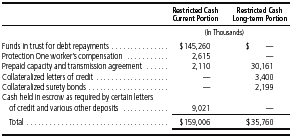
also had $159 million of restricted
cash classified as a current asset and
$35.8 million of restricted cash classified
as a long-term asset. The following
table details our restricted cash as
of December 31, 2002:
|


