|
Fossil
fuel: To supply a portion of
the fossil fuel requirements for our
generating plants, we have entered into
various commitments to obtain and deliver
coal and for natural gas transportation.
Some of these contracts contain provisions
for price escalation and minimum purchase
commitments. For additional information,
see Note 17 of the Notes to Consolidated
Financial Statements, “Commitments and
Contingencies — Fuel Commitments.”
Nuclear
fuel: To supply a portion of
the fuel requirements for Wolf Creek,
we have entered into various commitments
to obtain nuclear fuel consisting of
uranium concentrates, conversion and
enrichment. See Note 17 of the Notes
to Consolidated Financial Statements,
“Commitments and Contingencies — Fuel
Commitments,” for more details.
Call
option on putable/callable notes:
For information concerning a potential
liability under the call option related
to the issuance of $400 million of our
putable/callable notes, see Note 14
of the Notes to Consolidated Financial
Statements, “Call Option.”
Unconditional
purchase obligations: We use
purchase obligations as part of our
ongoing utility operations and construction
program. Protection One’s unconditional
purchase obligations represent its contract
tariff for telecommunication services.
See Note 17 of the Notes to Consolidated
Financial Statements, “Commitments and
Contingencies — Purchase Orders and
Contracts,” for additional information.
Commercial
Commitments
The following table summarizes our commercial
commitments by date of expiration existing at December 31, 2002:
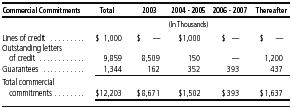
Lines
of credit: Certain banks provide
us a revolving credit facility on a
committed basis totaling $150 million.
As of December 31, 2002, borrowings
on the revolving credit facility were
$1.0 million, leaving $149 million remaining
under this facility. In addition, we
have a commitment to Protection One
for a line of credit of up to $228.4
million. As of March 14, 2003, Protection
One had borrowed $215.5 million under
this facility, resulting in an undrawn
commitment of $12.9 million. This commitment
is eliminated in consolidation and is
therefore not included in the table
above.
Outstanding
letters of credit: We obtain
letters of credit in the ordinary course
of our operating activities for energy
trading, worker’s compensation, an aircraft
lease and surety bonds. As of December
31, 2002, we had outstanding letters
of credit of $1.2 million related to
our power marketing and trading activities
and $8.7 million related to other operating
activities.
Guarantees:
In 1998, we issued a financial guarantee of an obligation of Onsite
Energy Corporation under which our maximum liability was $1.3 million.
This guarantee was released in the first quarter of 2003.
|
|
Debt Covenants
Our debt financing
agreements require, among other restrictions,
that we satisfy certain financial covenants.
These debt instruments contain restrictions
based on EBITDA. The definition of EBITDA
varies among the various indentures.
EBITDA is generally derived by adding
to income (loss) before income taxes,
the sum of interest expense and depreciation
and amortization expense. However, under
the varying definitions of the indentures,
additional adjustments are required.
A violation of these restrictions would
result in an event of default that would
allow the lenders to declare all amounts
outstanding immediately due and payable.
We are in compliance with these covenants.
The most restrictive of these covenants
in Westar Energy’s debt instruments
are as follows:
- Consolidated
Leverage Ratio: Consolidated
total debt to earnings before
interest, taxes, depreciation
and amortization (EBITDA) for
the most recent four consecutive
quarters must be less than 6.00
to 1.00 at December 31, 2002 and
5.75 to 1.00 each quarter thereafter
until June 2005. At December 31,
2002, our ratio was 5.13.
- Consolidated
Interest Coverage Ratio:
EBITDA to consolidated interest
expense for the most recent four
consecutive quarters must be greater
than 2.00 to 1.00. At December
31, 2002, our ratio was 2.54.
- Consolidated
Debt to Total Capital Ratio: Consolidated
total debt to consolidated total
capital for the most recent quarter
must be less than 0.65 to 1.00.
At December 31, 2002, our ratio
was 0.618.
The indentures
governing Protection One’s public indebtedness
require it to satisfy certain financial
covenants in order to borrow additional
funds. At December 31, 2002, Protection
One was in compliance with the covenants
under its debt instruments. The most
restrictive of these covenants in Protection
One’s debt instruments are as follows:
- Total
Debt to EBITDA Ratio: Total
debt to annualized EBITDA for
the most recent quarter must be
less than 6.0 to 1.0. For the
quarter ended December 31, 2002,
the ratio was 4.0 to 1.0.
- EBITDA
to Interest Expense Ratio:
EBITDA to interest expense for
the most recent quarter must be
greater than 2.25 to 1.0. For
the quarter ended December 31,
2002, the ratio was 3.1 to 1.0.
- Senior
Debt to EBITDA Ratio: Senior
debt to annualized EBITDA for
the most recent quarter must be
less than 4.0 to 1.0. For the
quarter ended December 31, 2002,
the ratio was 2.9 to 1.0.
The indentures
contain other covenants that impose
operational restrictions on Protection
One that are not as burdensome to Protection
One as those listed above, and none
are based on credit ratings. A violation
of the indenture covenants would result
in an event of default that would allow
the lenders to declare all amounts outstanding
immediately due and payable.
Following a change
of control of Protection One, its revolving
credit facility provided by Westar Industries
becomes due in full. The holders of
Protection One’s senior subordinated
discount notes and convertible notes
have an optional redemption at approximately
101% of par, and holders of Protection
One’s senior notes and senior subordinated
notes have an optional redemption at
101% of par if a change in control is
coupled with two ratings downgrades.
|


