Dividend Policy
Our board
of directors reviews our common stock
dividend policy from time to time. Among
the factors the board of directors considers
in determining dividend policy are earnings,
cash flows, capitalization ratios, regulation,
including the KCC’s order requiring
us to reduce our outstanding debt, competition
and financial loan covenants. In February
2003, we declared a first-quarter 2003
dividend of $0.19 per share. Our Articles
of Incorporation restrict the payment
of dividends or the making of other
distributions on our common stock while
any preferred shares remain outstanding
unless certain capitalization ratios
and other conditions are met. See Note
20 of the Notes to Consolidated Financial
Statements, “Common Stock, Preferred
Stock and Other Mandatorily Redeemable
Securities,” for a description of these
provisions. We do not expect these restrictions
to have an impact on our ability to
pay dividends on our common stock at
the current rate.
Debt Repurchase
Plans
Protection
One may, from time to time, purchase
its debt and equity securities in the
open market or through negotiated transactions.
We may also purchase our debt. The timing,
terms of such purchases and amount of
debt actually purchased will be determined
based on KCC orders, market conditions
and other factors.
Equity Issuance
Plans
We may, from
time to time, issue equity securities.
Credit Ratings
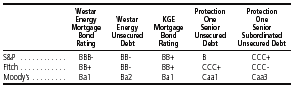
S&P, Moody’s
and Fitch Investors Service (Fitch)
are independent credit-rating agencies
that rate our debt securities. These
ratings indicate the agencies’ assessment
of our ability to pay interest and principal
on our securities.
On April
2, 2002, Moody’s downgraded its ratings
on Protection One’s outstanding securities
with the outlook remaining negative.
On April 29, 2002, Moody’s confirmed
our ratings with a negative outlook.
On January 29, 2003, Fitch revised our
and KGE’s Rating Watch status from evolving
to negative, but on March 11, 2003,
Fitch affirmed its ratings for us and
KGE and removed the ratings from Rating
Watch Negative. Following the filing
of the Debt Reduction Plan with the
KCC, S&P affirmed its ratings for us
and KGE and removed all ratings from
CreditWatch Negative, changing such
designation to CreditWatch Developing
on February 6, 2003.
As of March
14, 2003, ratings with these agencies
are as follows:
In general,
declines in our credit ratings make
debt financing more costly and more
difficult to obtain on terms that are
economically favorable to us. Westar
Energy and KGE do not have any credit
rating conditions in any of the agreements
under which our debt has been issued,
except for conditions in the agreements
governing the sale of our accounts receivable
discussed above.
|
|
OTHER
INFORMATION
Electric
Utility
Potential
Sale of Utility Assets
On October 14,
2002, we announced an agreement with
Midwest Energy, Inc. (Midwest Energy)
for the sale to Midwest Energy of a
portion of our transmission and distribution
assets and rights to provide service
to customers in an area of central Kansas.
The sale will affect about 10,000 customers,
or about 1.5% of our total customers,
over 895 square miles. The area, which
includes 42 towns, is on the west edge
of our service territory and is largely
surrounded by Midwest Energy’s existing
territory. The proposed sale is contingent
upon approval by the KCC and FERC. KCC
hearings have been scheduled to begin
on May 20, 2003. We can give no assurance
as to when or if this transaction will
occur. From time to time we may consider
similar transactions.
City
of Wichita Franchise
KGE’s franchise
with the City of Wichita to provide
retail electric service is effective
through December 1, 2003. We are currently
negotiating with the City of Wichita
for a long-term franchise agreement.
There can be no assurance that we can
successfully renegotiate the franchise
with terms similar, or as favorable,
as those in the current franchise. Under
Kansas law, KGE will continue to have
the right to serve the customers in
Wichita following the expiration of
the franchise. Customers within the
Wichita metropolitan area account for
approximately 21% of our total energy
sales volumes.
Network
Integration Transmission Service
Effective January
1, 2002, we began taking Network Integration
Transmission Service under the SPP’s
Open Access Transmission Tariff. This
provides a cost-effective way for us
to participate in a broader market of
generation resources with the possibility
of lower transmission costs. This tariff
provides for a zonal rate structure,
whereby transmission customers pay a
pro rata share, in the form of a reservation
charge, for the use of the facilities
for each transmission owner that serves
them. As a result, the SPP has operational
control over our transmission system,
although we still own our transmission
assets and maintain responsibility for
dispatching, maintenance and storm restoration.
Currently, all
revenues collected within a zone are
allocated back to the transmission owner
serving the zone. Since we are a transmission
provider for our zone and are currently
the only transmission customer taking
service from that zone, we are currently
being assessed 100% of the zonal costs
and receiving all of the costs back
as revenue, less servicing fees. In
2002, these network integration transmission
costs were approximately $65.9 million,
and the associated revenues were approximately
$60.1 million, for a net expense of
approximately $5.8 million. The revenues
received are reflected in electric operating
revenues, and the related charges are
expensed.
Stranded
Costs
Stranded
costs for a utility business are commitments or investments in,
and carrying costs on, property, plant and equipment, and other
regulatory assets that exceed the amount that can be recovered in
a competitive market. We currently apply accounting standards that
recognize the economic effects of rate regulation and record regulatory
assets and
|


