|
we expected to realize annual operating
cost savings of approximately $0.9 million. The cost savings will
be treated as a regulatory liability in accordance with a March
26, 2002, KCC order. For the year ended December 31, 2002, we recorded
$0.5 million in cost savings as a regulatory liability.
Protection
One Europe
On February
29, 2000, Westar Industries purchased
the European operations of Protection
One, and certain investments held by
a subsidiary of Protection One, for
an aggregate purchase price of $244
million. Westar Industries paid approximately
$183 million in cash and transferred
Protection One debt securities with
a market value of approximately $61
million to Protection One. Cash proceeds
from the transaction were used to reduce
the outstanding balance owed to Westar
Industries on Protection One’s revolving
credit facility. No gain or loss was
recorded on this intercompany transaction
and the net book value of the assets
was unaffected.
Hedging Activity
We use financial
and physical instruments to hedge a
portion of our anticipated fossil fuel
needs. At the time we enter into these
transactions, we are unable to determine
what the value will be when the agreements
are actually settled.
In an effort
to mitigate fuel commodity price market
risk, we use hedging arrangements to
reduce our exposure to increased coal,
natural gas and oil prices. Our future
exposure to changes in fossil fuel prices
will be dependent upon the market prices
and the extent and effectiveness of
any hedging arrangements into which
we enter.
See Note
6 of the Notes to Consolidated Financial
Statements, “Financial Instruments,
Energy Trading and Risk Management —
Derivative Instruments and Hedge Accounting
— Hedging Activities,” for detailed
information regarding hedging relationships
and an interest rate swap we entered
into during the third quarter of 2001.
ITEM 7A. QUANTITATIVE
AND QUALITATIVE DISCLOSURES
ABOUT MARKET RISK
Market Price
Risks
Our hedging
and trading activities involve risks,
including commodity price risk, equity
price risk, interest rate risk and credit
risk. Commodity price risk is the risk
that changes in commodity prices may
impact the price at which we are able
to buy and sell electricity and purchase
fuels for our generating units. These
commodities have experienced price volatility
in the past and can be expected to do
so in the future. This volatility may
increase or decrease future earnings.
Equity price
risk is the risk we may be exposed to
based on changes in the market value
of our equity securities.
Interest
rate risk is the risk of loss associated with movements in market
interest rates. During 2002, we used an interest rate swap to manage
our exposure to variable interest rates. The swap converted $500
million of variable rate debt to a fixed rate. In the future, we
may continue to use swaps or other financial instruments to manage
interest rate risk.
|
|
Credit risk is the risk of loss resulting
from non-performance by a counterparty of its contractual obligations.
We have exposure to credit risk and counterparty default through
our retail, power marketing and trading activities. We maintain
credit policies intended to reduce overall credit risk and actively
monitor these policies to reflect changes and scope of operations.
We employ additional credit risk control mechanisms when appropriate,
such as letters of credit, parental guarantees and standardized
master netting agreements from counterparties that allow for some
of the offsetting of positive and negative exposures. Credit exposure
is monitored and, when necessary, the activity with a specific counterparty
is limited until credit enhancement is provided. Results actually
achieved from hedging and trading activities could vary materially
from intended results and could materially affect our financial
results depending on the success of our credit risk management efforts.
Commodity Price Exposure
We engage in both
financial and physical trading to manage
our commodity price risk. We trade electricity,
coal, natural gas and oil. We use a
variety of financial instruments, including
forward contracts, options and swaps
and trade energy commodity contracts
daily. We also use hedging techniques
to manage overall fuel expenditures.
We procure physical product under fixed
price agreements and spot market transactions.
We are involved
in trading activities primarily to reduce
risk from market fluctuations, capitalize
on our market knowledge and enhance
system reliability. Net open positions
exist, or are established, due to the
origination of new transactions and
our assessment of, and response to,
changing market conditions. To the extent
we have open positions, we are exposed
to the risk that changing market prices
could have a material, adverse impact
on our financial position or results
of operations.
We manage and
measure the market price risk exposure
of our trading portfolio using a variance/covariance
value-at-risk (VaR) model. VaR measures
the predicted worst-case loss at a specific
confidence level over a specified period
of time. In addition to VaR, we employ
additional risk control processes such
as stress testing, daily loss limits,
and commodity position limits. We expect
to use the same VaR model and control
processes in 2003.
The use of the VaR method requires a number
of key assumptions, including the selection of a confidence level
for losses and the estimated holding period. We express VaR as a
potential dollar loss based on a 95% confidence level using a one-day
holding period. The calculation includes derivative commodity instruments
used for both trading and risk management purposes. The VaR amounts
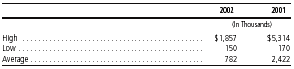
for 2002 and 2001 were as follows:
|


