WESTAR ENERGY, INC.
NOTES TO CONSOLIDATED FINANCIAL STATEMENTS
1. DESCRIPTION OF BUSINESS
Westar Energy, Inc., a Kansas corporation
incorporated in 1924, operates the largest electric utility in Kansas
and owns interests in monitored security businesses and other investments.
Unless the context otherwise indicates, all references in this Annual
Report on Form 10-K to “the company,” “we,” “us,” “our” or similar
words are to Westar Energy, Inc. and its consolidated subsidiaries.
The term “Westar Energy” refers to Westar Energy, Inc. alone and
not together with its consolidated subsidiaries. We provide electric
generation, transmission and distribution services to approximately
647,000 customers in Kansas. We also provide monitored security
services to over 1.1 million customers in the United States and
Europe. ONEOK, Inc. (ONEOK), in which we owned an approximate 45%
interest at December 31, 2002, (reduced to an approximate 27.5%
interest at March 14, 2003) provides natural gas transmission and
distribution services to approximately 1.9 million customers in
Kansas, Oklahoma and Texas. Our corporate headquarters are located
at 818 South Kansas Avenue, Topeka, Kansas 66612.
Westar Energy and Kansas Gas and
Electric Company (KGE), a wholly owned subsidiary, provide rate
regulated electric service. KGE owns 47% ofWolf Creek Nuclear Operating
Corporation (WCNOC), the operating company for Wolf Creek Generating
Station (Wolf Creek) our nuclear powered generating facility.
Westar Industries, Inc. (Westar Industries),
our wholly owned subsidiary, owns our interests in Protection One
Inc. (Protection One), Protection One Europe, ONEOK and our other
non-utility businesses. Protection One, a publicly traded, approximately
88%- owned subsidiary, and Protection One Europe provide monitored
security services. Protection One Europe refers collectively to
Protection One International, Inc., a wholly owned subsidiary of
Westar Industries, and its subsidiaries, including a French subsidiary
in which it owns an approximate 99.8% interest.
2. SUMMARY OF SIGNIFICANT ACCOUNTING
POLICIES
Principles of Consolidation
We prepare our consolidated financial
statements in accordance with accounting principles generally accepted
in the United States of America (GAAP). Our consolidated financial
statements include all operating divisions and majority owned subsidiaries
for which we maintain controlling interests. Common stock investments
that are not majority owned are accounted for using the equity method
when our investment allows us the ability to exert significant influence.
Undivided interests in jointly-owned generation facilities are consolidated
on a pro rata basis. All material intercompany accounts and transactions
have been eliminated in consolidation.
Use of Management’s Estimates
The preparation of consolidated financial
statements requires management to make estimates and assumptions
that affect the reported amounts of assets, liabilities, revenues
and expenses, and related disclosure of contingent assets and liabilities
at the date of our consolidated financial statements and the reported
amounts of revenues and expenses during the
|
|
reporting period. We evaluate our estimates
on an on-going basis, including those related to bad debts, inventories,
depreciation, revenue recognition, investments, customer accounts,
goodwill, intangible assets, income taxes, pensions and other post
retirement and post-employment benefits, decommissioning ofWolf
Creek, environmental issues, contingencies and litigation. Actual
results may differ from those estimates under different assumptions
or conditions.
Regulatory Accounting
We currently apply accounting standards
for our regulated utility operations that recognize the economic
effects of rate regulation in accordance with Statement of Financial
Accounting Standards (SFAS) No. 71, “Accounting for the Effects
of Certain Types of Regulation,” and, accordingly, have recorded
regulatory assets and liabilities when required by a regulatory
order or based on regulatory precedent.
Regulatory assets represent incurred costs
that have been deferred because they are probable of future recovery
in customer rates. Regulatory liabilities represent obligations
to make refunds to customers for previous collections for costs
that are not likely to be incurred in the future. We have recorded
these regulatory assets and liabilities in accordance with SFAS
No. 71. If we were required to terminate application of SFAS No.
71 for all of our regulated operations, we would have to record
the amounts of all regulatory assets and liabilities in our consolidated
statements of income at that time. Our earnings would be reduced
by the net amount calculated from the table below, net of applicable
income taxes. Regulatory assets and liabilities reflected in our
consolidated balance sheets are as follows:
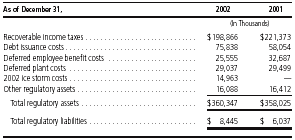
- Recoverable
income taxes: Recoverable income taxes represent amounts
due from customers for accelerated tax benefits that have been
previously flowed through to customers and are expected to be
recovered in the future as the accelerated tax benefits reverse.
This item will be recovered over the life of the utility plant.
- Debt issuance
costs: Debt reacquisition expenses are amortized over the
remaining term of the reacquired debt or, if refinanced, the term
of the new debt. Debt issuance costs are amortized and will be
recovered over the term of the associated debt\
- Deferred
employee benefit costs: Deferred employee benefit costs
represent post-retirement and post-employment expenses in excess
of amounts paid that are to be recovered over a period of five
years as authorized by the Kansas Corporation Commission (KCC).
- Deferred
plant costs: Deferred plant costs relate to the Wolf Creek
nuclear generating facility. For further information, see "-Depreciation,"
discussed below.
- 2002 ice
storm costs: Restoration costs associated with an ice storm
that occurred in January 2002. See Note 30 for additional information
regarding the ice storm.
|


