|
A return is allowed on coal contract settlement
costs (included in “Other regulatory assets” in the table above)
and on the 2002 ice storm costs.
Cash
and Cash Equivalents
We consider highly liquid investments
with a maturity of three months or less when purchased to be cash
equivalents.
Restricted Cash
Restricted cash consists of cash irrevocably
deposited in trust for debt repayments, cash collateralizing Protection
One’s workers’ compensation obligations, a prepaid capacity and
transmission agreement, letters of credit, surety bonds and escrow
arrangements as required by certain letters of credit, and various
other deposits.
Inventories and Supplies
Inventories and supplies for our utility
business are stated at average cost. Inventories for our monitored
services segment, comprised of alarm systems and parts, are stated
at the lower of average cost or market.
Property, Plant and Equipment
Property, plant and equipment is stated
at cost. For utility plant, cost includes contracted services, direct
labor and materials, indirect charges for engineering and supervision,
and an allowance for funds used during construction (AFUDC). AFUDC
represents the cost of borrowed funds used to finance construction
projects. The AFUDC rate was 5.95% in 2002, 9.01% in 2001 and 7.39%
in 2000. The cost of additions to utility plant and replacement
units of property is capitalized. Interest capitalized into construction
in progress was $2.2 million in 2002, $8.7 million in 2001 and $9.4
million in 2000.
Maintenance costs and replacement of minor
items of property are charged to expense as incurred. Incremental
costs incurred during scheduled Wolf Creek refueling and maintenance
outages are deferred and amortized monthly over the unit’s operating
cycle, normally about 18 months. For utility plant, when units of
depreciable property are retired, the original cost and removal
cost, less salvage value, are charged to accumulated depreciation.
Depreciation
Utility plant is depreciated on the straight-line
method at the lesser of rates set by the KCC or rates based on the
estimated remaining useful lives of the assets, which are based
on an average annual composite basis using group rates that approximated
2.66% during 2002, 3.03% during 2001 and 2.99% during 2000.
In its rate order of July 25, 2001, the
KCC extended the estimated service life for certain of our generating
assets, including Wolf Creek and the LaCygne 2 generating station,
for regulatory rate making purposes. The estimated retirement date
for Wolf Creek was extended from 2025 to 2045, although our operating
license for Wolf Creek expires in 2025, and the estimated retirement
date for LaCygne 2 was extended to 2032, although the term of our
lease for LaCygne 2 expires in 2016. On April 1, 2002, we adopted
the new depreciation rates as prescribed in the KCC order. We continue
to depreciate Wolf Creek over the term of our operating license,
and we continue to depreciate LaCygne 2 over the term of our lease.
We have created a regulatory asset, included under “Deferred plant
costs” in the above table, for the amount that our depreciation
expense exceeds our regulatory depreciation expense. |
|
On an annual basis, our depreciation expense
will be reduced by approximately $30.0 million as a result of these
extensions. If our generating license for Wolf Creek is not renewed
or the term of our lease for LaCygne 2 is not extended, we will
need to seek relief from the KCC to recover the remaining cost of
these assets.
Non-utility property, plant and equipment
is depreciated over the estimated useful lives of the related assets.
We periodically evaluate our depreciation rates considering the
past and expected future experience in the operation of our facilities.
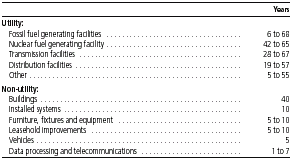
Depreciable lives of property, plant and
equipment are as follows:
Nuclear Fuel
Our share of the cost of nuclear fuel
in process of refinement, conversion, enrichment and fabrication
is recorded as an asset in property, plant and equipment on our
consolidated balance sheets at original cost and is amortized to
cost of sales based upon the quantity of heat produced (MMBtu) for
the generation of electricity. The accumulated amortization of nuclear
fuel in the reactor was $25.2 million at December 31, 2002 and $35.6
million at December 31, 2001. Spent fuel charged to cost of sales
was $17.8 million in 2002, $22.1 million in 2001 and $19.6 million
in 2000.
Customer Accounts
Customer accounts are stated at cost
and are amortized over the estimated customer life. The cost includes
amounts paid to dealers and the estimated fair value of accounts
acquired in business acquisitions. Internal costs incurred in support
of acquiring customer accounts are expensed as incurred.
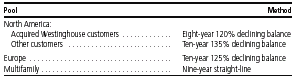
Protection One’s and Protection One Europe’s
amortization rates consider the average estimated remaining life
and historical and projected attrition rates. The amortization method
for each customer pool is as follows:
In accordance with SFAS No. 121, “Accounting
for the Impairment of Long-Lived Assets and for Long-Lived Assets
to Be Disposed Of,” long-lived assets held and used by Protection
One and Protection One Europe are evaluated for recoverability on
a periodic basis or as circumstances warrant. An impairment would
be recognized when the undiscounted expected future operating cash
flows by customer pool derived from customer accounts is less than
the carrying value
|


