|
of capitalized customer accounts
and related goodwill. See Note 23 for information regarding SFAS
No. 144, “Accounting for the Impairment and Disposal of Long-Lived
Assets,” which replaces SFAS No. 121 as of January 1, 2002.
Due to the customer attrition experienced
in 2002, 2001 and 2000, the decline in market value of Protection
One’s publicly traded equity and debt securities and recurring losses,
Protection One and Protection One Europe performed impairment tests
on their customer account assets and goodwill in 2002, 2001 and
2000. These tests indicated that future estimated undiscounted cash
flows exceeded the sum of the recorded balances for customer accounts
and goodwill. See Note 23 for a discussion of the impairment recorded
on these assets during 2002 pursuant to the adoption of new accounting
principles.
Goodwill
Goodwill represents the excess of
the purchase price over the fair value of net assets acquired by
Protection One and Protection One Europe. Protection One and Protection
One Europe changed their estimated goodwill life from 40 years to
20 years as of January 1, 2000. For 2001 and 2000, remaining goodwill,
net of accumulated amortization, was amortized over its remaining
useful life based on a 20-year life.
For 2001 and 2000, the carrying value
of goodwill was included in the evaluations of recoverability of
customer accounts. No reduction in the carrying value was necessary
at December 31, 2001 or 2000.
Effective as of January 1, 2002,
we adopted SFAS No. 142, “Accounting for Goodwill and Other Intangible
Assets” and no longer amortize goodwill. We are subject to the annual
goodwill impairment test. See Note 23 for information regarding
the effect of adopting SFAS No. 142.
Cash Surrender Value of Life Insurance
The following amounts related to
corporate-owned life insurance policies (COLI) are recorded in other
long-term assets on our consolidated balance sheets at December
31:
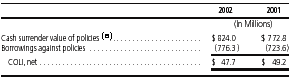 (a)Cash surrender value of policies as presented represents
the value of the policies as of the end of the respective policy
years and not as of December 31, 2002 and 2001.
(a)Cash surrender value of policies as presented represents
the value of the policies as of the end of the respective policy
years and not as of December 31, 2002 and 2001.
Income is recorded for increases in cash
surrender value and net death proceeds. Interest incurred on amounts
borrowed is offset against policy income. Income recognized from
death proceeds is highly variable from period to period. Death benefits
recognized as other income approximated $3.6 million in 2002, $2.7
million in 2001 and $0.8 million in 2000.
Minority Interests
Minority interests represent the minority
shareholders’ proportionate share of the shareholders’ equity and
net losses of Protection One and Protection One Europe.
|
|
Revenue Recognition
Energy Sales
Energy sales are recognized as delivered
and include an estimate for energy delivered but unbilled at the
end of each year. Power marketing activities are accounted for under
the mark-to-market method of accounting. Under this method, changes
in the portfolio value are recognized as gains or losses in the
period of change. The net mark-to-market change is included in energy
sales in our consolidated statements of income. The resulting unrealized
gains and losses are recorded as energy trading assets and liabilities
on our consolidated balance sheets.
We primarily use quoted market prices
to value our power marketing and energy trading contracts. When
market prices are not readily available or determinable, we use
alternative approaches, such as model pricing. The market prices
used to value these transactions reflect our best estimate of fair
values considering various factors, including closing exchange and
over-the-counter quotations, time value and volatility factors underlying
the commitments. Results actually achieved from these activities
could vary materially from intended results and could unfavorably
affect our financial results.
Monitored
Services Revenues
Monitored services revenues are recognized
when security services are provided. System installation revenues,
sales revenues on equipment upgrades and direct and incremental
costs of installations and sales are deferred for residential customers
with monitoring service contracts. For commercial customers, revenue
recognition is dependent upon each specific customer contract. In
instances when the company passes title to a system unaccompanied
by a service agreement or the company passes title at a price that
it believes is unaffected by an accompanying but undelivered service,
the company recognizes revenues and costs in the period incurred.
In cases where the company retains title to the system or it prices
the system lower than it otherwise would because of an accompanying
service agreement, the company defers and amortizes revenues and
direct costs.
Deferred system and upgrade installation
revenues are recognized over the expected life of the customer utilizing
an accelerated method for residential and commercial customers and
a straight-line method for Protection One’s Multifamily customers.
Deferred costs in excess of deferred revenue are recognized over
the initial contract term, utilizing a straight-line method, typically
two to three years for residential systems, five years for commercial
systems and five to ten years for Multifamily systems. To the extent
deferred costs are less than deferred revenues, such costs are recognized
over the estimated life of the customer relationship.
Deferred revenues also result from customers
who are billed for monitoring and extended service protection in
advance of the period in which such services are provided, on a
monthly, quarterly or annual basis. Revenues from monitoring activities
are recognized in the period such services are provided.
Income Taxes
Our consolidated financial statements
use the liability method to reflect income taxes. Deferred tax assets
and liabilities are recognized for temporary differences in amounts
recorded for financial reporting purposes and their respective tax
bases. We amortize deferred investment tax credits over the lives
of the related properties.
|


