|
Accrued
merger and integration costs recorded in connection with the
acquisition of Red Brick included approximately $1.6 million
for severance and other acquisition-related costs, $4.7 million
for costs associated with the shutdown and consolidation of
the Red Brick facilities and $1.6 million for costs associated
with settling acquired royalty commitments for abandoned technology.
As of December 31, 1999, $0.9 million had been paid for severance
and other acquisition-related costs, $1.5 million had been
paid for costs associated with the shutdown and consolidation
of Red Brick facilities and $1.0 million had been paid to
settle acquired royalty commitments for abandoned technology.
During 1999, accrued merger and integration costs were reduced
by $3.1 million, which resulted in a corresponding $3.1 million
decrease in goodwill. These adjustments were the result of
a decrease of approximately $2.3 million in the estimated
costs associated with various former Red Brick facilities
due to a change in the amount of sublease income to be received
for such facilities, a decrease of approximately $0.7 million
in severance-related costs and a decrease of $0.1 million
in royalty commitments.
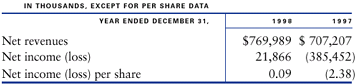
The
following pro forma financial information presents the combined
results of operations of Informix and Red Brick as if the
acquisition had occurred as of the beginning of 1998 and 1997,
after giving effect to certain adjustments, including amortization
of goodwill and excluding the write-off of acquired in-process
research and development. The pro forma financial information
does not necessarily reflect the results of operations that
would have occurred had the two companies constituted a single
entity during such periods.
In February
1997, the Company acquired all of the outstanding capital
stock of CenterView Software, Inc. (“CenterView”), a privately-owned
company which develops and sells software application development
tools. The aggregate purchase price paid was approximately
$8.7 million, which included cash and direct acquisition costs.
The transaction has been accounted for as a purchase and,
based on an independent appraisal of the assets acquired and
liabilities assumed, the purchase price has been allocated
to the net tangible and intangible assets acquired, including
developed software technology, acquired workforce, in-process
technology, and goodwill. The in-process technology, which
based on the independent appraisal has been valued at $7 million,
had not, at the date of acquisition, reached technological
feasibility and had no alternative future uses in other research
and development projects. Consequently, its value was charged
to operations in the first quarter of fiscal 1997, the period
the acquisition was consummated. The remaining identifiable
intangible assets are being amortized over three to five years.

Commencing
in April 1997, a series of class action lawsuits purportedly
by or on behalf of stockholders and a separate but related
stockholder action were filed in the United States District
Court for the Northern District of California. These actions
name as defendants the Company, certain of its present and
former officers and directors and, in some cases, its former
independent auditors. The complaints allege various violations
of the federal securities laws and seek unspecified but potentially
significant damages. Similar actions were also filed in California
state court and in Newfoundland, Canada.
Stockholder
derivative actions, purportedly on behalf of the Company and
naming virtually the same individual defendants and the Company’s
former independent auditors, were also filed, commencing in
August 1997, in California state court. While these actions
allege various violations of state law, any monetary judgments
in these derivative actions would accrue to the benefit of
the Company.
|







