

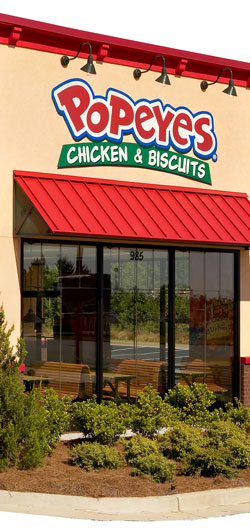
It seems like whenever a new Popeyes restaurant opens, excitement follows (see the sidebar, for a recent example). And it's easy to see why: nobody else offers Popeyes combination of flavors and choices—even for restaurant development.
Second, they know that we are more committed than ever to their success and the success of the entire system and are implementing the steps necessary to fulfill that commitment.
Third, our Development team worked to reduce new restaurant and re-imaging costs, which provided greater incentive to develop new restaurants and re-image existing units. We saw a solid increase in re-imaged restaurants in 2005 and we anticipate a continuation of that trend in 2006 as we push toward a goal of having all restaurants in the system re-imaged by 2008.
Fourth, and probably most important, was the transition from a centralized support model to one in which operations, development, and field marketing people live and work in the markets they support. This new model enables our field-based team members to form closer relationships with franchisees and have greater insight and knowledge of the market, customer base, and franchisee needs and issues. For the development team, this new structure fosters better relationships with developers and brokers in the area, improving the development process. Decentralization significantly improved our franchisee support system and was instrumental in our ability to attract many new quality franchisees in 2005—and is why we expect the trend to continue in 2006.
Fulfilling needs and providing resources
The year 2005 was a solid one for Popeyes Development. We are attracting new franchisees to the brand and stimulating growth from existing franchisees for a number of reasons. First, they know Popeyes offers a unique menu and flavor profile that customers love.Second, they know that we are more committed than ever to their success and the success of the entire system and are implementing the steps necessary to fulfill that commitment.
Third, our Development team worked to reduce new restaurant and re-imaging costs, which provided greater incentive to develop new restaurants and re-image existing units. We saw a solid increase in re-imaged restaurants in 2005 and we anticipate a continuation of that trend in 2006 as we push toward a goal of having all restaurants in the system re-imaged by 2008.
Fourth, and probably most important, was the transition from a centralized support model to one in which operations, development, and field marketing people live and work in the markets they support. This new model enables our field-based team members to form closer relationships with franchisees and have greater insight and knowledge of the market, customer base, and franchisee needs and issues. For the development team, this new structure fosters better relationships with developers and brokers in the area, improving the development process. Decentralization significantly improved our franchisee support system and was instrumental in our ability to attract many new quality franchisees in 2005—and is why we expect the trend to continue in 2006.
Maximizing choices for franchisees
Just as we pride ourselves on maximizing choices for customers, we do the same thing for our franchisees. We call it a "menu of venues," and it simply means that we help franchisees capitalize on opportunities in a variety of markets by enabling them to develop different types of restaurants for different locations.A three-hour wait for chicken?
Sure, if it's Popeyes chicken.
Sure, if it's Popeyes chicken.
In December 2005, a Popeyes franchisee opened
a new location in Des Moines, Iowa. Even he was stunned by the response. According to the Des Moines Register, "From joining the end of the line to leaving with your bag of chicken took three hours. The line for the dining room was 21/2 hours." Now that's a hot QSR concept.
In addition to the traditional standalone Popeyes restaurant, operators can open smaller walk-up locations, which are ideal for urban settings where space is tight, or they can develop a drive-through only location or add a drive-through to an existing standalone unit. Other restaurant options include an in-line format for a strip mall and institutional versions of Popeyes for locations such as hospitals, malls, and food courts.a new location in Des Moines, Iowa. Even he was stunned by the response. According to the Des Moines Register, "From joining the end of the line to leaving with your bag of chicken took three hours. The line for the dining room was 21/2 hours." Now that's a hot QSR concept.
Popeyes "menu of venues" is key to ensuring continued growth of the system and penetration of the brand domestically and internationally. For franchisees to continue to develop and grow, we must provide options so that they can build the right building type in the right location at the right cost.
Maximizing development maximizes profits
It's a simple equation: reducing development costs maximizes the bottom line. Good market planning—choosing the best sites—maximizes the top line.So the emphasis in development at Popeyes is maximizing new location opportunities, maximizing franchisee investment opportunities, and maximizing convenience to the customer by being where they already live, work, and play. That kind of convenience means customers will probably come more often.
It's all designed to make Popeyes attractive to consumers by making Popeyes attractive to franchisees.