       |
               |
|
|
Commissions and fees decreased 12.9% to $41.8 million in 2002, from
$47.9 million in 2001.This decrease is primarily due to lower commission-based
volumes and lower commission rates in our options order routing activities.
Additionally, there was a decrease in the fees we receive for providing
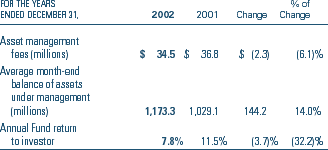
certain information to market data providers. Asset management fees decreased 6.1% to $34.5 million in 2002 from $36.8 million in 2001. The decrease in fees was primarily due to a decrease in fund returns to the investor from 11.5% in 2001 to 7.8% in 2002. The decrease was offset, in part, by the increase in the average amount of funds under management throughout the year in the Deephaven Fund.The average month-end balance of funds under management increased to approximately $1.2 billion during 2002, from an average of approximately $1.0 billion in 2001. |
 |
|
| Interest income, net of interest expense, decreased 76.3% to $5.9
million in 2002, from $24.9 million in 2001.This decrease was primarily
due to lower cash balances held at banks and at our clearing brokers,
changes in the composition of our market-making positions as well
as lower interest rates. Investment income and other income increased 42.1% to $14.8 million in 2002, from $10.4 million in 2001.This increase was primarily due to an increase in earnings related to our investment in the Deephaven Fund. The increased earnings were directly related to the increase in our investment in the Fund. The Company had $153.8 million invested in the Deephaven Fund as of December 31, 2002, up from $50.9 million as of December 31, 2001. Expenses Employee compensation and benefits expense decreased 11.9% to $220.2 million in 2002, from $250.0 million in 2001. The decrease was primarily due to lower headcount and lower incentive compensation as a result of a decrease in gross trading profits and margins, offset in part by increased severance costs. Due to a decrease in revenues and our profitability, employee headcount was reduced during 2001 and 2002. Our number of full time employees decreased to 1,027 at December 31, 2002, from 1,307 full time employees at December 31, 2001. In conjunction with these headcount reductions, we incurred severance costs of $10.2 million in 2002, up from $5.9 million for 2001. Execution and clearance fees increased 2.6% to $120.5 million in 2002, from $117.5 million in 2001. Execution and clearance fees increased due to the increase in U.S. options contracts and U.S. equity trades executed as well as increased costs related to executing orders through ECNs. In 2002, execution fees from ECNs were $13.1 million, compared to $10.8 million in 2001.The increase in execution and clearance fees was partially offset as a result of the reduction in clearing rates in our U.S. equities market-making businesses in 2001 and the closure of European equities market-making in 2002. Payments for order flow decreased 18.8% to $66.6 million in 2002, from $81.9 million in 2001. The decrease was primarily due to changes in our payment for order flow policy initiated in 2001 and 2002, partially offset by increased volumes for U.S. equity shares traded and U.S. options contracts executed. Communications and data processing expense decreased 25.8% to $37.7 million in 2002, from $50.9 million in 2001.This decrease was generally attributable to a decrease in headcount and related technology costs as well as the reduction in our European operations. Depreciation and amortization expense decreased 12.1% to $37.6 million in 2002, from $42.8 million in 2001.This decrease was primarily due to the adoption of SFAS No. 142 and the write-off of $11.0 million of fixed assets. The adoption of this statement decreased amortization expense by approximately $6.8 million in 2002, compared to 2001. Additionally, depreciation expense was impacted by both our purchases and writedowns of fixed assets throughout 2002. See Note 5 to the Consolidated Financial Statements for further information on our adoption of SFAS No. 142. |
|
 |
