|
|
|
Note 15: LONG-TERM INCENTIVE PLANS
The Company established the Knight Trading Group, Inc. 1998 Long-Term
Incentive Plan and the Knight Trading Group, Inc. 1998 Nonemployee
Director Stock Option Plan (together, the “Plans”) to
provide long-term incentive compensation to selected employees and
directors of Knight Trading Group and its subsidiaries. The Plans
are administered by the compensation committee of the Company’s
Board of Directors, and allow for the grant of options, restricted
stock and restricted stock units, as defined by the Plans. Including
a stockholder-approved increase in the number of shares reserved under
the Plans by 3,000,000 in May 2001, the maximum number of shares of
Class A Common Stock reserved for the grant of options under the Plans
is 27,819,000, subject to adjustment. The maximum number of restricted
stock and restricted stock units that may be issued under each of
the Plans is 3,000,000 each, which includes a 2,000,000 share increase
for each type of award that was approved by stockholders in May 2001.
In addition, the Plans limit the number of options or shares that
may be granted to a single individual, and the Plans also limit the
number of shares of restricted stock that may be awarded.
It is the Company’s policy to grant options for the purchase
of shares of Class A Common Stock at not less than market value, which
the Plans define as the average of the high and low sales prices on
the date prior to the grant date. Options and awards generally vest
over a three- or four-year period and expire on the fifth or tenth
anniversary of the grant date, pursuant to the terms of the agreements.
The Company has the right to fully vest employees in their option
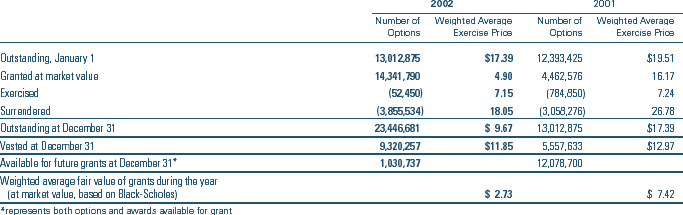
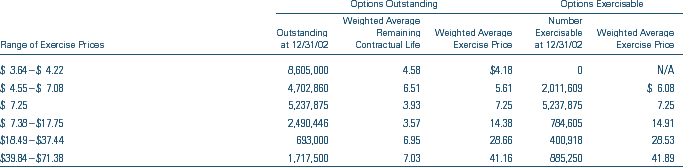
grants and awards upon retirement. The following is a reconciliation
of option activity for the Plans for 2002 and 2001, and a summary
of options outstanding and exercisable at December 31, 2002:
|
|
The Company granted a total of 499,425 restricted shares of Class
A Common Stock to certain current employees of the Company under the
1998 Long-Term Incentive Plan (the “1998 Plan”). In addition,
1,128,256 restricted shares of Class A Common Stock were granted to
certain current employees of the Company outside of the 1998 Plan.
At December 31, 2002, the Company had 1,563,725 restricted shares
outstanding, in aggregate, both under and outside of the 1998 Plan.
Such grants were made at fair market value and with terms consistent
with the Plan. The Company recognizes compensation expense for the
fair values of the restricted shares of Class A Common Stock granted
to employees. In 2002, the Company recorded compensation expense of
$2.0 million for all of its outstanding restricted shares, which has
been included in Compensation and Benefits in the Consolidated Statements
of Operations.The unamortized portion of the restricted shares is
recognized as compensation expense over the vesting period. The restricted
stock requires future service as a condition of the vesting of the
underlying shares of common stock.
The Company applies Accounting Principles Board Opinion No. 25, Accounting
for Stock Issued to Employees (“APB 25”) and related
interpretations in accounting for its stock option plans. As options
are granted at the then-market value, no compensation expense has
been recognized for the fair values of the options granted to employees.
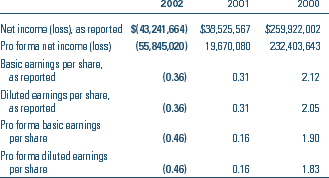
Had compensation expense for the Company’s options been determined
based on the fair value at the grant dates in accordance with SFAS
No. 123, Accounting for Stock-Based Compensation, the Company’s
net income and earnings per share amounts for the years ended December
31, 2002, 2001 and 2000 would have been as follows:
|
| |
|
| |
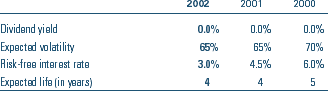
The fair value of each option granted is estimated as of its respective
grant date using the Black-Scholes option-pricing model with the following
assumptions:
|
| |
|
| |
On December 11, 2002, the Company filed with the SEC a Tender Offer
Statement on Schedule TO and associated documents relating to an offer
to exchange all outstanding vested and unvested options granted under
the Plan (the “Exchange Program”).To be eligible for the
Exchange Program the options had to have an exercise price of at least
$14.00 and be held by current employees who had not received an option
grant since June 1, 2002. Members of the Company’s Board of
Directors and executive officers were excluded from participating
in the Exchange Program.
Under the Exchange Program, for every option to purchase two-and-a-half
shares tendered for exchange, a new option to purchase one share will
be issued, at a date no earlier than the first business day that is
at least six months and one day after the date the Company cancelled
the options, at a price not less than the market value on the issuance
date and with a two-year vesting period.The Exchange Program has been
structured to comply with FIN 44 of APB 25 in order to achieve the
same accounting treatment as the original option grants that were
tendered for exchange. Of the total options outstanding, approximately
1.8 million were eligible to be exchanged.
The offering period under the Exchange Program expired on January
17, 2003. A total of 1,436,750 options to purchase one share were
cancelled. In accordance with the Exchange Program, 574,700 options
to purchase one share will be granted to current employees at a date
no earlier than July 18, 2003.The remaining 862,050 options to purchase
one share have been added to the total number of options available
for future grants. |
| |
|
|