
 |
|
|
|
|
 |
 |
 |
 |
|
|
|
|
|
|
 |
 |
 |
|
 |
|
 |
|
 |
 |
 |
|
|
||||||||||||||||||||||||||
|
|
 |
 |
     |
    |
  
|
|
|
|
|
|
| YEARS ENDED DECEMBER 31, 2001 AND 2000 In 2001, we had gross revenues of $684.7 million, down from $1,257.3 million in 2000. Our total expenses were $630.4 million, down from $838.8 million in 2000. Our 2001 net income was $38.5 million, resulting in earnings per share ("EPS") on a fully diluted basis of $0.31. This compares to net income of $259.9 million and an EPS of $2.05 on a fully diluted basis in 2000. Our international expansion efforts resulted in an approximate $0.30 charge to our EPS in 2001. During the third quarter of 2001, we had our first ever quarterly loss due to the effects of decimalization, international expansion, seasonality, market conditions and the lost trading days due to the terrorist attacks on September 11th. 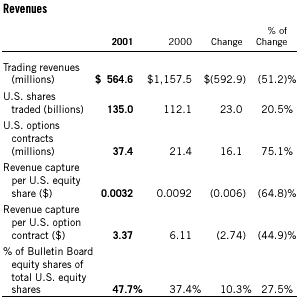 As a result of the market and economic conditions in 2001, our net trading revenue from equity security market-making decreased 57.3% to $435.7 million in 2001, from $1,020.9 million in 2000. U.S. equity trading revenue represents the majority of our equity marketmaking revenue. This decrease in equity trading revenue was primarily due to decreased average revenue capture per U.S. equity share and market conditions. Average revenue capture per U.S. equity share was impacted by a reduction in spreads due to decimalization and the introduction of a one-penny MPV, which allows for trading increments as small as one cent, in the second quarter 2001. Average revenue capture per U.S. equity share decreased to $0.0032 per share in 2001, from $0.0092 per share in 2000. The decrease was offset, in part, due to an increase in U.S. equity share volume. Total U.S. equity share volume increased 20.5% to 135.0 billion U.S. equity shares in 2001, from 112.1 billion U.S. equity shares in 2000. The increase in U.S. equity share volume only partially offset the reduction in net trading revenues from lower revenue capture from equity security marketmaking, as the majority of the increase resulted from share volume in low-priced Bulletin Board and Pink Sheet stocks which have lower revenue capture opportunity. Net trading revenue from options market-making decreased 5.6% to $128.9 million in 2001, from $136.6 million in 2000. The decrease is primarily due to lower average revenue capture per U.S. option contract due to low volatility and increased competition. Average revenue per U.S. option contract decreased to $3.37 in 2001, from $6.11 in 2000. The decrease was partially offset by the increase in U.S. option contracts executed. Total U.S. option contracts executed increased 75.1% to 37.4 million contracts in 2001, from 21.4 million contracts in 2000. Our U.S. option contract volume was positively impacted by KFP's purchases of additional exchange posts during 2001, which increased our overall options market-making coverage. Our commissions and fees increased 47.3% to $47.9 million in 2001, from $32.5 million in 2000. This increase is primarily due to payments received by our professional option execution services business, KEP, for directing order executions, as well as higher U.S. equity share volumes from institutional customers in listed securities. Asset management fees decreased 12.2% to $36.8 million in 2001 from $41.9 million in 2000. The decrease in fees was primarily due to a decrease in fund returns from 33.61% in 2000 to 11.52% in 2001. The decrease was offset, in part, by the increase in funds under management in the Deephaven Market Neutral Master Fund from $743.5 million at December 31, 2000 to $1.2 billion at December 31, 2001. Our interest income, net of interest expense, increased 54.6% to $24.9 million in 2001, from $16.1 million in 2000. This increase was primarily due to changes in our market-making positions from net long to net short. Investment income and other income increased 13.1% to $10.4 million in 2001, from $9.2 million in 2000. This increase was primarily due to an increase in benefits received from a state employment incentive grant. Expenses Our employee compensation and benefits expense decreased 40.7% to $250.0 million in 2001, from $421.4 million in 2000 (presented on a pro forma basis). As a percentage of total revenue, employee compensation and benefits expense increased to 36.5% in 2001 from 33.5% in 2000. The decrease on a dollar basis was primarily due to decreases in gross trading profits and lower margins offset, in part, by a growth in the number of our employees. The increase on a percentage basis was primarily due to the significantly lower revenues and the decrease in average revenue capture per U.S. equity share and per U.S. option contract as well as an increase for most of the year in our number of employees and severance costs. Due to unfavorable market and economic conditions, employee headcount was reduced and severance costs were incurred. The number of full time employees increased to approximately 1,400 for much of 2001, from 1,364 as of December 31, 2000; however, as of December 31, 2001 total headcount was 1,307. Severance costs related to the decrease in headcount amounted to approximately $5.9 million. Due to decreased net trading revenue and profitability, profitability based compensation decreased 62.7% to $123.8 million in 2001, from $331.8 million on a pro forma basis in 2000. Profitability based compensation represented 49.5% and 78.7% of total compensation and benefits for 2001 and on a pro forma basis in 2000, respectively. Execution and clearance fees increased 4.7% to $117.5 million in 2001, from $112.2 million in 2000. As a percentage of total revenue, execution and clearance fees increased to 17.2% in 2001 from 8.9% in 2000. The increase on a dollar basis was primarily due to the 75.1% increase in U.S. option contracts executed as well as additional fixed costs in relation to our purchases of additional options trading posts. Execution and clearance fees also increased as a result of our international expansion efforts in Europe and Japan. The increase was partially offset by a 17.8% decrease in U.S. equity trades executed to 117.3 million U.S. equity trades in 2001, from 142.7 million U.S. equity trades in 2000. The increase in execution and clearance fees as a percentage of total revenue was primarily due to the decrease in average revenue capture per U.S. equity trade and per U.S. option contract. Our payments for order flow decreased 53.1% to $81.9 million in 2001, from $174.6 million in 2000. As a percentage of total revenue, payments for order flow decreased to 12.0% in 2001 from 13.9% in 2000. The decrease in payments for order flow on a dollar basis and as a percentage of total revenue was primarily due to changes in our payment for order flow policy, resulting from decimalization and the introduction of a one-penny MPV, initiated in the second quarter 2001. The decrease was offset, in part, by the 20.5% increase in U.S. equity shares traded in 2001 as well as the fact that payment for order flow in the options marketplace was not introduced until the third quarter of 2000. Communications and data processing expense increased 54.0% to $50.9 million in 2001, from $33.0 million in 2000. This increase was generally attributable to an increase in the number of employees for most of the year, investment in technology and our international expansion in Europe and Japan. Additionally, communications and data processing expense increased due to the growth in our options trading business, which almost doubled the number of options that it trades. Our depreciation and amortization expense increased 68.8% to $42.8 million in 2001, from $25.3 million in 2000. This increase was primarily due to the purchase of approximately $50.6 million of additional fixed assets and leasehold improvements during 2001 and the amortization of goodwill and intangible assets primarily related to the acquisition of various options-related businesses. Occupancy and equipment rentals expense increased 9.6% to $20.5 million in 2001, from $18.7 million in 2000. This increase was primarily attributable to additional leased office space. Our professional fees decreased 30.1% to $15.1 million in 2001, from $21.5 million in 2000. This decrease was primarily due to decreased consulting expenses related to our investments in technology, our European and Asian expansion efforts as well as decreased other professional fees. Business development expense decreased 21.5% to $11.6 million in 2001, from $14.8 million in 2000. This decrease was primarily the result of decreased advertising and lower travel and entertainment costs. For the year ended December 31, 2001, pre-tax nonoperating charges of $20.5 million were incurred for the writedown of assets and a lease loss accrual. The charges consist of a $10.7 million non-recurring charge relating to impaired investments in non-public e-commerce companies, $6.8 million related to a writedown of fixed assets and other capitalized costs related to purchases of equipment and costs associated with the design of space for leased property which we do not believe we will fully occupy, $1.4 million related to estimated losses on the disposal of excess real estate and $1.6 million related to the writedown of certain options exchange seats. Other expenses increased 13.2% to $19.6 million in 2001, from $17.3 million in 2000. This was primarily the result of increased administrative expenses and other operating costs in connection with our options business growth as well as our European and Asian expansion. Income Tax Our effective and pro forma effective income tax rates for 2001 and 2000, respectively, differ from the federal statutory rate of 35% due to state income taxes, nondeductible foreign losses as well as non-deductible expenses, including the amortization of goodwill resulting from the acquisition of KCM and a portion of business development expenses. Pro forma income tax rates for 2000 are used because, before our merger with Arbitrade on January 12, 2000, Arbitrade (and its two subsidiaries, KFP and Deephaven) was a limited liability company, which was treated as a partnership for tax purposes and its U.S. federal and state income taxes were borne by its individual partners. Our effective tax rate increased to 46.9% in 2001 from a pro forma effective tax rate in 2000 of 38.3% primarily due to the nondeductible foreign losses incurred in 2001. |
|