 |
 |
 |
 |
 |
 |
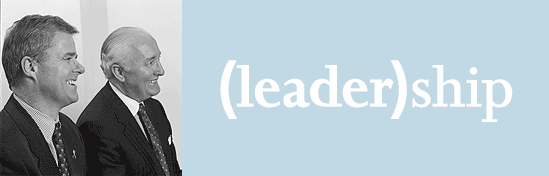
| left to right: Colin Goddard, Ph.D. Robert A. Ingram
|
Transforming Our Vision Into
Reality 2002 has been a year marred by recession, corporate scandal and high-profile clinical disappointments for both biotechnology and pharmaceutical companies alike. This has raised questions for some about the future prospects of the biotechnology sector and the integrity of leading U.S. corporations in general. For OSI, however, it’s been a year of continued progress toward our goal of building a world-class oncology company. We are committed to building an organization of high quality and integrity focused on discovering, developing and commercializing innovative cancer products that both extend life and improve the quality-of-life for cancer patients around the world. We want to be an organization recognized for these attributes throughout the industry, and in 2002 we believe we made major strides toward achieving that goal. In Tarceva™ we continue to believe that we have an outstanding drug candidate which is strongly positioned to emerge as a leader in the anti-HER1/ EGFR field. Over the last several years we have been building our oncology franchise around Tarceva.™ Most importantly, we have focused on ensuring that we provide all of the resources, experience and know-how to be confident that we have done all that we can do to allow for the successful development and registration of a product that has the potential to make a real difference in the lives of hundreds of thousands of cancer patients. To that end, we acquired and have successfully integrated both the oncology unit of Gilead Sciences, Inc. and the research operations of British Biotech plc which greatly enhanced our oncology pipeline and added strength to our research and development capabilities. With the Gilead acquisition, we added a proven world-class oncology drug development and regulatory affairs team which now leads our Tarceva™ development efforts. We also acquired three promising next-generation cytotoxic drug candidates in clinical development, balancing our pipeline of novel gene-targeted therapies. Supporting our Tarceva™ development efforts are our co-development and marketing partners, Genentech, Inc. and Roche. By leveraging the development, regulatory and commercial expertise of these two leading oncology players, we further ensure a quality development program and remain confident of our ability to compete effectively in the marketplace. In the United States, OSI and Genentech employ an equal cost and profit sharing arrangement for commercialization. Roche, our international partner, will commercialize Tarceva™ outside the United States and will pay us royalties on net sales. We have also focused on expanding and strengthening the leadership of the company and have proactively improved our corporate governance procedures, including the formation of a disclosure control committee, the institution of outside director-only sessions at board meetings and the recruitment and appointment of a new non-executive chairman of the board. To this end, I am delighted to both introduce and welcome our new Chairman of the Board, Robert A. Ingram. Bob is currently Vice Chairman of Pharmaceuticals at GlaxoSmithKline and, prior to his recent retirement, was President and Chief Operating Officer of GSK’s pharmaceutical operations. He is seen throughout the industry as a man of stature and integrity and, with a long and successful career on the commercial side of our business, will provide us with great wisdom and counsel as we move through the next exciting phase of our growth. Transforming Our Vision Into RealityTarceva™ Anchoring our oncology franchise is Tarceva,™a potent, selective and orally active inhibitor of HER1/EGFR, a receptor that is overexpressed or mutated in a wide variety of solid tumors including those of the lung and pancreas. Although some of our competitors have suffered disappointments with their EGFR development programs, we believe that the exciting potential of HER1/EGFR targeted therapies is firmly established within the oncology community. Although we have much to learn about the most effective way to use this approach in the fight against cancer, we remain confident that our broad-based registration strategy will ultimately be successful. Together with our partners, Genentech and Roche, we have carefully designed our clinical program to study Tarceva™ both in a monotherapy setting and in combination with standard cytotoxics. We are conducting four registration-oriented Phase III studies which are all large-scale, placebo-controlled and double-blinded with a primary endpoint of survival and secondary endpoints that include symptom relief and improvement in quality-of-life. Three of these studies are focused on our primary indication, non-small cell lung cancer (NSCLC) and the fourth on pancreatic cancer. 2003 will be a pivotal year for these studies with the possibility that top-line data for all four trials will be available by year end. In May 2002, we received notice of Fast Track designation for Tarceva™ from the U.S. Food and Drug Administration for the treatment of chemotherapy-naïve (or front-line) stage III/IV NSCLC patients. Genentech and Roche have completed patient enrollment for two large randomized Phase III trials in this indication, which compare Tarceva™ plus front-line chemotherapy to chemotherapy alone. We also received notice of a second FDA Fast Track designation in September for Tarceva™ used as a monotherapy for the second/third-line treatment of patients with incurable stage III/IV NSCLC who failed standard therapy for advanced or metastatic disease. We are collaborating with the National Cancer Institute of Canada Clinical Trials Group to conduct an international, randomized and placebo-controlled Phase III trial in these patients that compares Tarceva™ as a single agent to best supportive care. In order to more clearly measure improvement in patient survival as well as other potential benefits of Tarceva™ as a monotherapy, we announced the expansion of this trial from the original enrollment target of 330 patients to approximately 700 patients. We expect to complete enrollment within the first two months of 2003. We have provided updates to our Phase II NSCLC data at various clinical and scientific meetings during 2002, including the Annual Meeting of the American Society of Clinical Oncology (ASCO). These studies have continued to reinforce the basis for our Phase III program, revealing promising activity and survival data and a relatively benign side effect profile. An acneiform rash, which we now believe to be an important potential biomarker, and a mild diarrhea are the principal side effects, a considerable improvement in the often harsh toxicities of many cytotoxic therapy regimens. We observed a potentially important correlation between rash, as a potential biomarker of HER1/EGFR drug action, and improved patient survival. This analysis has further reinforced our belief, distinct from that of our major competitors, that aggressive dosing of Tarceva™ will be important to the potential success of our trials and for future clinical use. Other Activities Other Targeted Therapies Although the funded phase of our oncology drug discovery program with Pfizer Inc. has concluded, Pfizer has continued to develop drug candidates which originated from that collaboration. We will receive royalties from these products if and when they are ultimately commercialized. Two of these are the small molecule candidates, CP-724,714 and CP-547,632. CP-724,714, a potent, selective and orally active inhibitor of HER2 (epidermal growth factor receptor 2), recently entered Phase I clinical trials to inhibit the growth of tumors dependent on the activity of the HER2 oncogene. Pfizer is also continuing Phase I trials with CP-547,632, a potent and selective oral inhibitor of vascular endothelial growth factor receptor (VEGFR). VEGFR is a tyrosine kinase receptor involved in promoting angiogenesis, an important mechanism in tumor growth. In the Fall of 2002, we suspended clinical development of OSI-754, a farnesyl transferase inhibitor in Phase I clinical trials. Although we believe this compound represents a potential opportunity in the treatment of cancers containing the mutant h-ras oncogene, its limited commercial potential in the face of our more immediate needs with the Tarceva™ program led to this decision. Business Activities We remain committed to managing our business on a sound financial basis, balancing research and development investments in our future growth and success against our cash reserves and a strong belief that we should seek to take the business profitable within 18-24 months of a successful Tarceva™ launch. We closed our fiscal 2002 with approximately $476 million in cash reserves and anticipate that we need to manage the business to an approximate cost base not exceeding $145 million per year through the next several years in order to remain confident of our profitability goals, assuming the successful registration and launch of Tarceva.™ This philosophy, and our continued efforts to focus on oncology, led us to announce a number of important business decisions during 2002. In February 2002, in keeping with our desire to maintain a strong balance sheet, we issued $200 million aggregate principal amount of Convertible Notes with interest payable at a rate of 4% per year. The Notes mature in 2009 and may be converted into OSI common stock at a conversion price of $50 per share. In the fourth quarter of 2002, we took advantage of a market opportunity and repurchased $40 million of these Notes in the open market for a cost of approximately $26 million, resulting in a net gain of $12.6 million. In October 2002, we announced a modest reduction in staff who had been predominantly dedicated to contract discovery research, and a commitment to divest the Company’s remaining non-oncology assets. As part of this program, in July 2002 we decided to accelerate the wind-down period of our funded research alliance with Anaderm Research Corp. We will still receive royalties on the sales of products that might arise from drug candidates identified as a result of this alliance. We recently relocated our U.S. discovery research operations to a new 53,000 sq. ft. facility in Farmingdale, New York. The site is located on the grounds of State University of New York (SUNY) on land dedicated to the Broadhollow Bioscience Park, a New York State funded project to establish a biotechnology presence on Long Island. We serve as the anchor tenant in support of this initiative. We have also finished consolidating our United Kingdom operations into a state-of-the-art research facility in Oxford, UK which resulted from our acquisition of the pre-clinical research operations of British Biotech in September 2001. Approximately 50% of our pre-clinical discovery research is based on Long Island and the other 50% at the Oxford site. In 2002, we believe we created the basis for a world-class oncology franchise and established an integrated, well-managed organization made up of more than 400 individuals with a diverse array of talent, experience and integrity which we believe will prove to be a winning combination as we move forward into 2003. The next year will be a pivotal one for our lead product, Tarceva,™ a product that we believe will play an important role in opening up a new era of cancer treatment. We have built a strong and committed oncology organization behind Tarceva.™ We hope that you, whether shareholder, employee, oncology professional or patient, share our belief that a focus on quality, thoroughness, honesty and commitment is the right way to build an organization capable of delivering long-term sustainable growth and value while making a major contribution to the treatment and management of cancer worldwide. I thank you all for your continued support and look forward to an exciting 2003.
Colin Goddard, Ph.D.
|