| |
 |
Next Page >
Advancing the Fight Against Cancer
Targeted Therapies
Understading the Nature of the
Cancer Cell
Signal Transduction
Angiogenesis
Apoptosis
Oncology Pipeline
The increase in our knowledge of cancer biology and cancer treatment
over the last decade of the 20th century was dramatic, allowing
us to enter the 21st century with renewed hope, improved understanding
and a belief that we can now seriously contemplate the development
of next-generation anti-cancer drugs that will make a real difference
in the lives of cancer patients.
At OSI, we are proud to be a part of this revolution and to contribute
to the progress in both our fundamental understanding of this disease
and our efforts to treat it. To take full advantage of our growing
insight, we have developed a two-pronged approach with the goal
of improving available treatment options to both extend and increase
the quality-of-life for cancer patients.
The first approach involves using our growing understanding of cancer’s
genetic basis to develop specific mechanism-based therapies that
target both genetic abnormalities and normal processes that are
important to tumor growth. The second approach focuses on the development
of next-generation cytotoxic drugs that represent improvements over
the current cytotoxics. We believe that a successful oncology franchise
should provide an array of treatment options for oncologists and
the cancer patients they treat by developing both targeted therapies
and next-generation cytotoxic therapies.
Tarceva™—A Potential Cancer Blockbuster
Drugs that can target cancer cells with minimal side effects on
the rest of the body have become an important part of the oncologist’s
arsenal. Indeed, the oncology community increasingly believes in
selectively targeting genes important to the growth and survival
of cancer with the expectation that we can manage cancer for the
long term. At OSI, we have pioneered the development of anti-cancer
drugs that target the multiple underlying mechanisms of cancer.
Some of these novel anti-cancer drugs are designed to target cancer-causing
genes, or oncogenes. Oncogenes are growth-regulating genes that
are either overexpressed or mutated in cancer cells. One of the
most important of these oncogenes is the epidermal growth factor
receptor HER1/ EGFR. HER1/EGFR is mutated or overexpressed in a
variety of the tumor types that impact a significant number of the
approximately 1.3 million patients newly diagnosed with cancer in
the U.S. each year.
We believe drugs that inhibit HER1/EGFR may have utility in treating
a wide range of cancers. Our most advanced drug candidate, Tarceva™,
is a small molecule, selective and orally active inhibitor of the
HER1/EGFR tyrosine kinase activity, and is currently in Phase III
clinical trials.
 Tarceva™
is being developed as part of a global tripartite alliance with
Genentech, Inc. and Roche. This global co-development and commercialization
effort includes a broad-based Phase III clinical trial program that
is oriented toward an effective registration with the U.S. Food
and Drug Administration as well as other international regulatory
agencies. The Phase III program is based on promising results seen
in several completed Phase II clinical trials for Tarceva.™
In these trials, Tarceva™ was used as a monotherapy in the
treatment of refractory and advanced non-small cell lung cancer
(NSCLC), head and neck cancer and ovarian cancer patients who had
generally failed standard treatment regimens. Objective evidence
of anti-tumor activity manifested itself as complete and partial
responses and disease stabilization accompanied by encouraging survival
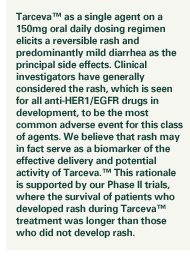
data. The most common side effect observed in all trials was the
development of an acneiform rash. Tarceva™
is being developed as part of a global tripartite alliance with
Genentech, Inc. and Roche. This global co-development and commercialization
effort includes a broad-based Phase III clinical trial program that
is oriented toward an effective registration with the U.S. Food
and Drug Administration as well as other international regulatory
agencies. The Phase III program is based on promising results seen
in several completed Phase II clinical trials for Tarceva.™
In these trials, Tarceva™ was used as a monotherapy in the
treatment of refractory and advanced non-small cell lung cancer
(NSCLC), head and neck cancer and ovarian cancer patients who had
generally failed standard treatment regimens. Objective evidence
of anti-tumor activity manifested itself as complete and partial
responses and disease stabilization accompanied by encouraging survival
data. The most common side effect observed in all trials was the
development of an acneiform rash.
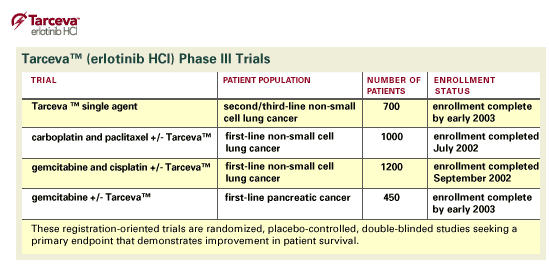
The Phase III Tarceva™ program includes one single-agent study
(versus best supportive care) for the treatment of refractory NSCLC
and three combination trials with existing chemotherapy regimens
for front-line use in NSCLC and pancreatic cancer. All the trials
are large, placebo-controlled, double-blinded studies designed to
demonstrate survival and quality-of-life benefits for the patients.
Our highest clinical priority at this time is the management of
the single-agent refractory NSCLC trial which is the primary registration
study for Tarceva.™ Currently this is the only single agent,
controlled Phase III study of a HER1/EGFR targeted drug designed
to detect a survival advantage.
The study of Tarceva™ for the treatment of pancreatic cancer
remains an important secondary program for us. However, as part
of our effort to focus resources on the refractory NSCLC study,
we have reduced the total sample size of the international Phase
III pancreatic study. This change in sample size will maintain the
statistical power of the trial while allowing us to prioritize our
resources into the NSCLC program. Specifically, the original 800-patient
design will now enroll approximately 450 patients in a study that
compares Tarceva™ in combination with gemcitabine to gemcitabine
alone as a first-line treatment. Like the refractory NSCLC trial,
this trial is also being conducted in collaboration with the National
Cancer Institute of Canada Clinical Trials Group.
We are also conducting several Phase Ib trials to study the effect
of Tarceva™ with other chemo-therapy drugs. Additional Phase
II studies are being conducted both independently and in collaboration
with the U.S. National Cancer Institute’s Cancer Therapy Evaluation
Program, or CTEP, in a wide variety of tumor types including bronchioalveolar
carcinoma and glioblastoma multiforme.
|