|
| MANAGEMENT’S DISCUSSION AND ANALYSIS OF FINANCIAL CONDITION AND RESULTS OF OPERATIONS |   |
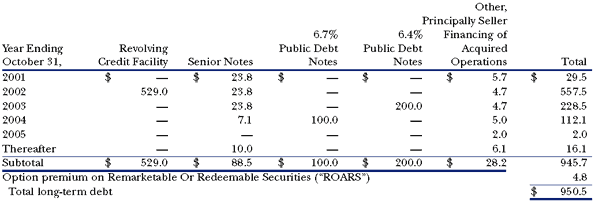
LIQUIDITY AND CAPITAL RESOURCES Early in fiscal year 2000, the Company’s management resolved to improve cash flow and build cash reserves in order to deleverage the Company’s balance sheet. The Company’s operations provided cash of $87.2 million for the year ended October 31, 2000, compared to $16.4 million for the corresponding period in 1999, due principally to a smaller increase in receivables, coupled with other working capital changes. The smaller increase in receivables resulted from increased cash collections combined with the impact of reduced preneed sales, both attributable to modifications made to the Company’s preneed sales strategies for increased cash retention. Operating cash flow exceeded the Company’s goal of $70 to $75 million for the fiscal year. As a result, the Company had accumulated $98.9 million in cash, cash equivalent investments and marketable securities as of October 31, 2000, an increase of approximately $21.4 million from October 31, 1999. The Company’s investing activities resulted in a cash outflow of $1.9 million for fiscal year 2000 compared to $208.6 million for fiscal year 1999. The reduction in cash used by investing activities was primarily due to the cessation of acquisition activity in early 2000, and due, to a smaller extent, to an increase in proceeds from the sale of marketable securities and reductions in capital expenditures. The Company’s financing activities resulted in a cash outflow of $18.8 million for fiscal year 2000, due principally to debt repayments, compared to a cash inflow of $193.9 million for fiscal year 1999. The level of cash provided by financing activities in 1999 resulted from the Company’s common stock offering completed in the second quarter of 1999, which was slightly offset by the repurchase of shares of the Company’s common stock in the second half of 1999. In February 1999, the Company completed the sale of 13.6 million shares of Class A common stock. This resulted in approximately $219 million in net proceeds, which were used principally to repay balances outstanding under its revolving credit facilities. The Company paid $2.3 million to current and former employees as a result of a self audit of pay procedures the Company conducted in partnership with the Department of Labor (“DOL”). The payment was made in the fourth quarter of fiscal year 2000. Stewart has revised its pay procedures and is in compliance with DOL payroll regulations. During fiscal year 2000, the Company expensed $1.8 million with the remaining $500,000 to be expensed as preneed funeral services are delivered in future periods. The Company has implemented various initiatives to generate cash and reduce debt. For example, the Company has suspended its acquisition activity, restructured its preneed sales activities, limited spending on internal growth initiatives, and on October 5, 2000, the Company’s Board of Directors suspended the payment of quarterly dividends on Class A and Class B common stock. Another initiative being considered is the possible sale of some or all of the Company’s foreign operations. The Company has engaged an investment banking firm to assist in evaluating and executing this option if the Company should decide to proceed. Currently, the Company is in discussions with several interested parties. A sale of some or all foreign assets could result in a material charge to earnings but could generate significant cash for debt reduction. Also, in addition to the Company’s regular communication with the lead bank in its revolving credit facility, during fiscal year 2000 the Company met with all the lenders party to that facility to discuss plans for deleveraging its balance sheet and to develop a workable plan well in advance of the April 2002 maturity date of the Company’s revolving credit facility. Any amendments, renegotiations or extensions of the Company’s existing revolving credit and senior note agreements are likely to result in higher interest costs to the Company, although the effect of the rate increases may be moderated if the Company is able to substantially reduce its total debt prior to or in connection with such refinancing. If the Company is not successful in extending or renegotiating its current revolving credit agreement prior to the end of the Company’s second quarter of fiscal year 2001, the revolving credit facility would become a current liability. The following table reflects future scheduled principal payments or maturities of the Company’s long-term debt (in millions):
For additional information on the Company’s debt, see Note 11 to the Company’s consolidated financial statements. Long-term debt at October 31, 2000 decreased to $950.5 million compared to $951.4 million at October 31, 1999, as a result of a reduction of debt of $13.3 million in fiscal year 2000, offset by one seller-financed acquisition which closed in the first quarter of fiscal year 2000, although it had been completed in 1999. All of the Company’s debt is uncollateralized, except for approximately $14.0 million of term notes incurred principally in connection with acquisitions. In September 2000, the Company received regulatory approval in Florida and in November 2000, withdrew approximately $40 million from its funeral trust funds and obtained a bond to guarantee performance under the related contracts in lieu of trusting requirements. The Company agreed to maintain unused credit facilities in the aggregate that will equal or exceed the bond amount related to these contracts. Management believes that cash flow from operations will be sufficient to cover its estimated cost of providing the related prearranged services and products in the future. Subsequent to fiscal year 2000, the Company made $24.9 million of regularly scheduled principal payments on its long-term debt and $55.0 million of additional principal payments to reduce the outstanding balance on its revolving credit facility. As a result, as of January 9, 2001, the Company had cash, cash equivalent investments and marketable securities of approximately $70 million and outstanding long-term debt of $870.6 million. The most restrictive of the Company’s credit agreements require it to maintain a debt-to-equity ratio no higher than 1.25 to 1.0. The Company has managed its capitalization within that limit, with a ratio of total debt to equity of .9 to 1.0 as of October 31, 2000 and 1999. As of January 16, 2001, the Company had a debt-to-equity ratio of approximately .8 to 1.0 and $472.7 million of additional borrowing capacity within this parameter, of which $79.4 million was available under its revolving credit facility after providing for the amount that the Company agreed would remain unused related to the bonding transaction discussed above. Additionally, the most restrictive of the Company’s credit agreements require it to maintain a coverage ratio, as defined by the agreement, of 2.25 to 1.0. On December 8, 1999, Moody’s Investors Service (“Moody’s”) announced that it had lowered the Company’s credit rating to Ba2 and on August 3, 2000, announced that it had lowered the Company’s credit rating to Ba3. On February 22, 2000, Standard & Poor’s (“S&P”) announced that it had lowered the Company’s credit rating to BB+ and on July 12, 2000, announced that it had lowered the Company’s credit rating to BB. Previously, the Company’s credit ratings from Moody’s and S&P were Baa3 and BBB, respectively. Interest paid by the Company on its revolving line of credit is based in part on its credit ratings from Moody’s and S&P and is currently at its maximum pricing under the existing agreement. The downgrades are estimated to have had an effect of less than $1 million on the Company’s annual net earnings. The Company’s ratio of earnings to fixed charges was as follows:
(1) Excludes the cumulative effect of change in accounting principles. (2) Pretax earnings for fiscal year 1998 include a nonrecurring, noncash charge of $76.8 million in connection with the vesting of performance-based stock options. Excluding the charge, the Company’s ratio of earnings to fixed charges for fiscal year 1998 would have been 4.01. For purposes of computing the ratio of earnings to fixed charges, earnings consist of pretax earnings plus fixed charges (excluding interest capitalized during the period). Fixed charges consist of gross interest expense, capitalized interest, amortization of debt expense and discount or premium relating to any indebtedness, and the portion of rental expense that management believes to be representative of the interest component of rental expense. Fiscal years 2000 and 1999 reflect the 1999 change in accounting principle; fiscal years 1998 and 1997 reflect the 1997 change in accounting principles; fiscal year 1996 reflects the Company’s previous accounting methods that were in effect at that time. During fiscal year 2000, the Company completed the acquisition of four cemeteries through seller financing at a net purchase price of $5.3 million. Historically, the Company’s growth has been primarily from acquisitions. This trend began to change in late fiscal year 1999. As industry conditions reduced the number of major consolidators participating in the acquisition market, those that remained generally applied significantly tighter pricing criteria, and many potential sellers withdrew their businesses from the market rather than pursuing transactions at lower prices. As the business model shifted, death care consolidators experienced diminishing access to capital. In response to these changes, the Company began to develop strategies for improving cash flow and reducing and restructuring debt. Throughout fiscal year 2000, the Company focused on liquidity, leverage and cash flow. As of January 16, 2001, the Company had no pending acquisitions. The Company’s current growth strategy focuses on achieving internal growth from existing operations and from new initiatives. For example, during fiscal year 2000, the Company began to implement programs based on the results of its comprehensive study of consumer preferences. The Company has begun to offer more personalized services and products and has enhanced its funeral arranger training. The Company has also created a new Sales and Marketing Division to strengthen sales effectiveness and create consistency in marketing, sales and training. During fiscal year 2000, the Company opened three new funeral homes in an operating partnership with the Archdiocese of Los Angeles. The fourth Archdiocese of Los Angeles funeral home opened during the first fiscal quarter of 2001, and a fifth funeral home is currently under construction. The operating partnerships enable the Company to build a total of nine funeral homes on cemetery land owned by the Archdiocese. Thus far, the number of families serviced by the Archdiocese funeral homes has exceeded management’s expectations. Although the Company has no material commitments for fiscal year 2001 (other than approximately $7.0 million related to construction of the Archdiocese of Los Angeles funeral homes), the Company contemplates capital expenditures of approximately $28.0 million for the fiscal year ending October 31, 2001, which includes $10.0 million in internal growth initiatives (including the construction of the Archdiocese of Los Angeles funeral homes) and approximately $18.0 million for maintenance capital expenditures. With potential long-term debt maturities of $557.5 million, $228.5 million and $112.1 million in fiscal years 2002, 2003 and 2004, respectively, management of liquidity and capitalization represents a significant short- and medium-term priority for the Company. The Company believes that its ability to meet its future capital requirements will depend primarily upon the successful implementation of its strategies to provide cash from operations and generate cash from other sources, such as the sale of some or all of its foreign operations, and its ability to refinance its revolving credit facility and public debt prior to or at their maturities. |
|
| Home | Financial Highlights | Shareholder Letter | Narrative | Financials | Investor Info | Officers |
| ©2001 Stewart Enterprises, Inc. All rights reserved. |