  |
  Enlarge Image  Enlarge Image  Enlarge Image | | As the owner and operator of funeral homes and cemeteries in the U.S., Canada and Mexico, Stewart Enterprises is the third largest death care provider in North America. We also own and operate facilities in South America, Europe and Australasia. At the close of fiscal 2000, we operated 627 funeral homes and 163 cemeteries and served nearly 200,000 families during the year. These families expected and trusted us to meet their personal needs and observe their traditions with care and attention to detail. Our commitment to meeting these needs and maintaining high standards is unchanging.
What does change, however, are our business strategies. Adapting to meet shifting market conditions and consumer trends is something we have done successfully on many occasions in our 91-year history. During the 1990s, a time of consolidation and acquisitions in the death care industry, our company achieved its position as the third largest death care provider in North America. As we entered fiscal 2000, however, we modified our business strategies to focus more on cash flow and operations rather than acquisitions. Because we redirected our focus and terminated acquisition activity, fiscal 2000 was a transition year for us.
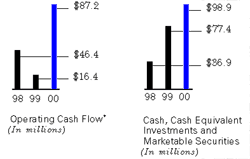
STRENGTHENING THE BALANCE SHEET We used a range of strategies to achieve the improvements in our cash position. We suspended our acquisitions program and limited our capital expenditures, keeping them well within our $43.5 million budget. We also restructured our preneed sales program—altering contract terms and conditions as well as standardizing the sales compensation plan—to promote optimal cash retention. In our domestic divisions, we replaced Company financing of at-need sales with third-party financing, a move that we expect to result in a one-time, $20-$25 million improvement in cash to be received over time. Additionally, in October 2000, we suspended payment of dividends, which should add approximately $8.5 million to our cash position each year. To reduce debt, we began analyzing our portfolio of assets to identify underperforming businesses or excess real estate that would be more valuable if sold or converted to another use. We also began evaluating the benefits associated with the possible sale of some or all of our foreign operations. These initiatives continue into fiscal 2001.
FOCUSING ON OPERATIONS
Combination operations Our success with combinations has led us to form alliances with third parties to construct, own and operate funeral homes on the grounds of their cemeteries. During fiscal 2000, Stewart built three funeral homes in cemeteries owned by the Archdiocese of Los Angeles. Thus far in fiscal 2001, we have opened a fourth and broken ground on a fifth. The performance of these funeral homes has exceeded our expectations. Also during the year, Wyuka Funeral Home—owned and operated by Stewart—was completed and opened in Wyuka Cemetery, a state-owned cemetery in Lincoln, Nebraska. For fiscal 2001, we have earmarked the capital needed to complete construction and open the fifth funeral home with the Archdiocese of Los Angeles. While our focus remains on cash flow and debt reduction, we will continue to explore third-party alliances in 2001.
Preneed sales During fiscal 2000, we made a number of changes in our preneed sales strategies. We had two goals—to optimize the cash flow from preneed sales and to prepare for significant accounting changes anticipated as a result of a staff accounting bulletin issued by the Securities and Exchange Commission (SEC). While the changes we made reduced our preneed sales revenue for the year, they helped improve our cash flow significantly and will serve our shareholders well in the long term. First, we adjusted the terms and conditions of our preneed contracts to improve cash flow and the quality of receivables. The adjustments included requiring larger down payments, increasing finance charges and shortening installment payment periods. Next, during the second and third quarters of the fiscal year, we developed a simplified, standardized sales compensation structure to promote increased growth in our customer base; it was implemented in the fourth quarter. While our sales force was dealing with these necessary modifications, we also rearranged the mix of our preneed products and services to emphasize sales of preneed funeral services and preneed property and de-emphasize sales of preneed funeral merchandise and preneed cemetery services. In December 1999, the SEC issued Staff Accounting Bulletin (SAB) 101. SAB 101, which was not directed exclusively at the death care industry, generally requires that companies recognize revenue from a sale only after the product or service has been delivered. Throughout the year, our company and other industry participants worked with the SEC to determine the effects of SAB 101 on accounting for preneed sales. As discussions with the SEC proceeded and in anticipation of the probable effects of SAB 101, we began to move our sales force toward a different sales mix by changing the incentives associated with preneed sales of certain products and services. In the fourth quarter, we significantly reduced the commissions paid on sales of preneed cemetery services (opening and closing the grave site) and preneed funeral merchandise (caskets). We believe that under SAB 101, we will not be able to recognize these sales as revenue until delivery. Our preneed strategy now emphasizes cemetery property sales and prearranged funeral services. These are the sales that establish the relationship with the consumer and grow market share. The changes in our sales approach resulted in reduced preneed sales for the year. However, we believe that the decisions we made to modify our preneed programs are prudent, long-term strategies that will ultimately improve the quality of our sales, our future cash flow and our future earnings. As a result of these changes, our revenues for our cemetery business in fiscal 2000 were $283 million compared to $310 million for the previous year. Overall, our funeral business performed well during the entire fiscal year. We generated $452 million in revenue compared to $446 million the previous year. Our domestic core funeral businesses (those owned for at least two full years) sustained the number of funeral services performed and increased the average sale at the same time. The average revenue per call grew 6.2 percent. Much of this success can be attributed to the outstanding reputation of our funeral homes and the high quality of service they provide, in addition to the funeral arranger training program introduced during the year. This program educated our funeral arrangers about how to more effectively merchandise our products and improve personalization of services to client families.
ENHANCING THE CUSTOMER’S EXPERIENCE
Research and Development For example, in our funeral arranger training program, we have been teaching our employees to better merchandise our services and to better tailor services to individual customers’ needs and preferences. Last year, we moved into the second phase of our research and development effort, known as Project Catalyst. Working with the same national consulting firm that conducted the study, we developed specific implementation-ready business models that we are now beginning to test.
Training
STRENGTHENED LEADERSHIP |
|
||
|
* Fiscal 1999 and 2000 results reflect a change in accounting principle effective
November 1, 1998. For comparative purposes, fiscal 1998 results are presented on a pro forma basis as if the accounting change had occurred at the beginning of the fiscal year. |
||
| Home
| Financial Highlights | Shareholder
Letter | Narrative | Financials
| Investor Info | Officers ©2001 Stewart Enterprises, Inc. All rights reserved. |
||