|
Generally, the
Company’s commercial loans are underwritten in the Company’s
primary market area on the basis of the borrower’ ability
to service such debt from cash flow. As a general practice, the
Company takes as collateral a lien on any available real estate,
equipment or other assets. Working capital loans are primarily collateralized
by short-term assets whereas term loans are primarily collateralized
by long-term assets.
A substantial
portion of the Company’s real estate loans consists of loans
collateralized by real estate and other assets of commercial customers.
Additionally, a portion of the Company’s lending activity consists
of the origination of single-family residential mortgage loans collateralized
by owner-occupied properties located in the Company’s primary
market area. The Company offers a variety of mortgage loan products
which generally are amortized over five to 30 years.
Loans collateralized
by single-family residential real estate generally have been originated
in amounts of no more than 90% of appraised value. The Company requires
mortgage title insurance and hazard insurance in the amount of the
loan. Although the contractual loan payment periods for single-family
residential real estate loans are generally for a 15 to 30 year
period, such loans often remain outstanding for significantly shorter
periods than their contractual terms.
The Company
originates and purchases residential and commercial mortgage loans
to sell to investors with servicing rights retained. The Company
also provides residential and commercial construction financing
to builders and developers and acts as a broker in the origination
of multi-family and commercial real estate loans.
Residential
construction financing to builders generally has been originated
in amounts of no more than 80% of appraised value. The Company requires
a mortgage title binder and builder ’ risk insurance in the
amount of the loan. The contractual loan payment periods for residential
constructions loans are generally for a six to twelve month period.
Consumer loans
made by the Company include automobile loans, recreational vehicle
loans, boat loans, home improvement loans, personal loans (collateralized
and uncollateralized) and deposit account collateralized loans.
The terms of these loans typically range from 12 to 84 months and
vary based upon the nature of collateral and size of loan.
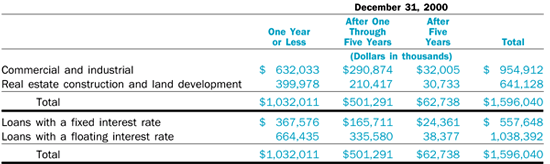
The contractual
maturity ranges of the commercial and industrial and real estate
construction loan portfolio and the amount of such loans with fixed
interest rates and floating rates in each maturity range as of December
31, 2000 are summarized in the following table:
Loans Held
for Sale
Loans held for
sale of $85.9 million at December 31, 2000 increased from $77.0
million at December 31, 1999. These loans are typically sold to
investors within one year of origination.
Loan
Review and Allowance for Loan Losses
The Company’s
loan review procedures include a Credit Quality Assurance Process
that begins with approval of lending policies and underwriting guidelines
by the Board of Directors, an independent loan review department
staffed with OCC experienced personnel, low individual lending limits
for officers, Senior Loan Committee approval for large credit relationships
and quality loan documentation procedures. The Company also maintains
a well developed monitoring process for credit extensions in excess
of $100,000. The Company performs monthly and quarterly concentration
analyses based on various factors such as industries, collateral
types, business lines, large credit sizes, international investments
and officer portfolio loads. The Company has established underwriting
guidelines to be followed by its officers. The Company also monitors
its delinquency levels for any negative or adverse trends. There
can be no assurance, however, that the Company’s loan portfolio
will not become subject to increasing pressures from deteriorating
borrower credit due to general economic conditions.
|



