|
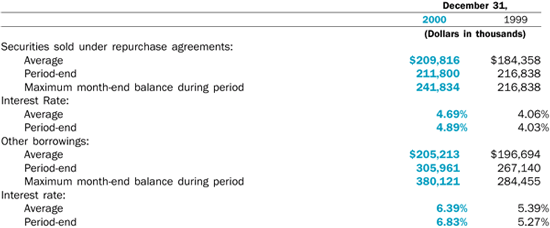
Borrowings
Securities sold
under repurchase agreements and other borrowings, consisting of
federal funds purchased and treasury,
tax, and loan deposits, generally represent borrowings with maturities
ranging from one to thirty days. Information
relating to these borrowings is summarized as follows:
Securities sold
under repurchase agreements are maintained in safekeeping by correspondent
banks.
Interest
Rate Sensitivity and Liquidity
Asset and liability
management is concerned with the timing and magnitude of repricing
assets compared to liabilities.
It is the objective of the Company to generate stable growth in
net interest income and to attempt to control risks
associated with interest rate movements. In general, management’
strategy is to reduce the impact of changes in interest
rates on its net interest income by maintaining a favorable match
between the maturities or repricing dates of its
interest-earning assets and interest-bearing liabilities. The Company
adjusts its interest sensitivity during the year through
changes in the mix of assets and liabilities and may use interest
rate products such as interest rate swap and cap agreements. The
Company did not utilize derivative financial instruments to manage
interest rate risk during the years ended December 31, 2000 and
1999. The Company’s asset and liability management strategy
is formulated and monitored by the Asset Liability Committee, which
is composed of senior officers of the Bank and three outside directors,
in accordance with policies approved by the Bank’s Board of
Directors. This Committee meets regularly to review, among other
things, the sensitivity of the Bank’s assets and liabilities
to interest rate changes, the book and market values of assets and
liabilities, unrealized gains and losses, purchase and sale activity,
and maturities of investments and borrowings. The Asset Liability
Committee also approves and establishes pricing and funding decisions
with respect to the Bank’s overall asset and liability composition.
The Committee reviews the Bank’s liquidity, cash flow flexibility,
maturities of investments, deposits and borrowings, retail and institutional
deposit activity, current market conditions, and interest rates
on both a local and national level.
To effectively
measure and manage interest rate risk, the Company uses simulation
analysis to determine the impact on net interest income of changes
in interest rates under various interest rate scenarios, balance
sheet trends, and strategies. From these simulations, interest rate
risk is quantified and appropriate strategies are developed and
implemented.
|



