|
|
|


|
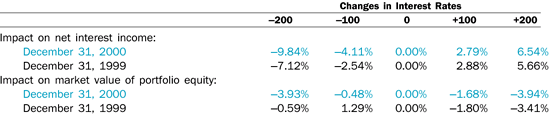
The following table presents an analysis of the sensitivity inherent in the Company’s net interest income and market value of portfolio equity. The interest rate scenarios presented in the table include interest rates at December 31, 2000 and 1999 and as adjusted by instantaneous rate changes upward and downward of up to 200 basis points. Each rate scenario reflects unique prepayment and repricing assumptions. Since there are limitations inherent in any methodology used to estimate the exposure to changes in market interest rates, this analysis is not intended to be a forecast of the actual effect of a change in market interest rates on the Company. The market value sensitivity analysis presented includes assumptions that (i) the composition of the Company’s interest sensitive assets and liabilities existing at year end will remain constant over the twelve month measurement period; and (ii) that changes in market rates are parallel and instantaneous across the yield curve regardless of duration or repricing characteristics of specific assets or liabilities. Further, the analysis does not contemplate any actions that the Company might undertake in response to changes in market interest rates. Accordingly, this analysis is not intended and does not provide a precise forecast of the effect actual changes in market rates will have on the Company.
The interest rate sensitivity (‘‘GAP") is defined as the difference between interest-earning assets and interest-bearing liabilities maturing or repricing within a given time period. A GAP is considered positive when the amount of interest rate sensitive assets exceeds the amount of interest rate sensitive liabilities. A GAP is considered negative when the amount of interest rate sensitive liabilities exceeds interest rate sensitive assets. During a period of rising interest rates, a negative GAP would tend to adversely affect net interest income, while a positive GAP would tend to result in an increase in net interest income. During a period of falling interest rates, a negative GAP would tend to result in an increase in net interest income, while a positive GAP would tend to affect net interest income adversely. While the GAP is a useful measurement and contributes toward effective asset and liability management, it is difficult to predict the effect of changing interest rates solely on that measure. Because different types of assets and liabilities with the same or similar maturities may react differently to changes in overall market rates or conditions, changes in interest rates may affect net interest income positively or negatively even if an institution were perfectly matched in each maturity category. The Company’s one-year cumulative GAP position at December 31, 2000 was positive $109.9 million or 2.77% of assets. This is a one-day position that is continually changing and is not indicative of the Company’s position at any other time. While the GAP position is a useful tool in measuring interest rate risk and contributes toward effective asset and liability management, shortcomings are inherent in GAP analysis since certain assets and liabilities may not move proportionally as interest rates change. |