|
|
|


|
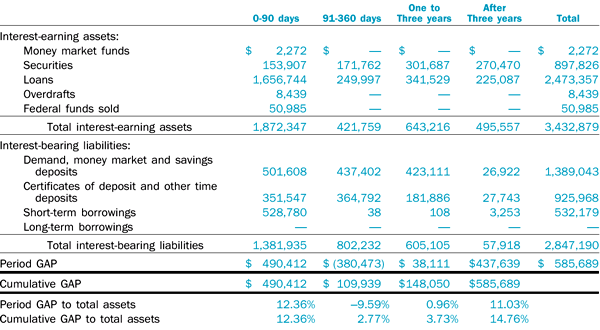
The following table sets forth an interest rate sensitivity analysis for the Company as of December 31, 2000:
Since December 31, 2000, market interest rates have declined as a result of the Federal Reserve’ 100 basis point reduction in the prime rate. This decline in interest rates has adversely impacted the Company’s net interest margin in 2001 as a result of its short term position GAP. While additional reductions in interest rates may be expected, the Company believes that its ability to manage its interest rate sensitivity will minimize the potential adverse impact on net interest income for the year 2001. For information on the Company’s results of operations for the month of January 2001, see ‘‘ Item 8 Statements and Supplementary Data" on pages 33-34. Liquidity involves the Company’s ability to raise funds to support asset growth or reduce assets to meet deposit withdrawals and other payment obligations, to maintain reserve requirements and otherwise to operate the Company on an ongoing basis. For the year ended December 31, 2000, the Company’s liquidity needs have primarily been met by growth in core deposits, and increases in short-term borrowings, primarily from the Federal Home Loan Bank. The cash and federal funds sold position, supplemented by amortizing securities and loan portfolios, have generally created an adequate liquidity position and are expected to do so in 2001. Subject to certain limitations, the Bank may borrow funds from the Federal Home Loan Bank (‘‘FHLB") in the form of advances. Credit availability from the FHLB to the Bank is based on the Bank’s financial and operating condition. Borrowings from the FHLB to the Bank were approximately $193.4 million at December 31, 2000. In addition to creditworthiness, the Bank must own a minimum amount of FHLB capital stock. This minimum is 5.00% of outstanding FHLB advances. Unused borrowing capacity at December 31, 2000 was approximately $293.2 million. The Bank uses FHLB advances for both long-term and short-term liquidity needs. Other than normal banking operations, the Bank has no long-term liquidity needs. The Bank has never been involved with highly leveraged transactions that may cause unusual potential long-term liquidity needs. Capital Resources Shareholders ’ equity increased to $298.1 million at December 31, 2000 from $233.1 million at December 31, 1999, an increase of $65.0 million, or 28%. |