|
|
|


|
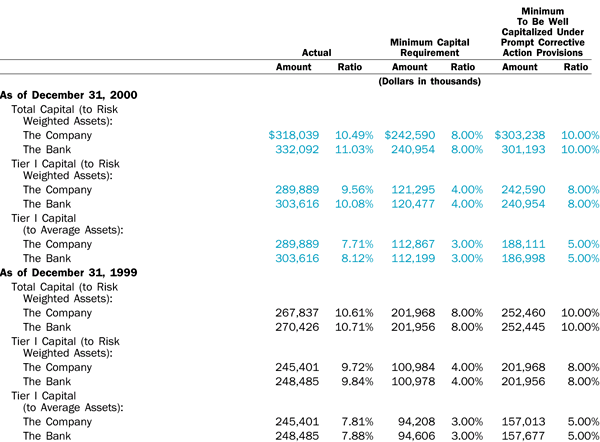
The following table compares the Company’s and the Bank’s leverage and risk-weighted capital ratios as of December 31, 2000 and 1999 to the minimum regulatory standards:
Pursuant to Federal Deposit Insurance Corporation Improvement Act of 1991 (‘‘FDICIA") , each federal banking agency revised its risk-based capital standards to ensure that those standards take adequate account of interest rate risk, concentration of credit risk and the risks of nontraditional activities, as well as reflect the actual performance and expected risk of loss on multifamily mortgages. Also pursuant to FDICIA, each federal banking agency has promulgated regulations setting the levels at which an insured institution would be considered ‘‘well capitalized," ‘‘adequately capitalized," ‘‘undercapitalized," ‘‘significantly undercapitalized" and ‘‘critically undercapitalized." Under the Federal Reserve Board’ regulations, the Bank is classified as ‘‘ well capitalized" for purposes of prompt corrective action. See ‘‘Supervision and Regulation." Other Matters In June 1998, Statement of Financial Accounting Standards (SFAS) No. 133, Accounting for Derivative Instruments and Hedging Activities, as amended, was issued by the Financial Accounting Standards Board to establish accounting and reporting standards for derivative instruments, including certain derivative instruments embedded in other contracts, and for hedging activities. SFAS No. 133 requires that an entity recognize those instruments at fair value. If certain conditions are met, a derivative may be specifically designated as (a) a hedge of the exposure to changes in the fair value of a recognized asset or liability or an unrecognized firm commitment, (b) a hedge of the exposure to variable cash flows of a forecasted transaction, or (c) a hedge of the foreign currency exposure of a net investment in a foreign operation, an unrecognized firm commitment, an available-for-sale security, or a foreign-currency-denominated fore-casted transaction. The accounting for the changes in the fair value of a derivative depends on the intended use of the derivative and the resulting designation. The Company adopted SFAS No. 133 on January 1, 2001. The impact of adoption was not material to the Company's consolidated financial position, results of operations or cash flows. |