|

In just four years,
AutoNation has built a company that retails more new cars and light
trucks than any other company in America -a $20.6 billion-a-year
giant that's more than three times the size of its nearest competitor.
Yet, as the following long-term strategic plan will show, AutoNation's
growth opportunities remain numerous in the nearly $1 trillion-a-year
U.S. automotive market.
That's because there's a collection of high-margin
business opportunities that already exists today inside AutoNation
and its vast network of dealerships. In addition to selling new
vehicles, AutoNation also:
- Sells more used vehicles than any other retailer, selling $3.9
billion worth in 2000
- Earns nearly as much gross margin from its $2.3 billion-a-year
parts and service business as it does from selling new vehicles
- Generates 14% of its gross margin from its $432 million-a-year
finance and insurance business
A diversified specialty retailer. This is AutoNation.

The Goal: Earnings-Per-Share
Growth
AutoNation's long-term strategy calls for extending
its leadership in new vehicles and growing the part of its business
that accounts for the majority of its gross margin - used vehicles,
parts and service, and finance and insurance. AutoNation's goal is
to maximize the performance of each of these categories to achieve
an annual earnings-per-share growth target of 10% to 12%, beginning
in 2002. The Company will achieve this level of operational excellence
by leveraging AutoNation's scale and by capitalizing on advantages
and opportunities that are characteristic of the Company's automotive
retailing business.
These high-margin opportunities exist throughout
the automotive industry's cycles, and play off the fact that AutoNation
enjoys a customer base of vehicle owners that grows with each year.
Also, because they account for nearly two-thirds of the Company's
gross margin, improvements in these businesses have an important effect
on results.
This is why AutoNation is driving programs and
initiatives through its dealerships that keep store personnel focused
on selling more vehicles, performing more parts and service work,
and selling more finance and insurance products through effective
marketing programs and improved methods of operation.
Tapping Advantages Beyond
Size 
To seize on these opportunities, and to stay focused
on earnings-per-share growth, AutoNation's long-term strategy leverages
more than the Company's considerable scale. It capitalizes on AutoNation's
steady cash flow and flexible cost structure.
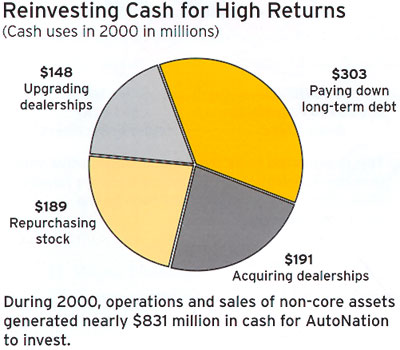
AutoNation is constantly seeking the highest return
for its cash. In 2000, AutoNation generated $441 million of cash from
operations to invest, plus additional cash it had raised through the
sale of non-core assets. The Company reinvested this cash in improving
stores, acquiring dealerships, buying back company shares and reducing
long-term debt. These opportunities become more numerous as AutoNation
drives costs out of its business and expands its operating margins.
AutoNation uses its flexible cost structure to
adjust to market conditions, redirecting resources to high-margin
opportunities. For example, when car-buying patterns shift away from
new vehicles, AutoNation dealerships can adjust inventories and advertising
budgets in favor of used vehicles. At the same time, AutoNation can
shift resources to the promotion of tune-ups, front-end alignments
and other maintenance services offered from its 8,200 service bays.
The flexible cost structure also supports AutoNation's ongoing emphasis
on expense control, as it did in 2000 when $100 million was taken
out of the Company's store and corporate expense.
|
 AutoNation's
Strategic Plan for long-term growth
AutoNation's
Strategic Plan for long-term growth 


